
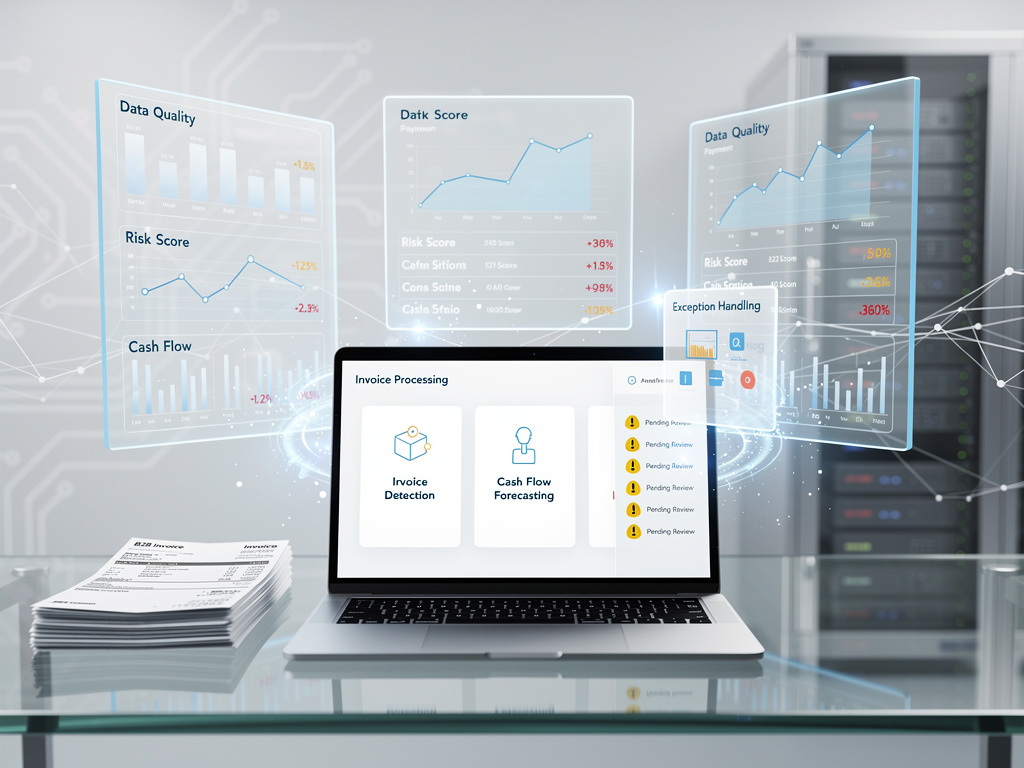
Artificial intelligence has become the buzzword in corporate technology boardrooms, but nowhere is the gap between promise and performance more stark than in business-to-business payments. As companies race to incorporate AI into mission-critical financial workflows, the industry is facing an uncomfortable reality. While technology is better at certain tasks, it remains inadequate at others. This distinction is critical for CFOs, treasurers, and payment leaders who must decide where to bet and budget.
B2B payments processes trillions of dollars annually through a complex system of invoices, purchase orders, approvals, and reconciliations, but many organizations remain incredibly manual. Traditional enterprise resource planning systems, strong banking relationships, and the sheer complexity of commercial payment terms make this area of financial services one of the last areas to become fully digital. According to PYMNTS, AI is now forcing its way into these workflows, disrupting traditional software models and shaking up markets as companies rethink their technology stacks.
AI is already proving its value in accounts payable and receivable management
Areas where AI provides measurable, immediate value in B2B payments tend to share common characteristics. This includes large amounts of repetitive data processing, pattern recognition across structured and semi-structured documents, and decision making that benefits from historical analysis. Invoice processing is the clearest success story. Machine learning models can now extract data from invoices with greater than 95% accuracy, dramatically reducing the need for manual keystrokes and cutting processing time from days to minutes. Optical character recognition powered by deep learning has matured to handle the wide variety of invoice formats that have long plagued accounts payable departments.
Fraud detection is another area of real AI success. By analyzing transaction patterns, vendor behavior, and anomalies throughout the payment flow, AI systems can flag suspicious activity much faster than human reviewers. This capability is becoming increasingly important as business email compromise schemes and invoice fraud proliferate. This technology does more than simply match rules; it learns and adapts from new attack vectors, providing a dynamic layer of defense that static rule-based systems cannot replicate. As PYMNTS reported, AI has shown clear advantages in these pattern recognition tasks, and while the amount of data dwarfs human capabilities, it is entirely within the strengths of machine intelligence.
Get Cash Flow Forecasting and Supplier Management AI Upgrade
Cash flow forecasting is emerging as a particularly promising application. AI models can incorporate historical payment data, seasonal patterns, macroeconomic indicators, and even supplier-specific behavioral trends to generate significantly more accurate forecasts than traditional spreadsheet-based approaches. For finance teams managing working capital across complex supply chains, this improvement directly translates into improved liquidity management, lower borrowing costs, and more strategic deployment of cash. Several enterprise software providers have begun incorporating predictive analytics into their financial management modules, and early adopters are reporting significant improvements in forecast accuracy.
Supplier management and onboarding is also benefiting from AI-driven automation. Verifying supplier credentials, checking sanctions lists, validating tax ID numbers, and assessing credit risk are all tasks that AI can perform more consistently and at scale than manual processes. This technology reduces friction in onboarding new vendors, a process that can take weeks for large enterprises, and helps maintain ongoing compliance with regulatory requirements. Dynamic discount platforms use AI to identify optimal payment timing, helping buyers earn early payment discounts and giving suppliers faster access to cash.
Stubborn limitations: Why AI cannot replace human judgment in complex payment decisions
However, despite all these advances, the limitations of AI in B2B payments are significant and often underestimated by technology vendors eager to sell next-generation solutions. The most fundamental limitation is that B2B payments involve relationship-driven decision making that defies simple algorithmic modeling. Payment terms are negotiated between humans, taking into account factors such as the strategic importance of the supplier, competitive dynamics, and long-term partnership considerations. While AI systems can recommend optimal payment timing based on cash flow, they cannot navigate delicate conversations with critical suppliers who need early payments to stay solvent during a difficult quarter.
Exception handling continues to be an area where AI struggles. While this technology is good at processing the 80% of transactions that follow a predictable pattern, B2B payments are notorious for complex exceptions such as partial shipments, disputed invoices, contract changes, credit memos, and multiparty payment arrangements. These exceptions often require contextual understanding across multiple systems, historical relationships, and contractual nuances that current AI models do not handle well. According to an analysis published by PYMNTS, this gap between routine processing and exception management is what causes many AI implementations to stall, resulting in impressive demo results but disappointing real-world performance.
Data quality issues can ruin even the best algorithms
Perhaps the most underestimated barrier to AI adoption in B2B payments is data quality. Enterprise payments data is notoriously fragmented, inconsistent, and siled across multiple systems. Invoices arrive in a variety of formats through a variety of channels, including email, EDI, supplier portals, and in some industries, fax. Payment records may be distributed across ERP systems, banking platforms, procurement tools, and spreadsheets. An AI model is only as good as the data it consumes. Many organizations have found that significant investments in data infrastructure are required before AI can deliver on its promise. The old adage “garbage in, garbage out” has never been more true.
Integration complexity compounds the data challenge. Most companies operate disparate technology environments with multiple ERP instances, banking relationships, and payment methods. Deploying AI into these environments requires not only sophisticated algorithms, but also robust data pipelines, API integration, and middleware that can normalize information from disparate sources. The cost and complexity of this integration effort often exceeds the cost of the AI technology itself, a reality that catches many organizations off guard during implementation. The companies that have had the greatest success leveraging AI in payments tend to be those that first invested in standardizing their data infrastructure and processes before layering on intelligent automation.
Enterprise payments software that reshapes competitive dynamics
The competitive impact of AI in B2B payments is already reshaping the enterprise software market. While traditional ERP vendors such as SAP, Oracle, and Microsoft are racing to incorporate AI capabilities into their payment modules, a new generation of specialized fintech companies are tackling specific pain points with purpose-built AI solutions. The question for enterprise buyers is whether to pursue a platform approach, relying on an existing ERP vendor’s AI roadmap, or go for a best-of-breed point solution that can provide superior performance in a given domain but is complex to integrate.
Market dynamics suggest that companies that can combine domain-specific AI capabilities with tight integration into existing enterprise workflows will be the winners. Pure AI companies lacking expertise in the payments space struggle to navigate the regulatory, compliance, and operational nuances of B2B transactions. Conversely, traditional payments platforms that add superficial AI capabilities without fundamentally redesigning their data models risk providing marginal improvements that are not worth the investment. The most compelling solutions emerging on the market are those built by teams that understand both the technical potential of modern AI and the operational realities of commercial payment processing.
Regulatory considerations and lack of trust
Regulatory considerations add further complexity. B2B payments are subject to anti-money laundering requirements, sanctions reviews, tax reporting obligations, and industry-specific regulations that vary by jurisdiction. AI systems that make decisions in these areas must be explainable. Regulators and auditors need to understand why certain payments were flagged, approved, or routed in a certain way. The “black box” nature of some machine learning models creates compliance risks that many organizations do not yet have the capacity to manage. While progress is being made in explainable AI, the gap between what regulators require and what current models can transparently deliver remains a major concern for risk-conscious businesses.
Trust is the ultimate currency in B2B payments, and that extends to the technology that processes payments. CFOs and treasurers are inherently conservative when it comes to payment practices. Errors can damage supplier relationships, pose regulatory risks, and directly impact cash flow. The willingness to delegate payment decisions to AI systems will only grow if organizations build trust through gradual adoption, rigorous testing, and proven reliability over time. Companies that have successfully implemented AI in their payments operations almost universally describe a phased approach. This means starting with low-risk, high-volume tasks such as data extraction, and gradually expanding to more complex functions as the technology proves effective.
What the next three years will reveal about the true impact of AI
In the future, the trajectory of AI in B2B payments is likely to follow a familiar pattern from previous technology adoption cycles. In other words, initial hype gives way to realistic evaluation, followed by steady and substantial progress as implementations mature and best practices emerge. The greatest value will be captured by organizations that approach AI with clear pragmatism. This means investing aggressively where technology is demonstrating capability and maintaining human oversight and judgment where it is not. The next three years will be decisive in separating real change from the marketing noise. The stakes for the B2B payments industry couldn’t be higher, translating into trillions of dollars in annual transaction volume.
It is clear that there is an urgent need for industry leaders to understand what AI can and cannot do today, invest in data infrastructure to support effective implementation, and resist the temptation to automate decisions that still require human expertise. Companies that strike this balance will not only improve their payments operations, but will be in a position to take advantage of the next wave of AI capabilities as technology continues to evolve rapidly. In B2B payments, as in many areas, the real competitive advantage lies not in being the first to adopt AI, but in deploying it wisely.


