
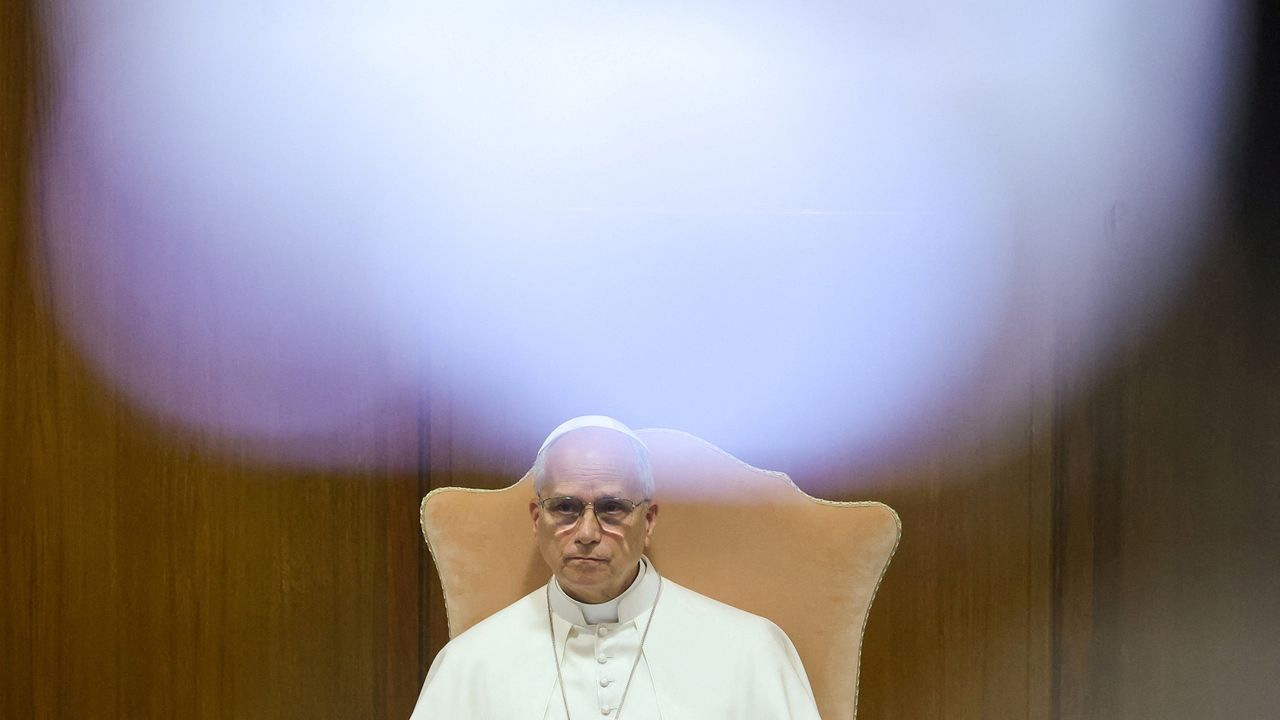
If we Catholic Americans are proud of this pope, many of us are even more proud that America’s first pope took on this important issue at such a critical moment. In much of American culture, particularly in the business and technology press, challenging the economic power and oligarchy of American-based artificial intelligence companies is tantamount to heresy. Pope Leo is not only willing to disagree, he is passionate about it. Please bless him.
Much of the encyclical includes defending the proposition that the Vatican should be, and has always been, engaged in making statements about new and deeply secular things like artificial intelligence. “The church exists in history and is in dialogue with the world,” Leo asserts. He agrees with the Sam Altmans and Elon Musks of the world that humanity is at a crossroads. But at this crossroads, he argues, three questions need to be asked: “Where are we going? What goals do we want to orient ourselves towards? What direction should we choose as a people and as a community of humanity?” He warns against arrogance and what he calls “Babel Syndrome,” citing the Biblical story of the building of the Tower of Babel. “namely, an idolatry of profit at the expense of the weak, a uniformity that neutralizes difference, and the pretense that a single language, even a digital one, can translate everything, including the mystery of the person, into data and performance.”
Leo begins with the fundamental dignity of the human person and traces it to the inalienable and universal equality of man and his inalienable rights. He established principles in the Church’s social doctrine (dating back to the Realm Novarum) that included a commitment to the common good, which he defined as “the social expression of dignity accorded to all people.” Revisiting his 2015 encyclical Laudati Si (Praise be to You), which called for the protection of the environment as “our common home,” Leo laments the rise of the “technocratic paradigm,” or the “tendency to shape personal, social, and economic decision-making solely through the logic of efficiency, control, and profit.” Here, about halfway through the encyclical, he arrives at the issue of artificial intelligence and struggles to distinguish it from human intelligence. “So-called artificial intelligence has no experience, no physical body, no sense of pleasure or pain, no maturation through human relationships, no internal knowledge of what love, work, friendship, responsibility means, no ability to judge right from wrong, grasp the ultimate meaning of a situation, He argues that no matter how valuable this tool is, it is being developed inadvertently, putting both “our common home” and our common humanity at risk.
The problem is not technology, the Pope argues in Magnifica Humanitas. It’s anthropology. Algorithms, forms of automation, and artificial intelligence sort out what is valuable and what is not. They manipulate information and undermine trust. Infringes on privacy. They strengthen the power of the already powerful and diminish the power of the already weak. They make war more ruthless. They undermine democratic governance. They take away the dignity of work, perhaps for much of humanity. He calls for various regulations, particularly democratic control of artificial intelligence, but most of all he calls for the “disarmament” of AI. “Disarmament does not mean rejecting technology, it means preventing technology from dominating humanity,” he writes. “It means freeing technology from monopolistic control and opening it up to discussion and debate, thereby making it human-friendly and returning it to the diversity of human cultures and ways of life.” He worries that the culture around artificial intelligence is undermining the search for truth that is necessary for both democratic life and any possibility of true spiritual existence.
The pope’s set of concerns, as I discuss in my forthcoming book, The Rise and Fall of the Artificial State, are very similar to concerns that have been raised by serious commentators for decades, particularly in the United States, where automation was the first to emerge and its dangers were recognized first. The term “artificial intelligence” was coined in 1955, the year Pope Francis was born. The negative effects of imitating or exceeding human intelligence on human dignity, equality, and freedom, and the dangers of replacing the functions of democratic government with automated systems, had already been noted. In 1957, Hannah Arendt wrote in The Human Condition that “so much scientific effort has been directed toward making even life ‘artificial,’ severing even man’s last ties to the children of nature,” and wondered whether humans, too, might one day “need artificial machines to think and speak.” In 1962, Americans were already wondering if they were living in a “cybernation.” The fear of an “automated state” soon began to be pointed out. In 1967, he collaborated with an American critic on “The Myth of the Machine.” new yorker Author Lewis Mumford lamented the rise of “cybernetic intelligence,” warning that “instead of actively functioning as autonomous personalities, humans will become passive, aimless, machine-conditioned animals whose proper functioning will either be incorporated into machines or strictly limited and controlled in the interests of depersonalized collective organizations, as engineers now interpret the human role.” Mumford said that technological determinism is a “fundamental misunderstanding of the entire process of human development” and a false belief that must be abandoned “if we are to properly grasp a mechanized culture before we lose both our sense of human purpose and our confidence in our ability to control our creations.”


