
Meta encourages advertisers to use its AI tools, but the results are confusing, from weirdly twisted limbs to gibberish to completely changed products.
Meta reaction to the brand: It’s your fault, not ours.
The tech giant has introduced a number of AI features into its advertising products in recent months. When it works as designed, it can help you fine-tune your ads to increase your chances of getting clicked. But advertisers say the tool is difficult to use and creates misrepresentation and absurdity.
Business Insider spoke to eight advertiser and agency executives who said dealing with meta-AI issues has become routine.
Jessica Grime, an advertising consultant who works with women-founded brands, told Business Insider that she regularly sees strange results with Meta’s AI creative recommendations for the ads she works on.
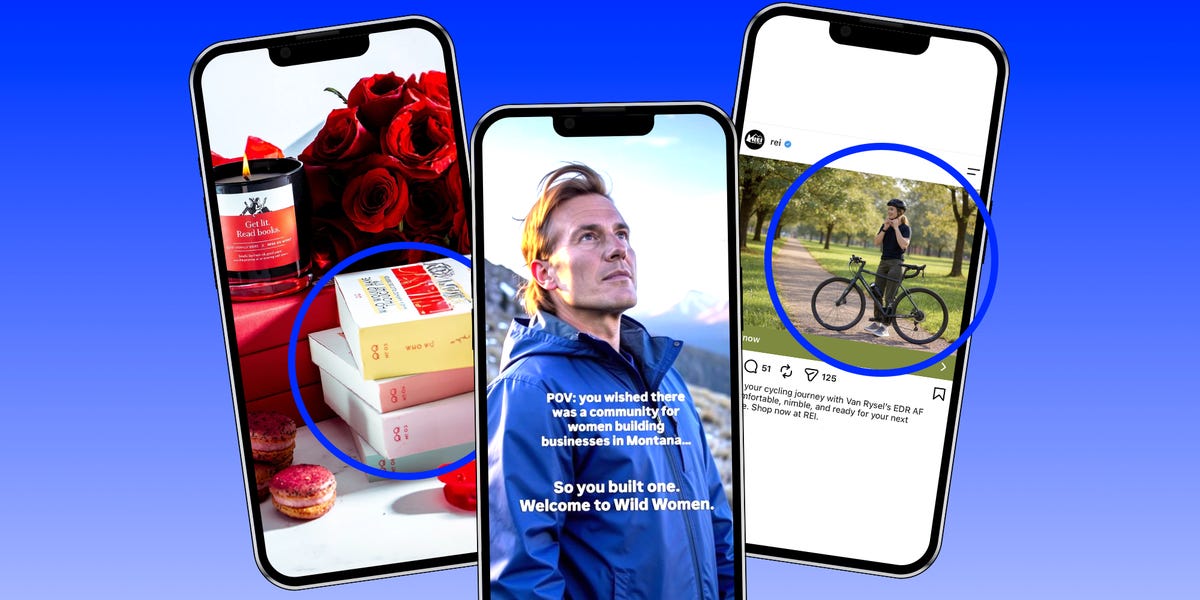
For one of her clients, a pajama brand, Meta recommended new assets that would change the actual product. While the brand was promoting pajama dresses, Mehta proposed a new image with shirts and pants. For another client, a women’s networking group in Montana, Mehta had a new vision: adding men to advertising.
Meta AI’s proposed changes to the women’s group ad included adding men. BI
“It can’t be used to help clients grow their businesses,” Grime said.
Some of Meta’s AI advertising features are turned off by default, but advertisers say they’re prone to bugs that can cause them to be turned on accidentally. Carissa Tussio, executive director of social and influencers at Mediaassociates, said most of her 15 meta advertising clients were regularly affected by a bug that toggled on AI settings. She said she reported the bug to a Meta representative on Thursday.
Meta’s AI completely changed the product with this suggested ad tweak that Gleim encountered. BI
Last month, outdoor retailer REI ran an Instagram ad depicting a nonsensical bicycle with two handlebars, sparking a backlash from consumers. REI said Meta “auto-enrolled” into its AI features and spewed out “inaccurate” and “inappropriate” images.
A Meta spokesperson said the company’s terms of service clearly state that “AI can make mistakes and it is the advertiser’s responsibility to verify the AI’s output.”
Advertisers’ main complaint with Meta’s AI advertising tools is simple. We feel like we need to double-check all of our AI features after every campaign to make sure nothing is turned on by mistake or something goes wrong. Some advertisers and agencies are running hundreds or even thousands of ads at any given time, so the extra steps required to master an AI tool create more work.
REI’s AI advertising incident caused a huge backlash from customers online. BI
“We somehow accepted this as the new standard operating procedure,” said Rok Hradnik, CEO of marketing agency Flat Circle. Flat Circle manages approximately $200 million in meta ad spend annually for numerous D2C brands.
Brands and advertisers say that while AI failures can be funny stories on the internet, they can also cause real problems for brands.
“If AI starts generating strange creative or making unauthorized changes, it can quietly damage brand awareness, especially for those who value consistency,” said Robert Webster, CEO of TAU Marketing, which manages about $500 million in ad spend annually across various platforms.
valentine’s day surprise
Around Valentine’s Day, photographer and marketer Abigail Hogue was uploading an ad campaign to Meta. She worked for a small business, Quite Literally Books, photographing creative assets for a holiday campaign featuring chocolates, macarons, candles, and books. Hogue was proud of the work he did.
“About 12 hours later, once everything was approved and running, I started receiving messages and screenshots of running ads from friends and acquaintances, cheekily accusing the AI of inaction,” Hogue said.
She said the product text in the image was “garbled” and “the actual product looks like a knock-off.”
Abigail Hogue was horrified by how Meta’s AI changed her ads. This is a literal book. BI
After seeing the AI ad, Hogue panicked, edited the campaign in Meta’s Ads Manager, turned off all AI creative enhancements, and republished the ad.
She then spent hours dealing with Meta’s customer service. Representatives also told her that this was a “sporadic” and “one-time occurrence” and that it was a “glitch,” according to screenshots of the exchange seen by Business Insider. She requested a refund and Mehta granted her request. Quite Literally Books said it had not received a refund as of Friday afternoon.
Other advertisers also told Business Insider about bizarre meta-AI ads, from unrealistic old ladies in loungewear to models whose legs appear to be bent in completely the wrong direction.
Luke Jonas, chief growth officer at marketing agency Nest Commerce, emphasized the importance of keeping humans in the loop when testing AI-generated ads.
“A machine optimized for 6 million advertisers could have two handlebars,” Jonas said, referring to the REI ad.
The two advertisers said Meta appears to have fixed a bug that caused clients to turn on AI settings, but Media Associates’ Tuccio said the same issue persisted for her as of last week.
Tuccio said a Meta representative told him last week that Meta had developed a quality control dashboard for large advertisers to prevent unwanted AI enhancements from being published in their ads.
“She said, ‘If you have a big release coming up, send me all your advertising IDs. We have an internal dashboard that makes sure all enhancements are completely turned off,'” Tuccio said. “Therefore, I believe it is not resolved.”
“Meta is still the best platform.”
Starting last month, Meta began automatically applying “AI information labels” to ads when they are created or heavily edited using its own AI tools or third-party tools like Midjourney and Dall-E. To view this, users can click on the three dots above the ad;[この広告について]Select[AI 情報]You need to tap . Last week, Google added a label to indicate whether an ad was created or edited using AI.
Meta also improves its AI image generation model. Last week, the company began rolling out Muse Image, a model developed by Superintelligence Labs that can help advertisers develop their creative assets. (Following backlash, Meta on Friday removed a feature from Muse Image that allowed users to generate AI images from other people’s public Instagram posts, calling it “missing the mark.”)
Still, advertisers argue that Meta’s basic design encourages relinquishing control over the system, with potentially dire consequences.
TAU’s Webster said: “The default settings are aggressive and switching is easy to miss. The system is clearly designed to reduce friction, so more money flows to the platform with less manual intervention.”
Meta says, “Millions of advertisers find value and improved performance using Advantage+ creative tools to support their ad creation.” A Meta spokesperson added that the company’s AI image generation tool, which creates variations based on seed images provided by advertisers, is turned off by default.
Meta isn’t the only one that automatically changes advertisers’ creatives. Google’s P-MAX and AI Max products also use AI to collect ad copy from brand websites and automatically trim or shorten videos for placements such as YouTube Shorts. Although some of these AI automation features are enabled by default, Google has largely avoided high-profile issues like those experienced by Meta.
Danny Wiseman, co-founder of Obsessed Media, said the main complaint he hears from brands about Google is that ads created using the company’s AI tools can be “ugly.”
“It’s not like someone’s hand is missing,” he said.
Meta’s advertising business, which generated about $196 billion in revenue last year, remains essential to most brands’ customer acquisition strategies. With a daily reach of 3.5 billion active users and a highly sophisticated ad targeting platform, it’s hard to quit if something goes wrong.
“This means the company can make unpopular decisions that increase its profits with near impunity, since most advertisers cannot realistically back out,” TAU’s Webster said.
And here’s the simple truth: Meta ads usually bring results.
“Meta is still the best platform,” Grime said. “It has the most robust option and includes the most data.”