

Deep learning is a branch of artificial intelligence concerned with solving highly complex problems by emulating the way the human brain works. Deep learning uses neural networks with multiple operators placed in nodes to break a problem into smaller parts and solve each one independently. However, neural networks can be very difficult to implement. This problem is solved by Keras, a deep learning framework.
In this article, What is Keras? The best introductory guide to Keras, we'll introduce you to Keras and explain why it's gaining popularity among developers.
What is Keras?
Keras is a high-level deep learning API developed by Google to implement neural networks. It is written in Python and is used to simplify the implementation of neural networks. It also supports multiple backend neural network computations.
Keras is relatively easy to learn and operate because it provides a Python front end with a high level of abstraction while having the option of multiple backends for computational purposes. This makes Keras slower than other deep learning frameworks, but it is very beginner-friendly.
Keras allows you to switch between different backends. The frameworks supported by Keras are:
- tensorflow
- Theano
- PlaidML
- MX net
- CNTK (Microsoft Cognitive Toolkit)
Among these five frameworks, TensorFlow adopts Keras as its official high-level API. Keras is built into TensorFlow and provides built-in modules for all neural network computations, so it can be used to perform deep learning faster. At the same time, computations including tensors, computation graphs, sessions, etc. can be custom created using the Tensorflow Core API. This gives you complete flexibility and control over your application, allowing you to implement your ideas in a relatively short period of time.
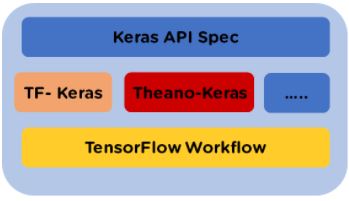
Figure 2: Keras backend
Your AI/ML career is just around the corner!
AI engineer master's programExplore the program

Why do we need Keras?
- Keras is an API designed to be easy for people to learn. Keras is made simple. It provides a consistent and simple API, reduces the actions required to implement common code, and clearly explains errors to the user.
- Prototyping time with Keras is reduced. This means ideas can be implemented and deployed more quickly. Keras also provides various deployment options depending on the user's needs.
- Languages with high levels of abstraction and built-in functionality can be slow and make it difficult to build custom functionality. However, Keras runs on TensorFlow and is relatively fast. Keras is also deeply integrated with TensorFlow, making it easy to create customized workflows.
- The Keras research community is vast and highly developed. The available documentation and help is much more extensive than other deep learning frameworks.
- Keras is used commercially by many companies, including Netflix, Uber, Square, and Yelp, who have deployed public domain products built using Keras.
Apart from this, Keras has the following features:
- It runs smoothly on both CPU and GPU.
- Supports almost all neural network models.
- Modular in nature, it is expressive, flexible, and suitable for innovative research.
How to build a model in Keras?
The diagram below shows the basic steps when building a model in Keras.

Figure 3: Building the model
- Define the network: In this step, you define the various layers in your model and the connections between them. Keras has two main types of models: Sequential models and Functional models. Select the types of models you want and define the data flow between them.
- Compile the network: Compiling code means converting it into a suitable format that a machine can understand. In Keras, the model.compile() method performs this function. To compile a model, you define a loss function to calculate the loss in the model, an optimizer to reduce the loss, and a metric used to find the accuracy of the model.
- Fit Network: Use this to fit the model to your data after compilation. This is used to train the model based on your data.
- Evaluate the network: After fitting the model, you need to evaluate the error in the model.
- Make predictions: To use a model to make predictions on new data, use model.predict().
Keras applications
- Keras is used to create deep models that can be brought to market on smartphones.
- Keras is also used for distributed training of deep learning models.
- Keras is used by companies like Netflix, Yelp, and Uber.
- Keras is also widely used in deep learning competitions to create and deploy fast-running models in a short amount of time.
Build deep learning models with TensorFlow and learn the TensorFlow open source framework with the Deep Learning course (using Keras &TensorFlow). Register now!
conclusion
In this article, “What is Keras?” The Best Getting Started Guide to Keras, we first answered the question, “What is Keras?” Next, we looked at why Keras is so popular and why you should use it, followed by basic steps on creating models in Keras. Next, we saw some uses for Keras.
I hope this article answered the question that was burning in the back of your mind: “What is Keras?” Do you have any doubts or questions? Please mention them in the comments section of this article. An expert will answer you as soon as possible.


