

AI crypto refers to a category of blockchain-based tokens and projects that integrate artificial intelligence into their core functionality, from decentralized machine learning networks to AI-powered trading agents and data marketplaces. Rather than describing a single technology, “AI crypto” is an umbrella term that covers any project where AI and blockchain infrastructure work together, either by using AI to improve blockchain operations or by using blockchain to decentralize and monetize AI systems. The sector’s market capitalization is expected to reach approximately $18-28 billion in 2026, driven by growing demand for cheaper decentralized alternatives to centralized AI computing.
- AI crypto refers to tokens and platforms that combine artificial intelligence and blockchain technology, rather than a single coin or protocol.
- This category spans decentralized AI computing networks, on-chain trading agents, AI-powered data marketplaces, and AI-driven content generation platforms.
- $NEAR Protocols and Bitensors ($TAO) Ranked as the two largest AI crypto tokens by market capitalization with over $2 billion each, followed by DeXe, Internet Computer, and Render
- AI cryptocurrency trading bots use AI to automate buy and sell decisions based on market data, making them one of the most searched applications in this space.
- The sector remains highly speculative, with valuations often driven by AI-related hype cycles rather than proven uses.
AI crypto sits at the intersection of two of the most discussed technology trends of the 2020s: artificial intelligence and blockchain. In reality, projects labeled as AI crypto typically fall into one of two directions. Some companies are using blockchain to decentralize their AI infrastructure. For example, instead of relying on a centralized cloud provider, you distribute GPU computing power across a network of independent providers. Some companies are also using AI to power blockchain-native capabilities such as autonomous trading bots, on-chain data analysis, and smart contract auditing.
The term covers such a wide range of use cases that it is more accurate to think of “AI crypto” as a sector rather than a specific type of token, just as “DeFi” refers to an entire category of financial applications rather than one protocol. If you want to learn more about how blockchain technology works at a fundamental level, check out our guide on what is blockchain?
What is AI crypto coin?
AI crypto coins are the native tokens of blockchain projects built around artificial intelligence use cases. These tokens typically serve one or more practical functions within the ecosystem. For example, staking to pay for AI computing resources, participate in network governance, reward data contributors, or serve as a transaction currency for interacting with AI agents. Unlike purely speculative meme tokens, most established AI crypto coins are tied to specific technology products, such as decentralized GPU marketplaces or AI model training networks, but the value of the token does not always track the actual usage of the underlying platform.
Types of AI crypto projects
infrastructure token It powers a distributed computing network that provides the GPU and processing power needed by AI models, providing an alternative to centralized cloud providers like AWS and Google Cloud.
AI agent token It supports autonomous software agents that can perform on-chain actions such as trading, portfolio management, or smart contract interactions without continuous human input.
Data Marketplace Token Facilitate the purchase, sale, and licensing of datasets used to train AI models, often with blockchain-based verification of data provenance and quality.
Application layer token Power consumer AI tools built on blockchain rails, including AI-generated content platforms, predictive markets, and analytical tools.
According to CoinMarketCap’s AI & Big Data category, the market capitalization of the AI crypto sector was approximately $18 billion as of early July 2026, and the 24-hour sector volume was approximately $2.5 billion. The following projects consistently rank among the largest by market capitalization across major data providers.
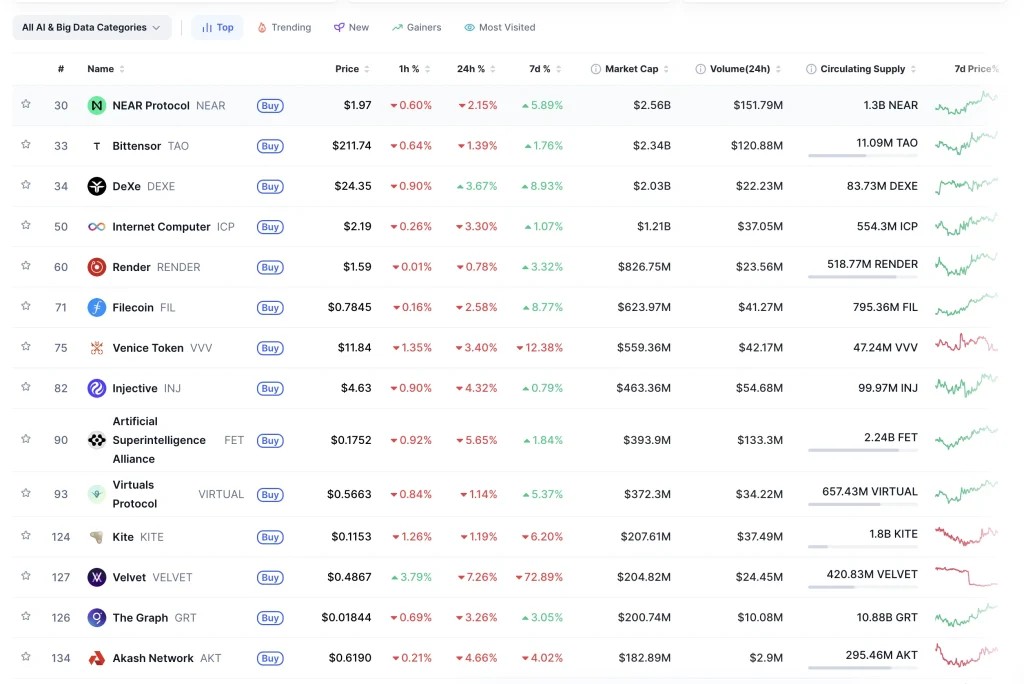
$NEAR Protocol and Bittensor traded hands for the top spot in the AI crypto category until mid-2026, reflecting investors preferring projects with measurable on-chain activity (compute jobs processed, models trained, agent transactions settled) over tokens that use “AI” as a marketing label with no practical product behind them.
AI Crypto Trading Bot Description
One of the most practically searched applications within the AI crypto sector is AI trading bots. It is a software that uses machine learning models to analyze market data and automatically execute buy and sell orders without the need for continuous manual input by traders. These bots typically work by identifying patterns in price movements, order book depth, or on-chain data, and act on predefined strategies faster than humans can manually track multiple markets. Although AI trading bots can process much more data than manual trading, they carry the same fundamental risks as automated strategies. If the underlying logic is poor or there are unforeseen market conditions, losses can occur just as quickly as profits.
Related tools include AI-driven portfolio management platforms that apply similar automated decision-making to rebalancing across multiple assets, rather than executing individual trades.
What is the best AI crypto to invest in?
There is no single “best” AI crypto token, and projects that claim otherwise should be treated with skepticism. A more useful question is which categories of AI crypto projects fit a particular risk tolerance or theory. Investors focused on measurable and verifiable usage are often drawn to decentralized computing infrastructures like Bittensor and Render, as they can see GPU rentals and network revenue on-chain. Those willing to accept higher risks for potential upside may look to early-stage AI agent platforms, but these come with considerable uncertainty given that the agent economy is still in its infancy. As with any crypto investment, independent research on position sizing and a project’s actual technical offering is important rather than following the sector-wide hype.
The main difference between AI crypto tokens and traditional cryptocurrencies such as Bitcoin lies in their intended functionality. Bitcoin is primarily designed as a decentralized store of value and payment network and has no native connection to artificial intelligence. In contrast, AI cryptographic tokens are generally built to play specific roles within AI-related ecosystems, such as paying for computing, incentivizing data sharing, and enabling autonomous agent transactions. This makes AI crypto tokens more comparable to utility tokens in other sectors, such as DeFi governance tokens, than to the purely monetary use case of Bitcoin.
The dynamics of evaluation are also different. Rather than tracking crypto market-specific catalysts such as the Bitcoin halving or ETF flows, AI crypto tokens tend to move in correlation with broader AI industry sentiment, and tend to rise in conjunction with major AI model releases and enterprise AI announcements. For live prices of major cryptocurrencies that frequently intersect with AI-driven trading and agent activity, see Bitcoin prices, Ethereum prices, and Solana prices. All three networks host significant AI-related token activity.
The AI crypto sector involves risks that exceed the volatility of typical cryptocurrencies. Many projects are yet to generate revenue, and token valuations are based on future speculative adoption rather than current usage. The rapid pace of AI development also means that today’s state-of-the-art decentralized AI infrastructure may be rendered obsolete by advances in centralized AI computing, potentially undermining the core value proposition of some projects. Token unlock schedules and emission rates also vary widely by sector, potentially diluting value for holders even as the underlying project continues to grow.
Additionally, the AI crypto label itself has attracted opportunistic token launches that seek to capitalize on AI-related search and social media interest without offering a genuine technology product. Analysts typically recommend evaluating AI crypto projects based on three factors. It’s not just an AI brand, it’s whether it has real, measurable usefulness. Whether developer activity is active and sustained. and whether Tokenomics involves a reasonable risk of dilution. For broader context on crypto project valuations, check out our articles on Crypto News Today and Crypto Market Today.


