

I’ve spent enough time testing AI video tools that I’ve noticed a pattern. That said, most people don’t actually need a brand new video to begin with. What they need is a better ending, a smoother transition, or a way to salvage footage that mostly works.
This is even more important now, as the latest wave of AI video tools aims for longer scenes, improved motion consistency, reusable characters, clip stitching, and even audio-aware generation. OpenAI’s Sora focuses on rapid image-based video creation, but new updates around clip stitching and reusable characters are geared toward longer-form workflows. Google’s latest Veo positioning also emphasizes audio and controls for filmmakers, with Runway’s Gen-4.5 built around motion quality and instant compliance.
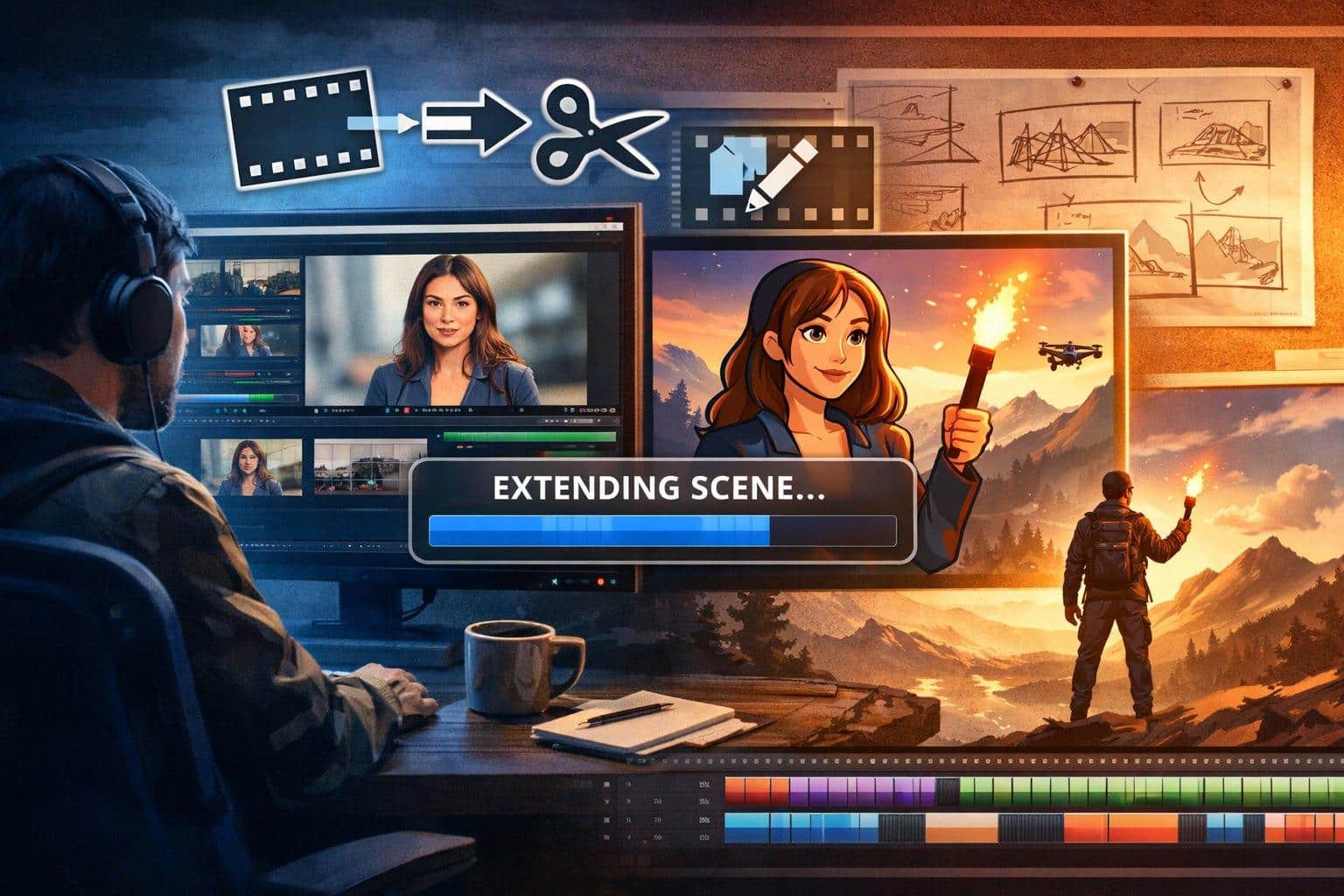
However, it turns out that “adding more generations” is not necessarily the answer. A good portion of my best results have come from extending rather than replacing existing ones. That’s why tools like GoEnhance AI Video Expander have become more useful in my workflow than I expected.
Why extensions will matter more in 2026 than before
When reviewing footage generated by AI, you usually don’t notice complete failures. I see near misses.
The scene appears fine for three seconds, but then it cuts too quickly. Character motion looks natural until the last beat. The stylized shots look good, but end the action before it’s resolved. These are not “starting over” issues. They are a matter of continuity.
This difference has changed the way I evaluate tools.
Instead of asking, “Can this platform generate cool demos?” I ask more realistic questions. Will it help keep usable shots long enough to publish?
The idea is less flashy, but far more valuable. Creators, editors, and marketers rarely find success collecting truncated four-second clips. What works is to maintain momentum. That means the sequence feels intentional by ending a reaction, extending a reveal, or giving a transition another breath.
Why the 2026 extension will be more important than a year ago
Today’s AI video conversations are obsessed with realism, cinematic movement, and model rankings. I understand why. Those things are easy to screenshot and easy to sell.
But if you’re actually building content, the bottlenecks are different. I’m not looking for the perfect blockbuster shot every time. We strive to reduce waste.
An 80% good clip is often worth more than a new clip with unpredictable output. Cleanly extending a good 80% clip saves time, maintains visual continuity, and avoids the lottery effect associated with regenerating from scratch.
This is especially true when you’re working to a deadline. In live content pipelines, consistency often trumps novelty more than people would like to admit.
What I personally check before extending a clip
Having made a lot of ugly extensions, I’ve found that not all source videos are worth saving. Some clips will need to be rebuilt. Others can be saved. The difference usually comes down to some practical signs.
| check | what i’m looking for | why is it important |
| Direction of operation | Clear and easy to read movements | The model is less ambiguous when continuing the action |
| Subject stability | Faces, bodies and objects already retain their shape | Strong continuity improves extension odds |
| simplicity of the scene | limited background chaos | Drift is reduced because there are fewer competing elements |
| End frame quality | The last visible moment feels “open” | Opening is easier to maintain than closing. |
| clarity of style | One clear visual language | Mixed styles tend to break during continuation |
I learned this the hard way. If the last frame is already confusing, expansion usually amplifies the confusion even more. When a shot ends with a clean momentum – a turn, a walk, a camera push, a hand movement – you often get something usable.
So I now treat the end of the source clip as the true starting point.
Where animation transformations fit into your workflow
Another change I’ve noticed is that many creators are no longer satisfied with simple realism. They want change. They want their footage to be stylized, branded, or visually distinct enough to stand out in a feed already saturated with glossy AI output.
So I found value in using tools that convert video to animation.
This is not used as a gimmick. Use this when the raw footage feels too ordinary or when you want a stronger visual identity without reshooting.
For example, if a clip has good motion but lacks personality, an animation conversion can give it a sharper editorial purpose. Talking head segments become more playful. Product shots become more socially friendly. A simple sequence of movements becomes something that makes the viewer actually pause.
The trick, at least in my experience, is to not force every clip to look animated. Some footage benefits from stylization. Some footage loses credibility the moment it’s over-processed.
The decision is more important than the tool itself.
the most common mistakes people make
AI videos are treated like a one-click editing alternative.
it’s not.
The most powerful results still come from small, targeted decisions.
- Expand the clip instead of regenerating it.
- Rather than forcing photorealism, we stylize the images,
- Instead of discarding everything, fix what can be used.
Once I stopped expecting the AI to “create the whole video for me,” my output improved. Not because models suddenly became perfect, but because we started using them for jobs that they actually handled well.
This is much less appealing than the “AI made my movie” story. It’s also much more honest.
My current work rules
If your clip already has good energy, try to maintain it.
Extend if pacing is an issue.
If appearance is a problem, transform it.
If both are broken, rebuild them.
This simple framework saved us more time than hype-based trend reports. And as AI video continues to move toward longer, more controlled, and more cinematic production, I think this practical middle layer—repairing, extending, and restyling existing footage—will become even more important. While the headline feature gets the attention, it’s often the quieter workflow tools that allow you to publish your content.
For me, this was the real lesson. The future of AI video isn’t just about producing more. It’s about cutting back on waste, keeping what works, and knowing exactly when you need one more second rather than completely redoing a clip.


