
Listen to the audio version of this article (generated by AI).
Key Points
- The U.S. government reportedly required Anthropic to disable access to its newest Claude AI models for users outside the United States, citing national-security concerns.
- The decision follows months of tension between Anthropic and the Pentagon over military applications of AI, including disagreements surrounding autonomous weapons and large-scale surveillance technologies.
- For investors, the episode underscores the growing regulatory risks facing AI companies and how government actions can affect revenue growth, strategic partnerships, and customer access to AI products.
Although the war in Iran appears to be winding down following the recent interim peace deal, the U.S government seems hell-bent on escalating its battle with artificial intelligence (“AI”) giant Anthropic.
On June 12, Anthropic was forced to “abruptly disable” its two most powerful AI models – Claude Fable 5 and Mythos 5.
According to Anthropic:
The US government, citing national security authorities, has issued an export control directive to suspend all access to Fable 5 and Mythos 5 by any foreign national, whether inside or outside the United States, including foreign national Anthropic employees. The net effect of this order is that we must abruptly disable Fable 5 and Mythos 5 for all our customers to ensure compliance.
Backlash from the cybersecurity and tech industries was swift and fierce. Criticism was leveled at the Commerce Department for banning the models without presenting any evidence beyond verbal claims of a security risk. Leaders at Nvidia (NVDA) and Adobe (ADBE) were among those pushing the Trump administration to lift the ban.
But this was merely the latest confrontation between the federal government and Anthropic.
A Look at Anthropic’s Battle with the U.S. Government
If you’ve been following the news for the past six months or so, the government’s recent move to ban Anthropic’s Claude Fable 5 and Mythos 5 AI models shouldn’t come as much of a surprise.
As of last July, Claude was the only AI model available within the Pentagon’s classified military network, and its employees loved it because Claude brought more to the table than other AI models. In fact, Anthropic was the first frontier AI company to operate within the Pentagon’s classified systems.
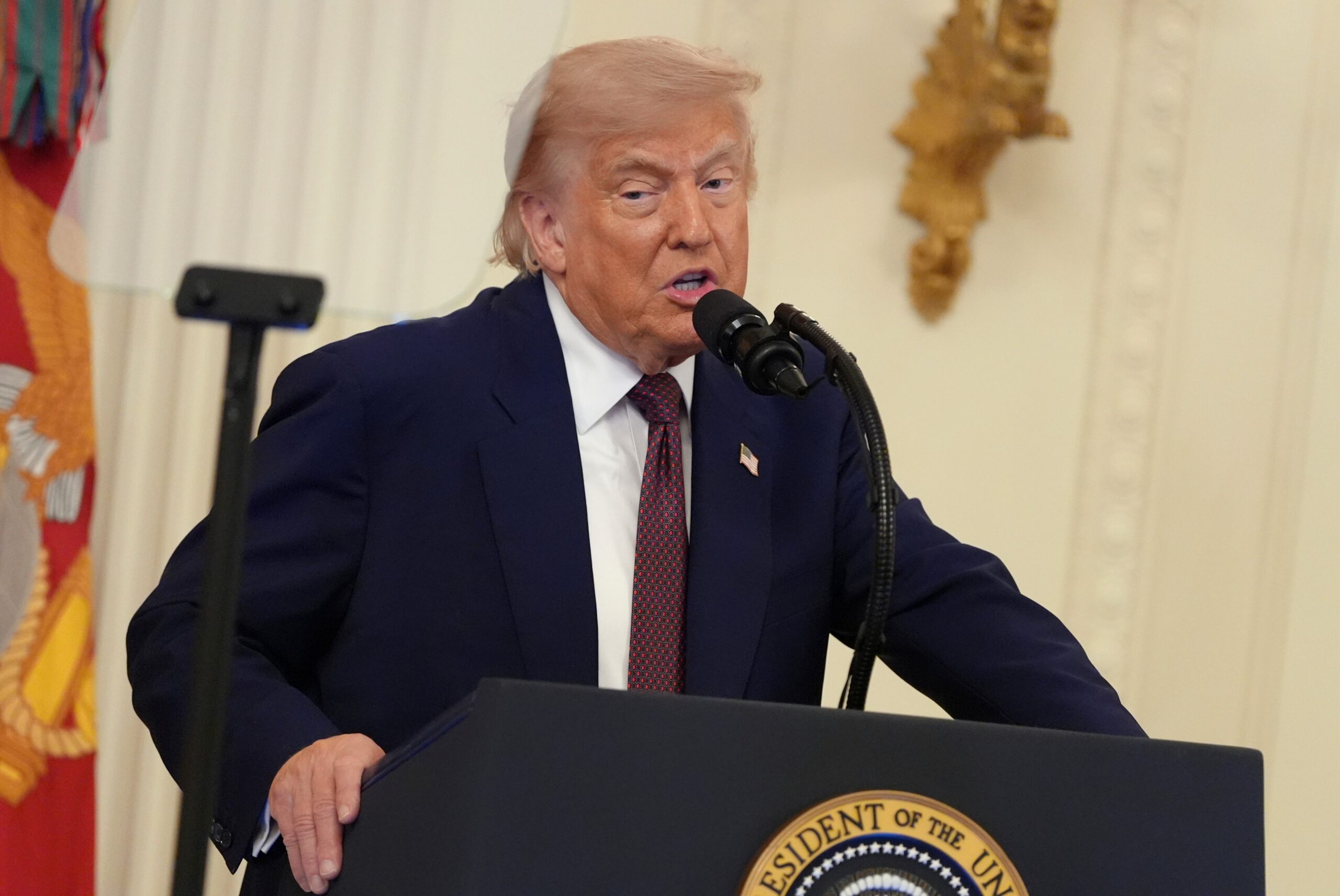
But in late February, just before the U.S. and Israel launched attacks on Iran, President Donald Trump announced that the government was, in no uncertain terms, done with Anthropic in a Truth Social post:
Why? Because the company refused to let the military use its AI without restrictions. That included uses such as the mass surveillance of American citizens and in fully autonomous weapons.
Anthropic has since been blacklisted by the U.S. government because Anthropic insisted that the Pentagon employ safety guardrails when using AI in warfare.
The Pentagon went on the offensive, with Defense Secretary Pete Hegseth designating Anthropic a “supply chain risk” to national security – the first time an American company has ever received that label.,
Anthropic, not about to go down quietly, responded by suing the Trump administration. A California federal judge indefinitely blocked the government from punishing Anthropic simply because it disagreed on how its own AI models should be used.
But the government’s message was loud and clear – Anthropic would have no say in how the Pentagon used its AI models, or it wouldn’t have a contract at all.
What Anthropic’s Blacklisting Means for the Larger AI Market
The AI sector is a complex, highly intertwined and interconnected web of companies that are often both rivals and codependent. So, while the big AI companies compete for capacity and contracts, it’s generally in their best interest to see the larger industry succeed as well.
For example, Anthropic and Amazon (AMZN) have a deep history of collaboration. Not only is Amazon Web Services (“AWS”) Anthropic’s “primary cloud and training partner,” but Amazon has invested $13 billion in Anthropic as of April.
Anthropic is also a cloud partner of Alphabet’s (GOOGL) Google. This multibillion-dollar deal grants Anthropic access to up to a million of Google’s tensor processing units. Google has also announced plans to invest up to $40 billion in Anthropic, with $30 billion contingent upon specific performance milestones.
Nvidia is another partner, having signed an agreement to “collaborate on design and engineering, with the goal of optimizing Anthropic models for the best possible performance, efficiency and TCO [total cost of ownership], and optimizing future Nvidia architectures for Anthropic workloads,” according to the chip giant. Anthropic received a $10 billion investment commitment from Nvidia as part of the deal.
Microsoft (MSFT) also expanded upon its existing partnership with Anthropic to increase access to Claude for businesses. The deal made “Claude the only frontier LLM model available on all three of the world’s most prominent cloud services.” Through this arrangement, Microsoft pledged up to a $5 billion investment in Anthropic, while Anthropic committed to buy $30 billion of Azure compute capacity.
In May, Anthropic also agreed to a deal with Elon Musk’s SpaceX (SPCX). With this agreement, Anthropic secured all the compute capacity – 300 megawatts per month – at SpaceX’s Colossus 1 data center near Memphis, Tennessee. The deal also includes access to more than 220,000 of Nvidia’s graphics processing units.
Perhaps the most important partnership Anthropic forged was with Palantir (PLTR), the defense-tech company with close ties to the U.S. government. This alliance, formed in late 2024, gave American defense and intelligence agency customers access to Claude models within Palantir’s AI Platform.
But by March of this year, those same agencies were removing Anthropic tools and models from their systems.
As illustrated by Anthropic’s agreements with competing AI and tech companies, the government’s ban on Anthropic has far-reaching effects. It stands to damage the entire AI industry.
From a global perspective, virtually every country uses AI tools developed by American companies. So, not only did the American government revoke worldwide user access to Anthropic’s highly impactful tools, but it also announced to the world that other nations simply can’t rely on the U.S. for their AI technology – because access to that technology could be revoked at a moment’s notice.
While the Anthropic news sent a chill down the collective spine of the AI industry, it still didn’t deter Anthropic’s competitors from cashing in on the void Anthropic left within the Pentagon.
The Pentagon Signed Deals with Eight Competitors After Anthropic Ban
The Trump administration couldn’t legally brand Anthropic a national security risk. So, its next step was to hit the company where it hurts… its bottom line. On May 1, the Department of Defense announced agreements with eight rival technology companies to use their AI tools.
SpaceX, OpenAI, Google, Microsoft, Amazon Web Services, Nvidia, Reflection (RECT), and Oracle (ORCL) all made deals with the government, with the Pentagon stating that these companies will help create an “AI-first fighting force and will strengthen our warfighters’ ability to maintain decision superiority across all domains of warfare.”
While these contracts undoubtedly provided a nice revenue boost for the companies involved, the loss of business was costly for Anthropic.
In its lawsuit against the Trump administration, Anthropic claimed an immediate loss of $150 million in annual recurring revenue from Defense Department contracts, a lost pipeline of another $100 million based on a partner switching to a rival AI company for a U.S. Food and Drug Administration project, and disrupted “negotiations with financial institutions worth roughly $180 million combined,” according to Anthropic Chief Commercial Officer Paul Smith.
Even more damaging is Anthropic Chief Financial Officer Krishna Rao’s assertion that the company could lose up to $5 billion in sales. Not to mention Smith’s claim that more than 100 enterprise customers expressed “deep fear, confusion, and doubt” about working with the company.
In a show of solidarity, more than 875 researchers and employees from rivals OpenAI and Google have expressed their support for Anthropic, contending that the “supply chain risk” label could hurt the overall domestic AI industry.
Why the Government Banned Foreign Access to Claude Fable 5 and Mythos 5 Models
If you listen to what comes out of the Pentagon, the government’s decision to use an export-control directive blocking all non-Americans (including Anthropic employees) from using Anthropic’s new Claude Fable 5 and Mythos 5 models is strictly security-related.
Pentagon Chief Information Officer Kirsten Davies posted on social media platform X (formerly Twitter) that the Department of Defense was “prioritizing national security and the security of our warfighters.”
There may be more to it than that, however.
When Anthropic rolled out Claude Fable 5, its newest AI model, on June 9, the company touted that its capabilities “exceed those of any model we’ve ever made generally available.” Especially when it comes to identifying vulnerabilities in software.
However, AI experts had expressed concerns about the model being used in cyberattacks. Anthropic admitted as much, saying there are risks associated with releasing an AI model as advanced as Fable 5. But the company also unveiled safeguards designed to protect the model from being “misused to cause serious damage.”
That wasn’t enough reassurance for the government, which claimed that a “jailbreak” exists in the model that allows users to circumvent those safeguards. The jailbreak was reportedly identified by Amazon security researchers and communicated to the White House by Amazon CEO Andy Jassy.
White House AI “czar” David Sacks wrote on X:
A highly credible trusted partner identified a jailbreak of Fable that raised serious national security concerns. The administration acted appropriately and responsibly. Fable is Mythos with guardrails. But if those guardrails fail, then you’ve exposed Mythos and its advanced cyber capabilities to people who shouldn’t have them.
Anthropic countered in a statement, saying, “We disagree that the finding of a narrow potential jailbreak should be cause for recalling a commercial model deployed to hundreds of millions of people.”
The problem here is twofold.
First, this so-called jailbreak is essentially a request for the AI model to scan and review code for potential vulnerabilities – for defense and security purposes. That means this review is basically standard operating procedure for professionals in the defense field to identify those vulnerabilities and fix them.
Second, this same capability that Anthropic is being punished for is rather simple for other frontier AI models to achieve… including OpenAI’s GPT-5.5. In other words, this ability to bypass guardrails is far from exclusive to Anthropic.
So, why ban only Anthropic?
Doing so gives critics of the government’s action – and there are many – plenty of ammunition for their argument that this restriction is punitive and personal. After all, Anthropic has been embroiled in a feud with the White House for months. And it’s no secret that Anthropic CEO Dario Amodei is not a fan of Trump.
A few other questions to consider:
- Does the same level of scrutiny apply to other AI companies and their models? Why isn’t OpenAI’s GPT-5.5 subject to the same standards if it demonstrates the same potential security risks and vulnerabilities as Fable 5?
- What kind of precedent does this government blacklisting set for other companies, regardless of industry?
Unfortunately, we don’t really know the answers to these questions. Aside from Sacks’ comments on X, the Trump administration has been noticeably quiet since Anthropic was forced to pull its newest AI models offline. Though Trump and Commerce Secretary Howard Lutnick both commented during the June 17 Group of Seven (“G7”) summit in France that negotiations with Anthropic were “going fine.”
How the Government’s Actions Impact Anthropic and AI Investors
What we do know is that Anthropic is on the verge of going public. On June 1, the company filed a confidential IPO prospectus with the Securities and Exchange Commission. In that filing, Anthropic disclosed a revenue run rate of $47 billion and a $965 billion valuation.
And we also know that the federal government, whether compelled by legitimate security concerns or simple retribution, can quite easily shut down an AI platform used by hundreds of millions of people with the stroke of a pen (or a social media post).
Will that spook investors looking to get a piece of Anthropic during its expected public debut? We’ll have to wait and see.
But the government’s blacklisting of Anthropic and its ban on the latest Claude models should serve as a warning to tech companies and their investors. Something along the lines of “If you don’t comply, we will shut you down.” And that’s a risky proposition for investors in an industry that’s already volatile by nature.
That shouldn’t preclude investors from getting in on the AI trade, but it should serve as a cautionary note.
Regards,
David Engle
Editor’s Note: Today’s AI models — ChatGPT, Gemini, even Elon Musk’s Grok — all share a critical design problem. And it’s holding them back from true scientific breakthroughs. That’s why the Trump Administration has partnered with billionaires Jeff Bezos, Jensen Huang and Sam Altman to create a new kind of AI… launching in 2026. Billion-dollar money manager Louis Navellier (our colleague at InvestorPlace) calls it: “Artificial Superintelligence, but better.” So, what’s coming? How is it about to trigger a new $100 trillion AI 2.0 boom? And what’s the name of the stock building this breakthrough right now? Go here for the details from Louis.


