Wall Street is once again grappling with the threat of AI to a wide range of white-collar jobs, indiscriminately wiping billions of dollars from stocks in sectors from wealth managers to insurance brokers to real estate services.
Investors are starting to worry this week about how quickly automation will spread beyond the tech industry itself, after new AI tools like Anthropic’s Claude Code and Google’s Project Genie caused stocks of software companies and video game developers to fall last week.
Traders are capitalizing on developments in little-known startups, triggering a wave of selling in stocks of established companies in traditional financial services and beyond, from Charles Schwab to CBRE. Trucking stocks also joined the selloff on Thursday, citing threats to the freight brokerage business.
“It feels like a mob with bats looking for the next hit. It’s indiscriminate,” said Peter Ebert, a former Lehman Brothers stock analyst and co-founder of the tech investment firm Lux Capital.
The announcement of new tools by insurance AI startup Insurify and tax planning chatbot developer Altruist hit financial stocks on both sides of the Atlantic, leaving investors wondering which industry will be next.
Traders are increasingly heeding warnings from AI founders like Anthropic’s Dario Amodei that the technology could soon become a “common labor replacement” for white-collar jobs.
Azeem Azhar, founder of the popular AI newsletter Exponential View, said stock market investors are making extrapolations from the speed at which AI services have improved over the past year.
Today’s ability of so-called “agents,” or bots, to complete a wide range of tasks with little or no human intervention “would have been incomprehensible a year ago,” he says. This created an “idea contagion” in which many computer-based tasks could be automated.
Benedict Evans, an independent technology industry analyst, said there has been a “huge expansion in the number of tasks” that AI can now perform that previously required humans to “get into Excel.”
Claude Code’s proficiency in creating software has put many programmers in an existential crisis, especially as AI-assisted “vibe coding” gains popularity.
“The reason why so many people gathered was [tech] The industry is sounding the alarm [about AI] software developer Matt Schumer wrote in a viral blog post last week. We are telling you what has already happened in our work and warning you that you are next. ”
But even tech investors betting on big profits from AI startups are wary of the speed with which Wall Street has begun selling off legacy companies.
“I think there’s been a bit of an overcorrection,” said Andreas Helbig, a partner at London-based tech investment firm Atomico. “It’s really hard to code the atmosphere of a bank.”
“A lot of people are jumping into the shadows,” Evans said. But after two decades of tech startups tearing apart the publishing, advertising, retail and transportation industries, “it’s suddenly easier to look at a lot of industries and say, with AI, we might be able to save a lot of money.”
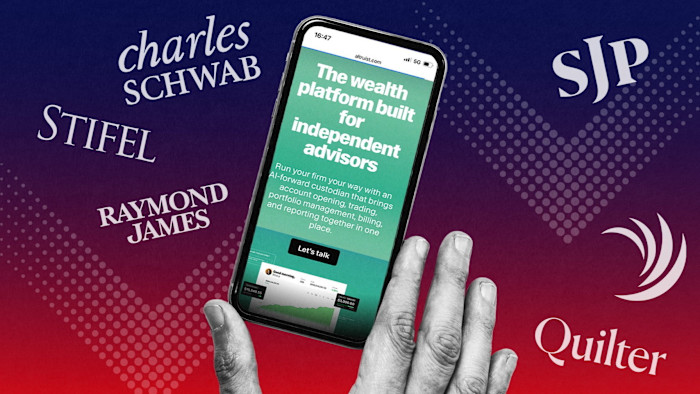
A new tax management tool released this week by Los Angeles-based startup Altruist has prompted investors to sell stakes in traditional financial services groups such as Charles Schwab, Raymond James and Stifel Financial, as well as British wealth advisory firms St. James Place, Quilter and AJ Bell.
Even major banks involved in the wealth business, such as Morgan Stanley, were caught up in the sell-off.
Financial industry veterans are bristling at the idea that their decades-old companies could be replaced by robot-powered startups.
Paul Manduca, chairman of St James’s Place, told the FT that the share price movement was “astonishing and almost certainly an overreaction”. “In a rapidly changing world, the demand for face-to-face advice is increasing,” he said.
But technology investors and entrepreneurs say incumbent companies may struggle to adapt and take advantage of AI tools.
“Generally speaking, I don’t think this decline is unwarranted,” said Christian Owens, co-founder of UK-based AI wealth management startup Clove.
He believes that if the average wealth manager can advise around 100 clients, an AI-assisted advisor could advise hundreds of clients. He argues that only “AI-native” companies can reap these benefits because “traditional companies are too organically and institutionally bloated.”
Altruist claims that its AI tool, Hazel, can automate advisors’ work “in minutes” by allowing advisors to open accounts, manage client portfolios, recommend investment strategies, and bill and report faster.
“Hazel’s job is to essentially eliminate the need for any human involvement” in much of the financial advisor’s workload, said Maj Bahadri, chief operating officer of Altruist, which last year raised $152 million from investors including Singapore’s sovereign wealth fund GIC.
“In my mind, without a doubt, [traditional financial firms] you’ll understand [AI] But by the time that happens, companies like Altruist will probably have a 20-25 year head start,” Bahadri said.
An executive at a major UK asset management firm has claimed that AI’s ability to “personalize advice in bulk” and reduce costs. [is] For incumbents, this is both a threat and an opportunity.
Insurance brokers have also been targeted by Wall Street since startup Insurify released a tool that uses OpenAI’s ChatGPT to compare auto insurance quotes.
Shares in Gallagher and WTW, two of the world’s largest insurance brokers, fell more than 15% last week, and shares in Mony Group, owner of price comparison site MoneySupermarket, fell to a 13-year low on Tuesday.
William Hawkins, an insurance equity analyst at KBW, said the big moves were based on “a small press release from a U.S. company with little track record and little size.” “People are in the mood to just sell, so this is a catalyst,” he says.
Hebert said the sell-off also reflects an investor dilemma as Big Tech’s valuations have increased significantly in the three years since ChatGPT’s launch. Even those who are investing in AI are reluctant to let tech stocks rise any further.
“People are trying to short companies that may be in trouble because they can’t go long on the other side of the trade,” he said. “We’re at a natural point in the cycle where people are looking for heads to play against.”
Reporting by Tim Bradshaw, Rais Al Khalaf and Lee Harris in London, George Hammond in San Francisco and Jill R. Shah, Akira Kinio and George Steer in New York