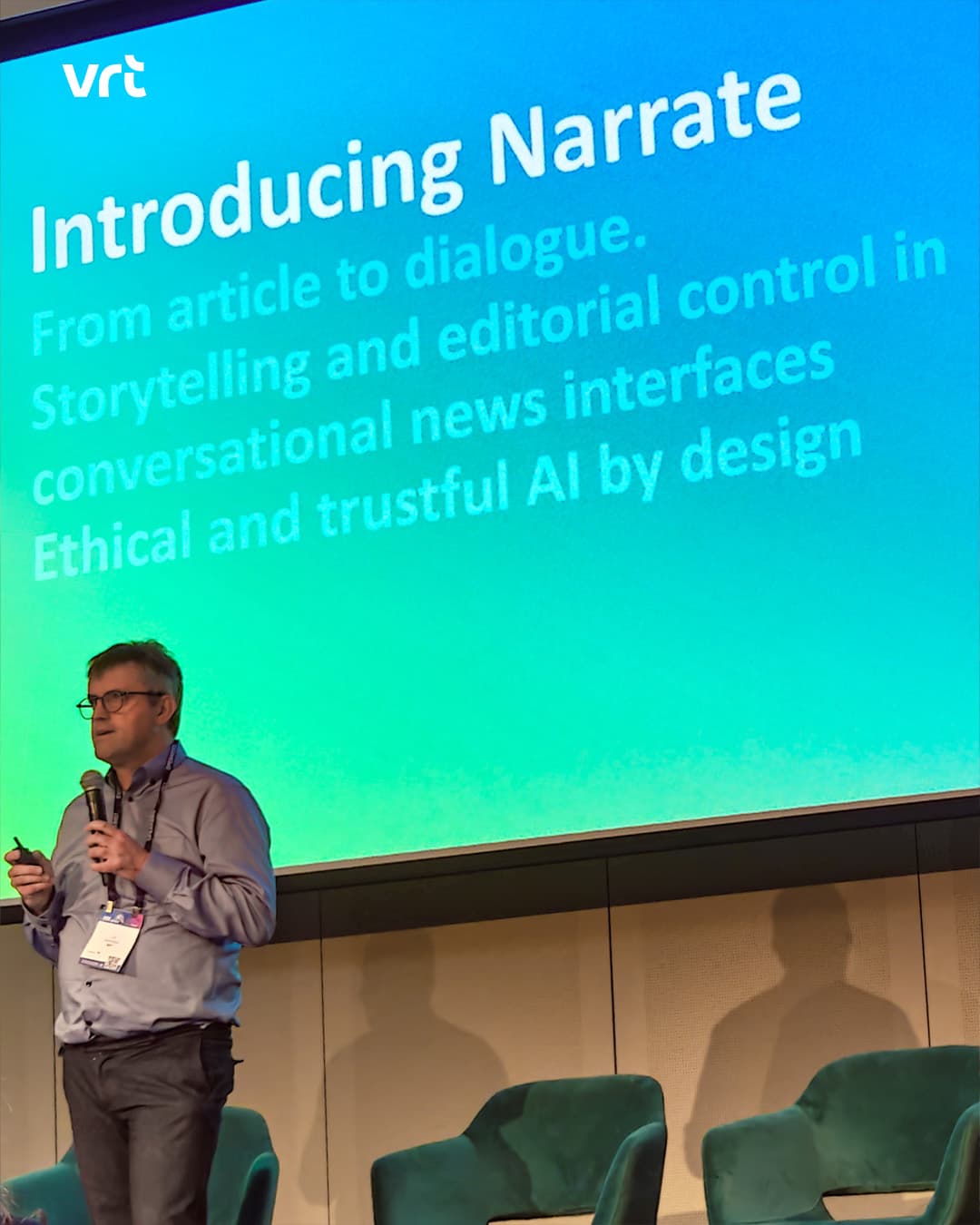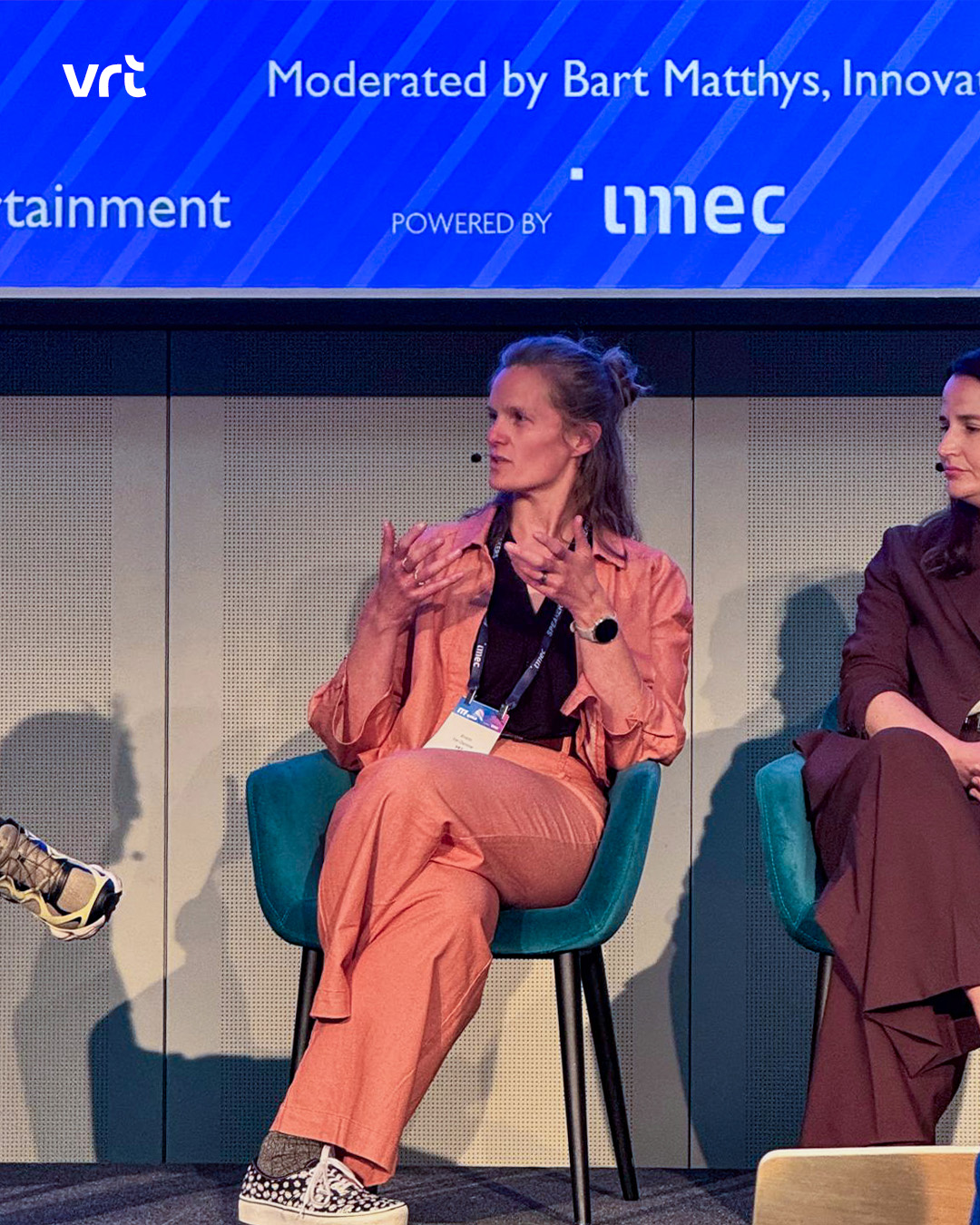
At the heart of this effort are important questions. How can AI help make news more accessible and more personal, while staying firmly rooted in the journalistic context?
Responding to evolving user behavior
This project is built on clear trends. More and more people are turning to AI systems and chat interfaces to find news and other information. In Flanders, more than a quarter of viewers are already using generative AI to search for news topics (imec.digimeter, 2026).
“This evolution has caused news organizations to rethink how they present their content,” said Luc Obermaier, who initiated the research project.
Aiming for interaction-driven journalism
Traditional news formats such as articles, videos, and audio remain essential, but opportunities for dialogue are limited. “While these formats are important, they don’t allow users to easily ask follow-up questions or request additional context, which can be a barrier, especially for complex topics like geopolitics or major societal changes,” Obermeier explains.
Artificial intelligence can help address this challenge by searching through large amounts of information and providing relevant answers. At the same time, important questions arise. Many generation systems provide quick responses, but the source of the information is not always clearly indicated, making it difficult to distinguish between reliable and false information. Established news outlets are also often underrepresented in these systems.
“With VRT, we are exploring a different approach,” says Kristin Van Damme, researcher at VRT Innovation. “We’re developing AI applications built on unique journalistic sources, editorial choices, and storytelling. We’re moving beyond chatbots and experimenting with conversational interfaces that can tailor news to users’ needs.”
These interfaces can include formats that allow you to adapt to individual users, save and revisit information, and improve your understanding of a topic over time. “AI is a tool that brings journalism closer to the audience,” Obermeier adds. “We are also working with imec to explore ways to make news archives searchable for complex topics in the future.”
human-centered approach
Research goes beyond theory. VRT is already testing conversational formats around major news topics, including the year in the Trump administration and the war in Ukraine. Instead of a single overview article, users can ask questions and get answers from VRT NWS journalists.
This interaction-based approach has proven effective in helping users navigate complex stories. Those seeking more background will see additional explanations tailored to their needs. VRT is currently researching how AI can further support and extend this concept. All answers are based on VRT’s own extensive and trusted news archive, and the key principle remains: ensuring existing information is presented in a clear and accessible way.
Editorial oversight remains essential
Full chatbot delivery is not expected in the short term. “If we make news available through chatbots, it must be completely trustworthy,” said Karel Degrave, journalist and AI and innovation expert at VRT NWS. “Current AI systems still fall short in this regard. Especially since our archives are primarily comprised of video and audio, challenges remain with these technologies.”
Therefore, editorial oversight remains important. VRT is currently focusing on interactive formats such as ‘De Belastingspecial’ which uses AI to analyze many questions from users and ensure all relevant themes are addressed.
Trust as a key differentiator
The overall conclusion of the study is clear. The future of news will not be completely automated, but human-centered and interactive.
“In a world full of information, trust is becoming increasingly important,” Van Dam concludes. “That’s exactly where public service media like VRT can continue to make a difference.”