
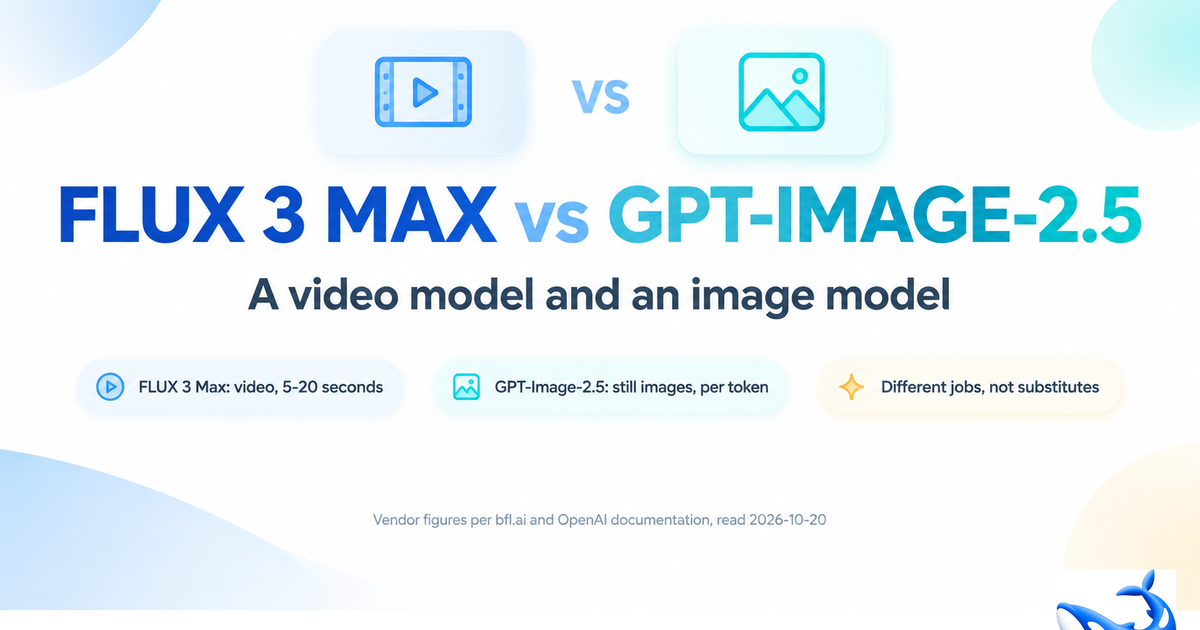
Put FLUX 3 Max and GPT-Image-2.5 side by side and the first thing that happens is a category error. FLUX 3 Max generates video — ten seconds of it, in twelve seconds according to Black Forest Labs — and does not produce a still image at all. GPT-Image-2.5 generates and edits still images, in two variants, and produces no video whatsoever. They can be compared, but only if the comparison is honest about what each one is for: a team choosing between them is really choosing between a motion pipeline and a stills pipeline, and the overlap is narrower than the search query implies. What follows separates the parts of the decision that are genuinely head-to-head from the parts that are not, because pretending the two are substitutes is how people end up buying the wrong one. The documented AI failures and agent incidents behind releases like this one are collected in the OrcaRouter AI Incident Archive where each entry carries its own sources, severity, confidence grade and disputed flag.
Sources are the vendors’ own documentation, read on 2026-10-20: Black Forest Labs’ model and pricing pages plus its public API schema, and OpenAI’s developer documentation for both GPT-Image-2.5 variants. Neither vendor publishes an independent benchmark of the thing this page is named after, and neither publishes a single number that puts the two in the same units. That absence is a fact about the comparison, not a gap in the research.
The mismatch, stated plainly
FLUX 3 Max is the fastest configuration of FLUX 3 Video, launched October 19, 2026. Its outputs are clips: 5 to 20 seconds, with optional native synchronized audio, at resolutions from HD to 4K. Its inputs are text, a still image, a video clip, or keyframes. It is built for motion.
GPT-Image-2.5 is OpenAI’s image generation and editing generation, which arrived in the API on 2026-09-08 and ships as two separately named models: GPT-Image-2.5 Sunburst, positioned for editing precision, and GPT-Image-2.5 Flare, positioned for fast everyday generation. Its outputs are still images, returned as tokens and billed as tokens. It is built for frames.
• Task — FLUX 3 Max makes moving pictures with sound; GPT-Image-2.5 makes still pictures you can edit.
• Input → output — text/image/video/keyframes → video at FLUX 3 Max; text/image → image at GPT-Image-2.5.
• Pricing unit — per second of output video at FLUX 3 Max; per million tokens at GPT-Image-2.5.
• Duration — 5 to 20 seconds per clip at FLUX 3 Max; not applicable at GPT-Image-2.5, which has no temporal dimension.
• Audio — native, synchronized, included at FLUX 3 Max; GPT-Image-2.5 produces none.
• Text rendering — FLUX 3 Max animates typography within a shot; GPT-Image-2.5 renders high-accuracy text inside a still, across languages, per OpenAI’s documentation.
A comparison in which one side cannot do the other side’s job in either direction is not a benchmark. It is a build-versus-build decision.
If what you need is a still image, FLUX 3 Max is the wrong product
This is the correction that matters most, because the query “FLUX 3 Max vs GPT Image 2.5” is usually asked by someone who wants images and has heard the FLUX name attached to speed.
Black Forest Labs does sell an image model. Several, in fact. FLUX 3 Image generates and edits stills with bounding-box layout and box-scoped multi-turn edits up to 4K. FLUX 3 Image Klein is the 5.6B open-weights model that shipped on October 15 with a base checkpoint for fine-tuning, FP8/INT8/NVFP4 builds, and a licence permitting free commercial use below $5M annual revenue. Those are the FLUX models that answer an image question. FLUX 3 Max answers a video question, and its own model-index description says so: “Fastest, highest quality video model.”
So the real comparison, if you want stills, is GPT-Image-2.5 against FLUX 3 Image or FLUX 3 Image Klein — a genuinely like-for-like matchup with published per-image rates on one side and per-token rates on the other. This page keeps FLUX 3 Max in the title because that is what people search for, and then points them at the right product. Buying a video tier to get stills is the expensive way to discover the difference.
Where they do compete: the pipeline that needs both
There is one situation where the two names belong in the same sentence, and it is common in commerce and marketing. A campaign needs product stills for a catalogue page and short motion for the feed. The stills come from an image model. The motion comes from a video model. Someone has to budget both, and the interesting comparison is cost per finished asset, not cost per call.
On the video side, BFL publishes per-second rates for the FLUX 3 Video family and does not publish a Max-specific row. The documentation’s billing page, as read on 2026-10-20:
• Text-to-video and image-to-video — $0.15/s HD, $0.24/s FHD, $0.28/s QHD, $0.41/s UHD.
• Video-to-video and continuation — $0.21/s HD, $0.27/s FHD, $0.31/s QHD, $0.45/s UHD.
• Draft HD — $0.06/s, text-to-video only; a draft is then rendered to full quality at the standard rate for the band you commit to.
• Worked example — a ten-second HD clip is $1.50; five seconds of standard HD text-to-video is $0.85; audio included; partial seconds round up.

Whether Max bills at those rates is unconfirmed. The billing page’s footnote says rates depend on modality, model variant and resolution band, and names FLUX 3 Video and FLUX 3 Video Draft as variants — not Max. And the model page’s own FAQ still quotes a different, higher card for the same work: $0.17/s HD against the documentation’s $0.15/s, and $0.80/s UHD against $0.41/s. Anyone budgeting a Max clip should confirm the charge on the first invoice rather than trust either derived figure.
On the image side, OpenAI meters GPT-Image-2.5 in tokens, identically for both variants and identically to GPT-Image-2:
• Text input — $5.00 per 1M tokens; cached $1.25.
• Image input — $8.00 per 1M tokens; cached $2.00.
• Image output — $30.00 per 1M tokens; batch halves it to $15.00.
• Text output — not billed, because the model does not produce text.
OpenAI publishes no per-image price, and its own note says the GPT Image 2 cost calculator does not estimate 2.5 usage. So any “$X per image” figure for GPT-Image-2.5 that you see quoted is a third party’s conversion, not OpenAI’s, and the conversion depends on the size and quality tier you select. That is the honest state of the arithmetic: one side quotes per second, the other per token, and neither vendor hands you a per-asset number you can put in a spreadsheet without doing the modelling yourself.

What GPT-Image-2.5 is actually better at
Setting the categories aside, there are three things the OpenAI models do that no FLUX 3 tier matches, and they are the reasons this comparison is not a foregone conclusion for stills work.
First, the edit loop. Sunburst is positioned explicitly for workflows where an edit made in turn two has to survive turn three — the iterative case, not the one-shot case. FLUX 3 Image has its own answer to this, box-scoped editing where everything you did not touch stays put, and it is a serious one. But FLUX 3 Max, being video, contributes nothing here.
Second, the size envelope. Both GPT-Image-2.5 variants accept arbitrary WIDTHxHEIGHT strings with width and height as multiples of 16, an aspect ratio between 1:3 and 3:1, no edge above 3840 pixels, and a total pixel budget between 655,360 and 8,294,400. Resolutions above 2560×1440 are flagged experimental. That is a wider canvas than the preset-driven framing most image APIs offer, and it comes with quality tiers — low, medium, high, xhigh, max, auto — that compound with the variant choice on both latency and cost.
Third, the price did not move. The 2.5 generation carries the same $8 in / $30 out image rates as GPT-Image-2, where GPT-Image-1.5 was $8 in / $32 out and GPT-Image-1 was $10 in / $40 out. A capability upgrade at an unchanged rate card is a real argument for teams already on the OpenAI stack: no repricing, no migration budget.
What FLUX 3 Max is better at, and the caveat attached
Motion, obviously — but the specific advantage is worth stating precisely, because “faster” is doing a lot of work in the launch material.
BFL claims a ten-second video in twelve seconds, 22× faster than Seedance 2.5 at the same quality, and a tie for first in image-to-video. None of those has been independently verified, and the launch post supplies no resolution, no audio setting, no hardware and no sample size. The video page itself still presents draft mode as the fast path — a cheap HD preview you then commit to full quality — which is a strange thing for a product that supposedly renders everything in twelve seconds. And the public API surface has no /v1/flux-3-max endpoint; the family’s video endpoint is /v1/flux-3-video, whose request body has no field that selects Max. A day after launch, the model is a product listing before it is a documented API.
What is not in doubt is the feature set underneath: 5–20 second clips, native synchronized audio at no extra charge, multilingual dialogue, keyframe control, multiple scenes per generation, and resolutions to 4K. For a brand team that needs a fifteen-second social cut with sound, this is the only side of the comparison that can deliver it at all.
The decision, by job to be done
You need stills, at volume, with edits. GPT-Image-2.5 Flare as the default and Sunburst where an edit has to hold. FLUX 3 Max is irrelevant to this job; FLUX 3 Image or FLUX 3 Image Klein are the FLUX alternatives worth pricing against it. Both GPT-Image-2.5 variants are in OrcaRouter’s live catalogue today at the $8 in / $30 out image rates, which means you can A/B them against an image model from another vendor on one key rather than two contracts.
You need short motion with sound. FLUX 3 Max is the only candidate in this pair, and the question is whether its unverified speed claim holds on your content. Test it with your own prompts at your own resolution, and price it from the published FLUX 3 Video card until BFL publishes a Max row.
You need both, at production scale. The cost model that matters is per finished asset, and neither vendor gives it to you directly. Build the estimate yourself: seconds of video times the per-second rate, against token consumption per image at the size and quality tier you pick. Then check that estimate against one real week of invoices, because neither rate card is stable enough to plan against blind — BFL’s own documentation and model page quote different video rates for the same modes, and OpenAI’s calculator does not cover 2.5.
You need to keep the door open. This is the case where a router earns its place rather than being a plug. Video and image model generations are turning over on a weeks-long cadence — FLUX 3 Max arrived yesterday, GPT-Image-2.5 six weeks ago — and the cost of adopting the next one should be a configuration change. OrcaRouter gives you one OpenAI-compatible endpoint across 200+ models with provider list prices passed through at 0% markup, automatic failover when a provider degrades, and a routing DSL that can send stills to one model and video to another from the same key. FLUX 3 Max is not on that catalogue today; the GPT-Image-2.5 variants are.

What would make this a real comparison
Three artefacts would turn this page from a category correction into a genuine head-to-head, and none exists today. An independent image-quality board that carries FLUX 3 Image beside both GPT-Image-2.5 variants on a matched harness. A second of video priced in the same units as a still, which means a vendor publishing cost per finished asset rather than per second or per token. And a Max-specific rate from BFL, so the video side of the ledger stops being an inference.
Until then, the sane posture is the one this page has taken: buy the modality you need from the vendor that sells it, keep the choice reversible, and be suspicious of any comparison that puts a per-second rate next to a per-token rate and calls the result a winner. The two models are not rivals. They are adjacent tools, and the only real mistake is picking the wrong one.


