

DUBLIN, March 9, 2026 (GLOBE NEWSWIRE) — The U.S. Video Production Market Report (By Genre, End-Use, State, Company Analysis 2025-2033) has been added. ResearchAndMarkets.com Offerings.
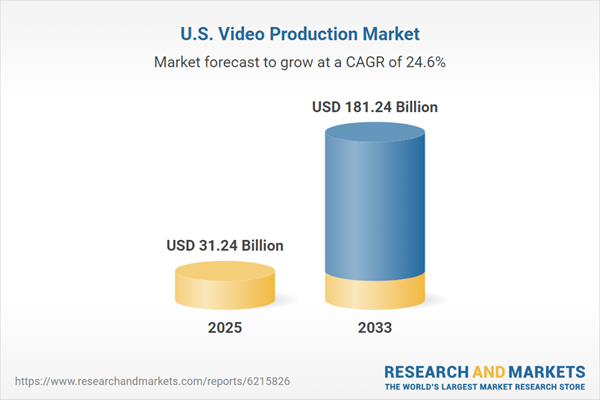
The US video production industry is expected to grow strongly from US$31.24 billion in 2025 to US$181.24 billion in 2033. This growth will represent a compound annual growth rate (CAGR) of 24.58% from 2025 to 2033.
The reasons for this growth are the increasing demand for digital content, technological advances in production, and the growth of streaming services, which will create new opportunities for the video production sector.
Video content creation has recently become very popular in the United States due to the increased use of digital platforms and social media. The advent of YouTube, TikTok, and Instagram has increased the demand for engaging video content. Businesses and individuals are leveraging video as a powerful marketing tool, appreciating its ability to grab people’s attention and get their message across. This boom has also been fueled by advances in technology, which have made high-quality video production possible and more accessible at lower costs.
The rapid emergence of digital platforms and streaming services has significantly increased the demand for the U.S. video production market. Platforms like Netflix, Amazon Prime, YouTube, and Hulu are changing the way people watch video content, and there is always a demand for high-quality, original content. As streaming subscriptions increase, so too does the competition among platforms to offer interesting, story-driven, and diverse visual experiences. This momentum is driving increased investment in both short-form and long-form video content. And with the rise of corporate video content, influencer marketing, and branded storytelling, production is expanding beyond mainstream film and television. Social media sites like TikTok and Instagram have also become essential channels for innovative video content.
Technological innovation has been a major driver of the U.S. video production industry, driving creativity, efficiency, and accessibility. Filming technologies such as high definition (HD), 4K, and even 8K have raised the bar for video quality. The use of artificial intelligence (AI), virtual production, and augmented reality (AR) is revolutionizing pre- and post-production workflows, allowing filmmakers to create cinematic effects at lower costs. Cloud collaboration software allows remote teams to easily collaborate across editing, sound design, and color grading, greatly improving production schedules. Drone filming, advanced CGI, and motion capture technology are also opening up new storytelling opportunities.
Beyond entertainment, video has emerged as a fundamental communication tool for corporate branding, marketing, and employee training across every industry in the United States. Companies are increasingly turning to video production for advertising campaigns, investor relations, internal communications, and product launches. Video learning and e-learning are becoming increasingly popular in the educational and corporate worlds, especially since the adaptation of hybrid working and online learning styles. Universities, online learning websites, and businesses are investing in professionally produced educational videos to facilitate interaction and knowledge retention. Additionally, the rise of social media marketing has made short-form videos essential for brand awareness and customer engagement.
Despite increasing demand, the U.S. video production market faces increasing production costs. Particularly in large cities like Los Angeles and New York, the costs of talent search, on-location work, equipment rental, and post-editing continue to rise. Labor costs, union rules, insurance requirements, etc. further increase cost pressures, especially for low-budget producers and small studios. Inflationary pressures and increased competition for scarce studio facilities are also contributing to budget pressures.
While technology has made certain production processes more efficient, the pressure for cinematic quality and high-end effects has increased costs. It’s difficult for small agencies to be as competitive as big studios with access to high-end equipment and advertising. Maintaining high production values while remaining profitable is the biggest challenge, forcing production companies to adopt cost-effective workflows and collaboration without sacrificing creativity or quality.
The US video production market has become increasingly competitive, with a proliferation of both professional studios and individual freelancers offering the same services. The democratization of equipment and software tools has opened up barriers to entry, leading to market saturation. Customers in the enterprise and digital industries now have many choices, leading to a focus on price and lower profit margins.
Additionally, streaming services and media organizations are also facing pressure to continually deliver new content, putting a strain on production schedules and creative teams. Independent filmmakers are struggling to secure funding and distribution in a saturated market. The high volume of content also complicates audience engagement, especially for smaller producers who lack marketing infrastructure.
Featured companies
- Armaan Productions
- bluffton
- CBS Corporation
- century studio
- gardner productions
- Levitate Media LLC
- Skeleton Productions Co., Ltd.
- Sony Pictures Inc. Digital Productions
- walt disney company
- universal pictures
Key attributes:
| report attributes | detail |
| Number of pages | 200 |
| Forecast period | 2025-2033 |
| Estimated market value in 2025 (USD) | $31.24 billion |
| Projected market value to 2033 (USD) | $181.24 billion |
| compound annual growth rate | 24.5% |
| Target area | US |
Main topics covered:
1. Introduction
2. Research and methodology
2.1 Data sources
2.1.1 Primary sources
2.1.2 Secondary sources
2.2 Research approach
2.2.1 Top-down approach
2.2.2 Bottom-up approach
2.3 Prediction prediction methodology
3. Summary
4. Market trends
4.1 Drivers of growth
4.2 Challenges
5. US video production market
5.1 Past market trends
5.2 Market forecast
6. Market share analysis
6.1 By genre
6.2 By end use
6.3 By state
7. Genre
7.1 Action and Adventure
7.2 Thriller & Horror
7.3 Fantasy and Science Fiction
7.4 Drama
7.5 Documentary
7.6 Others
8. End use
8.1 Enterprise
8.2 Consumers
9. Top states
9.1 California
9.2 Texas
9.3 New York
9.4 Florida
9.5 Illinois
9.6 Pennsylvania
9.7 Ohio
9.8 Georgia
9.9 New Jersey
9.10 Washington
9.11 North Carolina
9.12 Massachusetts
9.13 Virginia
9.14 Michigan
9.15 Maryland
9.16 Colorado
9.17 Tennessee
9.18 Indiana
9.19 Arizona
9.20 Minnesota
9.21 Wisconsin
9.22 Missouri
9.23 Connecticut
9.24 South Carolina
9.25 Oregon
9.26 Louisiana
9.27 Alabama
9.28 Kentucky
9.29 Rest of the United States
10. Value chain analysis
11. Porter’s Five Forces Analysis
11.1 Bargaining power of buyers
11.2 Bargaining power of suppliers
11.3 Degree of competition
11.4 Threat of new entrants
11.5 Threat of substitutes
12.SWOT analysis
12.1 Strength
12.2 Weaknesses
12.3 Opportunities
12.4 Threats
13. Analysis of major companies
13.1 Overview
13.2 Key Person
13.3 Recent trends
13.4 SWOT analysis
13.5 Revenue analysis
For more information on this report, please visit https://www.researchandmarkets.com/r/3vrsmu.
About ResearchAndMarkets.com
ResearchAndMarkets.com is the world’s leading source of international market research reports and market data. We provide the latest data on international and regional markets, key industries, top companies, new products and latest trends.
-
US video production market


