


Zero-shot learning is an advanced machine learning technique that enables models to predict tasks without being explicitly trained on them. This innovative paradigm avoids extensive data collection and training, relying instead on pre-trained models that can generalize to a wide variety of tasks. Zero-shot models can leverage knowledge acquired during pre-training and infer information about new, unknown tasks by drawing similarities with the existing knowledge base. This capability is particularly useful in rapidly evolving domains where new tasks emerge frequently and it is impractical to collect and annotate data for each new task.
A key issue with zero-shot models is their vulnerability to biases and unintended correlations due to training on large datasets. These biases can have a significant impact on model performance, especially when the processed data falls outside the distribution of the training data. For example, a zero-shot model trained primarily on images of waterbirds may incorrectly associate images with watery backgrounds with waterbirds. This leads to poor accuracy and reliability, especially for data slices that break correlations within the distribution, and poor generalization on rare or atypical instances. The challenge therefore lies in developing ways to mitigate these biases without compromising the core advantage of zero-shot models: their ability to run quickly.
Current approaches to address bias in zero-shot models often use labeled data to fine-tune them to increase robustness. Although effective, these methods reintroduce the need for additional training, thereby undermining the main benefit of zero-shot learning. For example, some strategies detect erroneous attributes and use these explanations to fine-tune the model, while others use specialized contrastive losses to train adapters on fixed embeddings. Another line of research focuses on removing bias in word and multimodal embeddings by manually identifying and removing unnecessary concepts. However, these methods are labor-intensive and require domain-specific expertise, limiting their scalability and applicability across different tasks.
Researchers at the University of Wisconsin-Madison say RoboshotROBOSHOT is a novel method designed to robustify zero-shot models without requiring labeled data, training, or manual specification. This innovative approach leverages insights from language models to identify and mitigate bias in model embeddings. ROBOSHOT leverages the capabilities of language models to generate useful insights from task descriptions. These insights are embedded and used to tune components of the model's latent representations, effectively removing harmful elements and enhancing beneficial elements. The process is fully unsupervised, preserving the zero-shot properties of the model while significantly enhancing its robustness.

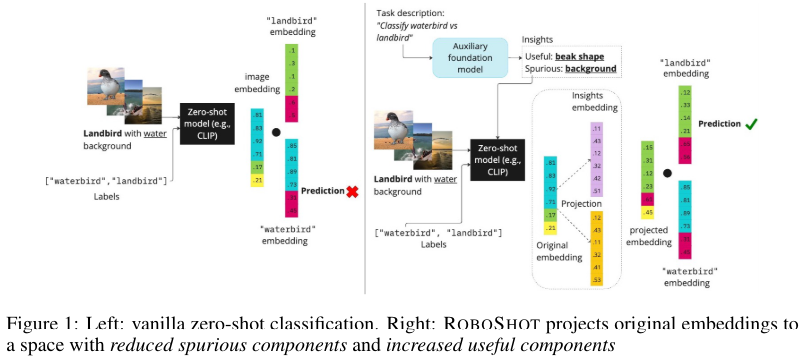
ROBOSHOT works by first using the task description to gain insights from the language model. These insights help identify both harmful and beneficial components in the embeddings. The system then modifies these embeddings to neutralize the harmful components and emphasize the beneficial ones. For example, in a classification task, ROBOSHOT can adjust the model's representation to reduce the impact of background correlations (e.g., the association of water with waterfowl) and emphasize relevant features (e.g., bird features). This adjustment is achieved through a simple vector operation that projects the original embeddings into a space that has fewer unnecessary components and more useful components. This method captures and quantifies the impairments of zero-shot models and provides a theoretical model that characterizes the conditions under which ROBOSHOT can improve performance.

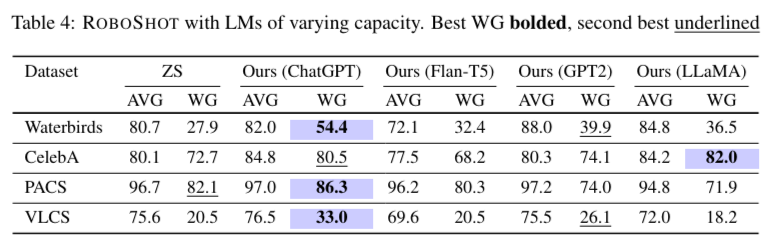
Empirical evaluation of ROBOSHOT on nine images and NLP classification tasks demonstrates its effectiveness. The technique improves worst-group accuracy, a key metric for evaluating robustness, by an average of 15.98% while maintaining or slightly improving overall accuracy. For example, the system significantly improves performance on the Waterbirds dataset by reducing the detrimental correlation between the water background and waterbird labels. Similar improvements are seen on other datasets, including CelebA, PACS, VLCS, and CXR14, demonstrating the versatility and robustness of the technique. These results highlight that ROBOSHOT has the potential to increase the robustness of zero-shot models without requiring additional data or training.


In conclusion, this work addresses the critical issue of bias in zero-shot learning by introducing ROBOSHOT, a method that leverages language model insights to tune embeddings and enhance robustness. The approach effectively mitigates bias without requiring labeled data or training, while preserving the core advantages of zero-shot models. ROBOSHOT provides a practical and efficient solution to increase the reliability and applicability of zero-shot models by improving worst-case accuracy and overall performance across multiple tasks.
Please check paper. All credit for this work goes to the researchers of this project. Also, don't forget to follow us: twitter. participate Telegram Channel, Discord Channeland LinkedIn GroupsUp.
If you like our work, you will love our Newsletter..
Please join us 43,000+ ML subreddits | In addition, our AI Event Platform


Asif Razzaq is the CEO of Marktechpost Media Inc. As a visionary entrepreneur and engineer, Asif is committed to harnessing the potential of Artificial Intelligence for social good. His latest endeavor is the launch of Marktechpost, an Artificial Intelligence media platform. The platform stands out for its in-depth coverage of Machine Learning and Deep Learning news in a manner that is technically accurate yet easily understandable to a wide audience. The platform has gained popularity among its audience with over 2 million views every month.


