New research shows most organizations have adopted AI, but few are transforming their workflows as leaders focus on skills, trust, and measurable impact
phoenix, June 8, 2026 /PRNewswire/ — University of Phoenix Announces Today Executive AI Impact Report: Getting value from AIa new study examining how organizations are working to turn investments in artificial intelligence into measurable business outcomes. Based on a survey of 150 executives across North America conducted in collaboration with future of work strategist and HR consultant Jeanne Meister, the report found that the gap between AI adoption and enterprise-wide transformation is widening.
Key findings from the 2026 Executive AI Impact Report
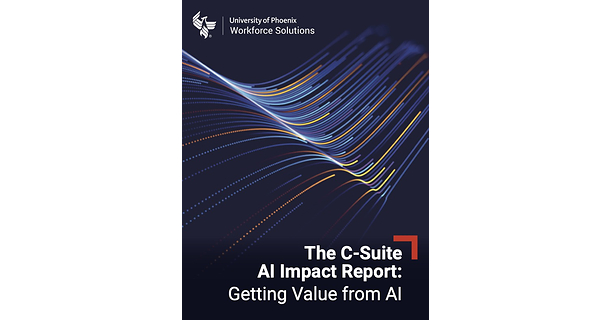
Pictured is the cover of “The C-Suite AI Impact Report: Getting Value from AI,” a new study from the University of Phoenix that examines how organizations are working to turn investments in artificial intelligence into measurable business outcomes.
- 63% of executives have implemented at least one AI use case, but less than one-third are using AI to transform business processes and workflows.
- 56% expect AI to become an active human capital tool by the end of 2026
- 90% of executives cite learning and development as the primary use case for AI in HR.
- Nearly 60% report adopting a skills-based workforce model, but ownership remains fragmented
- 75% say HR and IT are unlikely to merge, but will work more closely together
- More than 6 in 10 people cite productivity and competitive advantage as their top benefits, but employee fear and mistrust remain key barriers.
- Leaders recognize critical thinking and role modeling AI literacy as essential competencies to scale AI
“The next step in AI adoption is not experimentation, but execution,” Meister said. “Our research shows that leaders are increasingly focused on turning AI investments into measurable value by incorporating AI into workflow design, skill development, and day-to-day decision-making. Organizations that align AI with a clear skills strategy and model its use at the leadership level will be well-positioned to scale impact across the enterprise.”
AI adoption trends show a gap between adoption and workforce transformation
The findings highlight the gap between adoption and transformation as many organizations continue to pilot AI without fully integrating it into their core business processes. Leaders are prioritizing how to connect AI to workflow design and measurable outcomes as they move from individual use cases to enterprise-wide scaling.
Skills-based workforce strategy and HR IT collaboration will shape AI scaling
Organizations are increasingly taking a skills-based approach to their workforce strategy. Although nearly 60% of C-suite leaders report moving in this direction, responsibility for skills initiatives remains fragmented across functions such as HR, IT, and business leaders. The report also found that while most leaders do not expect HR and IT to converge, they believe close collaboration between the two functions is critical to aligning workforce strategies and AI investments.
“The University of Phoenix is proud to be partnering with the University of Phoenix,” said Jay Titus, vice president of the Workforce Solutions Group at the University of Phoenix. “To get the most out of AI and scale it well, organizations need to focus on how they get work done, including how teams build skills, collaborate across departments, and address employee concerns. Trust, leadership behavior, and demonstrating clear use cases are just as important as the technology itself.”
Human factors such as trust and AI literacy influence recruitment
This study highlights the importance of addressing the human aspects of AI deployment. Leaders cite productivity and competitive advantage as key benefits, but employee fear and mistrust remain the biggest barriers to widespread adoption. The report also identifies an “AI expectations gap” in which younger leaders are less optimistic about the impact of AI than older generations.
To address these challenges, leaders are prioritizing AI literacy as a core competency for their workforce, but the report notes that organizations must also define what AI literacy means on the job to clarify expectations for employees. AI literacy is increasingly seen as a baseline skill, and leaders are emphasizing the importance of role modeling the use of AI to accelerate adoption and embed AI in daily work.
This report includes recommendations for organizations to move beyond isolated AI pilots and develop integrated strategies that connect skills, workflow redesign, and measurable business outcomes.
Click here for more information. Read the full report.
About University of Phoenix
University of Phoenix is built for real life. 50 years of strength. The University is innovating to help working professionals enhance their careers and develop skills in a rapidly changing world through flexible online learning, relevant courses, the Academic AI Pillar, and a skills-mapped curriculum for associate, bachelor’s, and master’s degree programs. Current students and alumni have access to lifelong career services® Resources such as career guidance and tools. For more information, visit phoenix.edu.
Source University of Phoenix