HANGZHOU, Feb. 16 (Xinhua) – When Chinese skater Sun Long stood on the podium at the Milan-Cortina Winter Olympics, the bright China red of his award ceremony uniform signaled more than national pride, it also signaled the growing role of artificial intelligence (AI) in China’s manufacturing industry.
At a textile factory in eastern China’s Zhejiang province, digital printers hum as newly designed sportswear fabric rolls off the production line. The AI-powered image processing system adjusts colors with incredible precision, automatically detecting and correcting deviations in real-time.
“We used to rely on skilled craftsmen with decades of experience to visually judge color combinations. Now, AI reads colors with X-ray-like precision,” says Xiao Xingshui, general manager of Qianyong Textile Co. in Shaoxing, a city long known as a textile capital.
Since implementing AI-powered printing technology, the acceptance rate for plain fabrics has increased from about 50 percent to more than 90 percent, allowing the company to overcome long-standing production bottlenecks.
This shift reflects a broader trend across Zhejiang province, one of China’s manufacturing powerhouses, where AI is steadily moving from concept to shop floor.
At Nakazawa Rubber Group in the provincial capital Hangzhou, engineers are using AI to redesign the way tires are developed and manufactured. Instead of the traditional sight of roaring machinery and oil-stained workshops, the company’s digital platform now allows engineers to generate dozens of three-dimensional tire models within minutes.
“Previously, we needed the support of a team of more than 20 people just for data entry during the design phase,” said engineer Wang Xueyan. “Now, thanks to AI, I can do my own work.”
Zhongce currently has 18 AI agents deployed across its operations covering R&D, production, and testing. Company executives say the goal of integrating AI into manufacturing is not to replace workers, but to equip them with smarter tools.
“It is important to find the sweet spot between efficiency and humanity in industrial upgrading,” said Zheng Li, executive vice general manager of Zhongce’s manufacturing plant.
With the help of AI, the company increased labor productivity by five times while reducing daily pollution and energy consumption at source by approximately 80%.
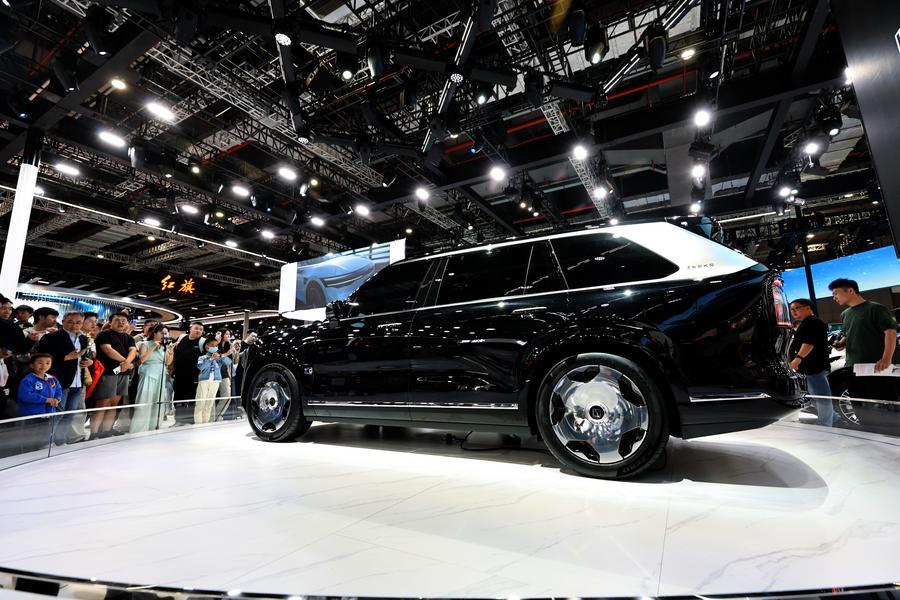
The application of AI is also reshaping automotive manufacturing.
At Zeekr’s 5G-enabled smart factory in the coastal city of Ningbo, four robots work in sync at the tire installation station in the final assembly workshop. The time required to install one tire has been reduced to 45 seconds.
Zeekr’s production line processes multiple vehicle models simultaneously, each with a customized configuration. “Every car you see is different,” said Dai Longcai, the company’s director of manufacturing and quality digitalization.
Tire specifications vary widely and used to be one of the most error-prone steps in assembly. “Now, with 5G-enabled AI visual inspection, we can verify tire information in less than a second and achieve a 100% error rejection rate,” said Dai.
Zhejiang Province is accelerating its digitalization and intelligentization efforts, and the integration of AI into traditional industries is progressing across the province.
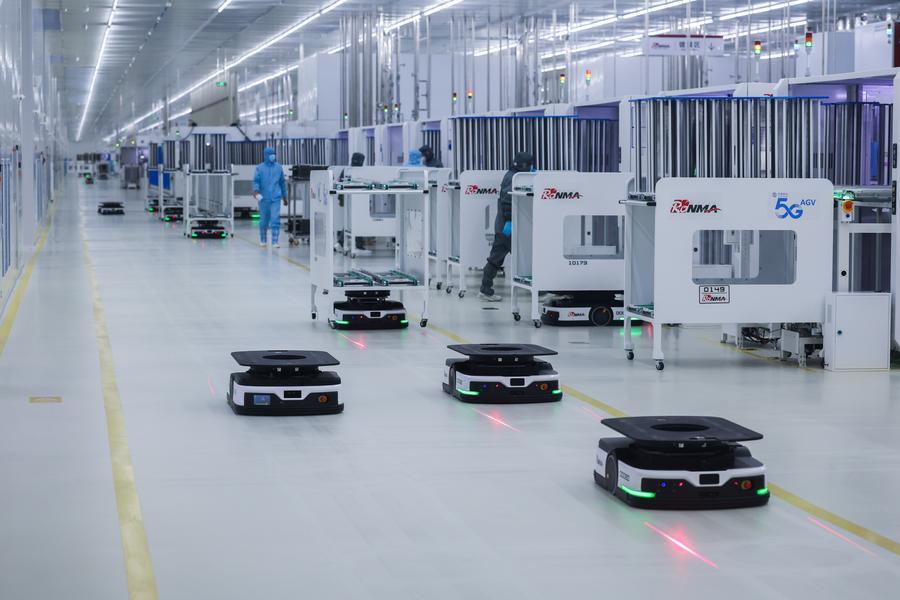
According to local authorities, Zhejiang province has fully covered the digital transformation of industrial enterprises above designated size by the end of 2025. The state has established 608 digital workshops, 381 smart factories, and 93 “Factories of the Future” integrating AI, 5G and industrial internet technologies.
Lan Jianping, deputy director of the Zhejiang Provincial Development Planning Research Institute, said, “Intelligent transformation will be a feature of the new type of industrialization in the future,” pointing out that AI is not just a technology upgrade, but a systematic transformation of production methods.
By 2027, Zhejiang plans to deploy 300 premium AI-powered smart products, including wearables and robotics, secure 50 breakthroughs in major AI terminal technologies, and raise the penetration rate of AI terminals in major industrial enterprises to more than 70 percent.
“By incorporating AI into every link in the industrial chain, from design and manufacturing to quality control and service, Zhejiang is cultivating new high-quality production capabilities and laying a solid foundation for sustainable and high-quality growth,” Lan said. ■