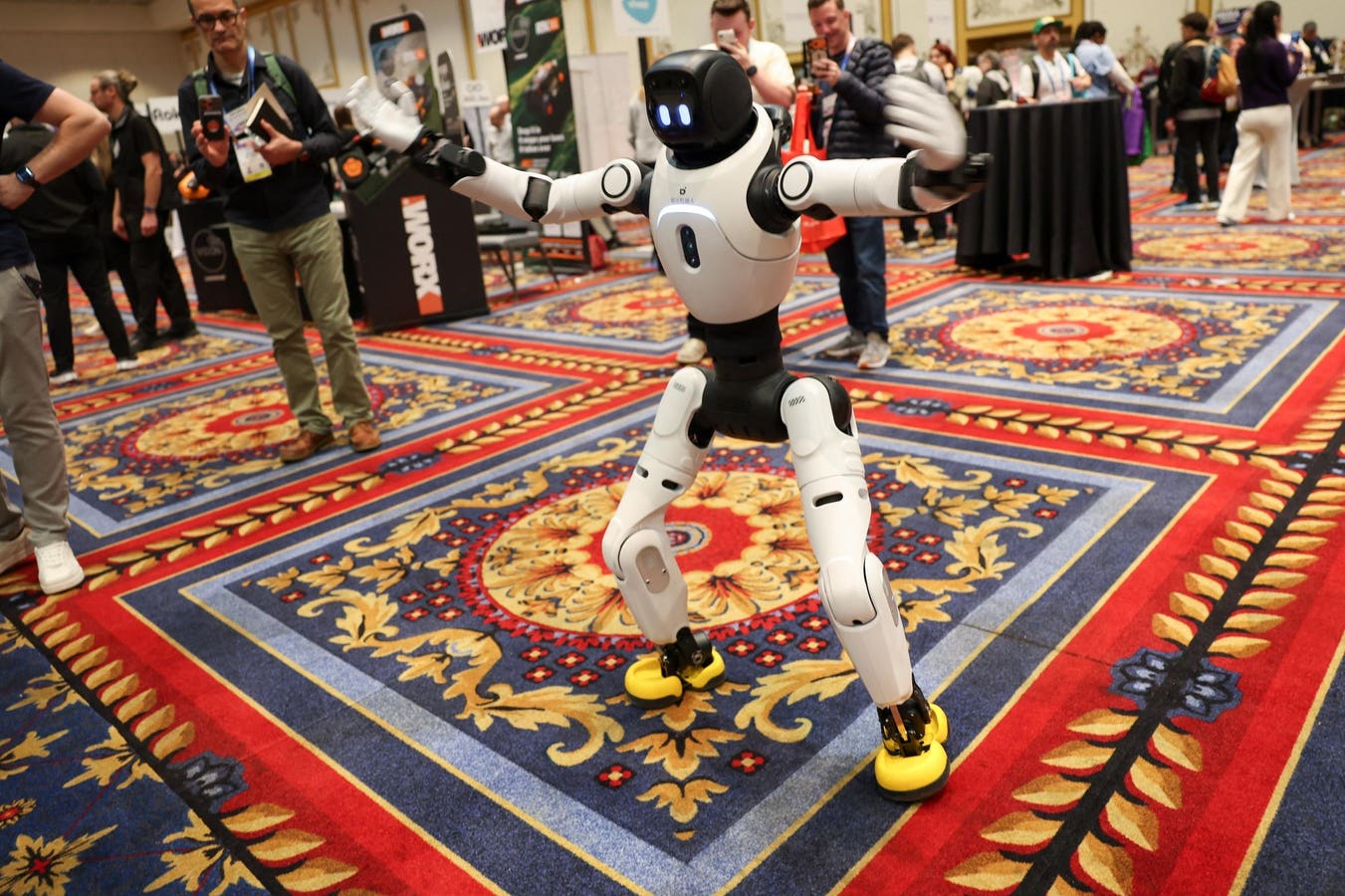

CES features 12 companies that are redefining personalization using robots, AI, and Web3. Humanoid robot “Agibot X2” dances. (Photo by Patrick T. Fallon/AFP via Getty Images)
AFP (via Getty Images)
CES has always been a preview of what’s to come, and with AI, Web3, and robots all converging, it’s become a measure of what’s becoming fundamental.
The show shook Las Vegas with over 148,000 attendees from over 150 countries, 4,500 exhibitors and 1,400 startups. per CTA.
Artificial intelligence was everywhere, but most importantly it wasn’t about smarter models or faster chips. A major consistent theme across everything I looked at was personalization and how difficult it is becoming to get it right, securely, and at scale.
The companies that stood out throughout the exhibition hall weren’t chasing novelty. They were building systems that adapted to people, preferences, and situations. This is where Web3, robots, and AI are converging, not just as buzzwords, but as infrastructure.
At CES, personalization starts with trust
You might think of personalization as a front-end problem focused on recommendations, interfaces, and feeds. At CES, it became clear that personalization is a key element of trust.
According to McKinsey, when leveraging AI and agent systems, personalization can improve customer satisfaction by 15-20%, increase revenue by 5-8%, and reduce service costs by up to 30%.
As AI systems move into higher-risk environments, the provenance and trust of data will become as important as the intelligence itself.
Vannadium demonstrated this shift with Leap, a real-time, on-chain data platform designed to make AI systems explainable and auditable. By enabling high-value data to be streamed on-chain with full provenance and access control, Vannadium reimagines blockchain as an enterprise trust layer for AI rather than a financial experiment.
Laura Fredericks, co-founder and chief growth officer at Vannadium, took the photo, which was directly on-chain.
sandy carter
When I chatted with Laura Fredericks, co-founder and chief growth officer at Vannadium, she said this while we were taking photos “on-chain.” “At St Vannadium, we believe that trusted data must be verifiable and persistent. Taking a photo and storing it on-chain is more than just metadata. It is an immutable foothold in the digital record that future AI systems can trust with confidence. When an AI model is trained and audited against data that can be verified, the personalization and decision-making it enables is more than just intelligent, but responsible and secure.”
Identity followed a similar trajectory. Veintree demonstrated privacy-first authentication using biometric cryptography to authenticate individuals without storing biometric data. In an era of increased regulation and declining consumer trust, proving identity without collecting it sends a powerful signal.
Some of the most inspiring women in AI and Web3 at CES.
CES AI House
Trust is becoming not just a technical thing, but also a human thing. At AI House, we featured Web3’s Unstoppable Women and AI Initiative (note, this is a company I work with) to highlight how reputation and credibility are turning into portable infrastructure.
In a world of AI-generated content, verified human identity is becoming a differentiator.
AI is becoming the operating layer at CES
Another clear theme at CES was the evolution of AI from tools to orchestration.
Lenovo’s CES keynote was held at Sphere in Las Vegas.
sandy carter
Lenovo’s immersive Sphere experience showed how AI functions as a connectivity layer across devices and workflows, rather than a standalone assistant. The focus wasn’t on novelty, but on reducing friction by having AI understand context and coordinate work across systems.
The same idea appeared in Modev’s AI House, where personalization was applied to access itself. Instead of generic content, Modeff emphasized that relevance is now the most valuable form of personalization, curating conversations with the right people at the right time.
CTGT CEO and Founder Cyril Gorlla was discussing new AI solutions at CES
Getty Images
CTGT AI approached the problem from a decision intelligence perspective. Its system prioritizes actions based on role, timing, and intent. The takeaway was subtle, but important. AI that simply answers questions increases cognitive load. AI guiding decision-making will alleviate that.
In a conversation with Cyril Gorlla, CEO and founder of CTGT, he explained to me: “Personalization and trust go hand in hand. AI cannot scale if we cannot trust it to operate reliably in context-sensitive environments. Our approach goes beyond surface-level prompts and caching results. It gives enterprises detailed control over model behavior, reduces unnecessary output in real-time, and surfaces insights that make AI trustworthy in high-stakes decisions.”
With CES, built-in personalization doesn’t necessarily require connectivity
One of the most quietly significant moments at CES came from a company typically not associated with the AI hype.
Lego smart bricks work without an internet connection, continuous data collection, or on/off switch. Intelligence is built into behaviors and interactions, not cloud connections. Designed for durability, privacy, and fail-safe operation.
Lego has unveiled new smart bricks that use a decentralized network and feature sounds, lights and colors to keep children safe. These bricks have no on/off switch and are not connected to the internet.
sandy carter
This challenges the assumption that smarter products always require more connectivity. As AI becomes ubiquitous, human first personalization may depend on fewer points of failure rather than increased data exhaustion.
Identity and expression become software
Personalization is also moving from functional customization to dynamic self-expression.
iPolish and Peuty approached different categories of beauty and accessories, but conveyed the same message. Identity is becoming programmable. Nails that change color using software and bags that adapt their visuals in real time signal the transition from static products to living interfaces.
Richard Peuty, founder and CEO of Peuty, shows off the Peuty bag, which can be modified to suit the wearer’s situation, mood, and intentions.
sandy carter
While playing with Peuty bags, Richard Peuty, founder and CEO of Peuty, said: “At Peuty, we’re reimagining what fashion can be when style and technology truly come together. The Infinity bag isn’t about being connected for its own sake; it’s about using AI to make personal expression fluid and dynamic in real time. Personalization is no longer static product design; it’s adaptive style that reacts to the wearer’s situation, mood, and intent.”
Creative tools like Lollipop Star have facilitated new changes. The combination of new hardware and personalized audio experiences delivered through bone conduction suggests how AI-powered personalization will move beyond screens and into physical, sensory interactions. Rather than algorithms selecting content for users, AI becomes a co-creator, allowing people to actively shape what they consume.
A lollipop that plays music while enjoying the flavor of a lollipop.
matty greenspan
Personalization has moved into the physical world everywhere at CES
CES also showed how personalization is moving from screens to everyday life.
Nosh demonstrated how AI can customize dishes based on dietary needs, preferences, and habits. This is not automation for its own sake. It is a context-aware service, where intelligence adapts to the individual rather than forcing standardized behavior.
At CES, Nosh showed how robots can cook for you.
sandy carter
The same philosophy was evident in LG’s vision for housing. LG doesn’t treat robots as a separate novelty. Instead, we are building towards an integrated AI home, with robotic technology embedded in appliances and throughout the environment. This includes household robots designed to assist with housework, as well as robotized home appliances such as robot vacuum cleaners, which LG calls appliance robots, and refrigerators that open automatically when someone approaches them.
The goal is not to add more devices, but to reduce friction in daily life. By distributing intelligence across home appliances and home robots, LG is working to create a zero-work home where AI systems take care of mundane household chores and people can reclaim their time for higher-value activities.
LG CLOiD home robots are designed to naturally interact with and understand humans, providing an optimal level of domestic help.
LG
“LG CLOiD home robots are designed to naturally interact with and understand the humans they serve, providing an optimal level of household assistance,” said Steve Baek, president of LG Home Appliance Solutions Company. “We work tirelessly to achieve our vision of a zero labor home, making housework a thing of the past and allowing our customers to spend more time doing the things that really matter.”
This framework is important. We position personalization not as a function, but as an ambient function. AI adapts to how people live, move, and behave in their homes, silently reducing effort rather than demanding attention. When intelligence becomes infrastructure, you’ll see what personalization looks like.
CES showed that efficiency may be the most underrated aspect of personalization
One of the most fascinating ideas at CES came from infrastructure, not interfaces.
Superheat has reimagined Bitcoin mining by capturing waste heat and reusing it to heat homes and buildings. This innovation was not about cryptocurrencies. It was about infrastructure that adapts to location and purpose, turning excess cost into functional value.
CES takeaways for business leaders
CES 2026 was more than just an AI show. It was a system show.
Outstanding companies understood that personalization is no longer a surface-level feature. It’s a structural thing. For this to work, adaptation will require AI and trust, provenance, and accountability will require Web3 technologies such as blockchain and identity.
The next competitive advantage won’t just come from smarter models. It comes from systems that understand people, adapt to situations, and earn trust by design. At CES, it was on display in how robots, Web3, and AI are redefining personalization, and why this change is only just beginning.