Binghamton University faculty are diving into the vast world of AI, from talking robot guide dogs to machine learning-based ASL training tools. But as AI permeates science, how will it impact the arts and humanities fields? This is the central question behind the latest round of Provost Awards for Research Grants, which will provide seed grants of up to $100,000 to support research that addresses the impact of artificial intelligence and machine learning on the arts and creativity.
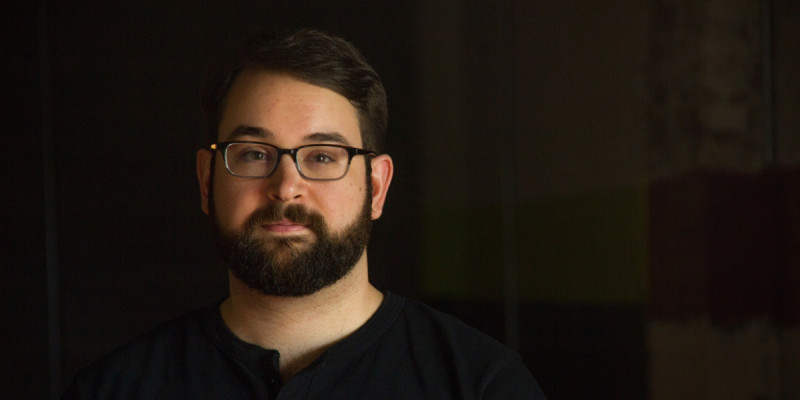
“It’s really great to see Binghamton supporting this and looking at AI in the arts and humanities fields. I think AI is important to all of us right now because it’s pervasive in all of our lives right now,” said James Budinich, one of the grantees and a lecturer in composition and creative sound technology. “While we are constantly asked to use AI, it is important to find ways to use AI more ethically, as a partner in creative or research-based processes, rather than simply churning out original research and creation.”
This year, four projects were funded to explore the various ethical, philosophical, and creative implications of AI in the humanities and other artistic endeavors:
1. “Algorithms, composition, and improvisation: new generative collaborations using sensory percussion instruments and machine learning”
This collaboration between Budinich and Assistant Professor of Music Gregory Evans uses artificial intelligence and improvisation to enable generative AI to respond to live performance data in real time, becoming a new musical “partner” for human instrumentalists.
The project, which received $12,530, includes a fall workshop as well as a live performance that will premiere at Binghamton University, then in Ithaca, New York City, with guest violist Stephanie Griffin. Budinich expects no two performances will be the same.
“Every time it’s played, it takes on a whole new rawness, a whole new identity. I think that’s interesting, because it might change the way we think about musical documentation, the role of performance, and how AI can help with that,” Budinich said.
2. “AI as a movie system”
The more generative AI advances, the more artists may feel like they only have one of two options: embrace it completely or reject it completely. A collaboration between Magdalena Bermudez and Jason Bernagozzi, assistant professors in the Department of Film Studies, aims to address this gap in adoption and usage. More specifically, they plan to research ways to help creators maintain their independence as artists while using AI technology.
Bermudez and Bernagozzi will raise $37,500 in funding to develop a responsive machine learning system that conversationally combines historical and modern film and audio techniques with other AI tools.
3. “Against Detection: Exploring Human and Machine Vision through Print-Based Practices.”
How much can AI actually recognize? Are there aspects of creation that are fundamentally human that machines can’t really understand or touch? The project is a collaborative effort between the Faculty of Arts and Design, and the Faculty of Digital Studies and Data Studies, and will experiment with different types of artwork, from wearables to painted surfaces, to see what thwarts algorithmic interpretation and what remains ‘irreducibly human’.
Researchers use printmaking techniques to generate three classes of images. Prints that computer vision can’t classify, images that humans and machines perceive differently, traditional works of art that are detectable but incomprehensible.
This project is a collaboration between art and design faculty members Christopher Swift and Alexandros Skouras, and digital and data studies faculty members Ruth Carpenter and Gregory Hallenbeck. Received $32,000.
4. “How does generative AI read literature?: Designing the RAG benchmark for social knowledge.”
Throughout history, literature has been an important indicator of social knowledge. Fiction allows readers to grapple with moral conundrums, diverse perspectives, and other pressing cultural or philosophical issues. This is a practice that builds empathy and critical thinking skills, which are especially important in times of division.
This project is a collaboration with Junting Huang, assistant professor of comparative literature. Sujoy Sikdar, Assistant Professor, Department of Computing. William Hayes, assistant professor of psychology, will investigate how generative AI systems interpret literary novels. The team plans to curate at least 30 literary works from around the world to test how multiple search augmentation generation (RAG) configurations work against more than 150 annotated question-answer pairs.
The goal of the project, which received $17,500, is to test how good AI is at interpreting literature and where it might fall short.
Funding for these research projects will be provided over an 18-month period. The Provost Award for Research Grants is made possible thanks to a special gift fund established by New York State that matches individual donations to the Binghamton University Foundation.
“This is a huge deal to me. This is a really great resource that the chancellor has created for Binghamton faculty,” Budinich said. “This is taking my practice in a whole new direction. Without this funding, I would not have had the opportunity to really focus on this project.”