
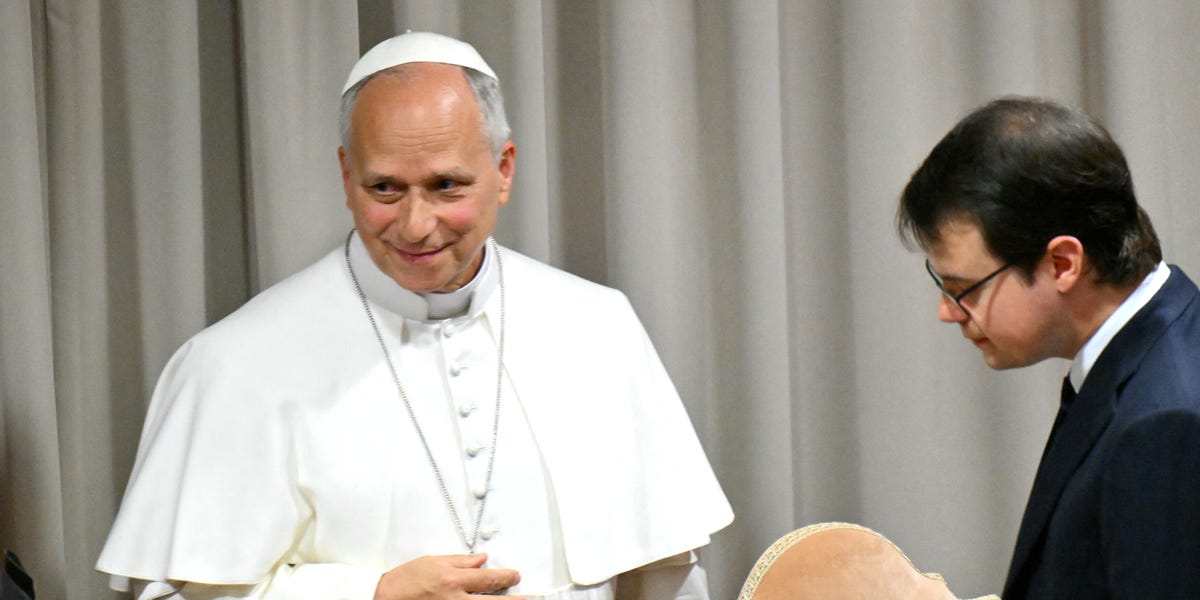
In a lengthy speech on AI released on Monday, Pope Leo XIV said: It’s a wake-up call for everything from mass job losses to Big Tech’s takeover of AI.
The Pope’s first encyclical, a major letter to the Church setting out the Pope’s thinking on moral or social issues, is a 245-paragraph text entitled “Magnifica humanitas: On the protection of humans in the age of artificial intelligence.”
AI leaders lobbied the Vatican ahead of the release of the letter, and Anthropic co-founder Chris Oler spoke in Vatican City after the Pope released the letter.
The Pope also thanked Ola and vowed to cooperate.
“I accept your invitation to work together, to listen, to speak, to work together to find a way for humanity to live in the age of artificial intelligence,” the Pope said.
In his extensive work, Pope Leo warned about autonomous weapons, the environmental impact of AI, and the risks it poses to human connections. He also made it clear that he does not think artificial intelligence is “inherently evil.”
While many of the concerns raised by the Pope in Monday’s letter echo points he has previously made and those raised by AI skeptics, the encyclical marks his major intervention in the always-contentious AI debate.
The main takeaways are:
1. AI should not be monopolized by Big Tech
Throughout his letter, Pope Leo repeatedly warned that the power of AI is becoming concentrated “in the hands of a few.”
The industry is dominated by major Big Tech companies such as Nvidia, Microsoft, Amazon, Google, Meta, OpenAI, and Anthropic.
Although the pope did not name specific companies, he warned that “major economic and technological actors” increasingly control platforms, infrastructure, data and computing power.
“When such power is concentrated in the hands of a few, it becomes opaque and tends to escape public scrutiny, increasing the risk of distorted forms of development that create new dependencies, exclusions, manipulations, and inequalities,” he wrote.
The Pope suggested that the Catholic principle of the “universal destination of goods,” which traditionally holds that all humans have an inherent right to natural resources such as air and water, should now be extended to algorithms, digital platforms and data.
The Pope also warned that “small but highly influential groups” could use AI to shape the democratic process and steer the economic system to their own benefit.
In his letter, Pope Leo called for AI to be “disarmed” from the competition for more powerful algorithms, larger data sets and commercial advantages.
Disarming AI, he wrote, “means liberating technology from monopolistic control and opening it up to discussion and debate, thereby making it human-friendly and returning it to the diversity of human cultures and ways of life.”
2. Message to AI developers
Pope Leo has issued a “special appeal” to AI developers.
He said developers “have certain ethical and spiritual responsibilities” because every design choice “reflects a vision of humanity.”
The Pope urged AI developers to develop systems that incorporate the values of transparency, responsibility and “great care to ensure that what is being cultivated is authentic.”
Pope Leo also warned against presenting AI systems as completely neutral and objective, when they often reflect and reinforce the biases of their creators.
3. We should all be worried about AI-related unemployment
The main theme of the letter was AI-related unemployment, with Pope Leo warning that mass unemployment could become a “real social disaster.”
Concerns that AI will crush the job market have been part of the debate since generative AI first began to take off. Some companies are blaming AI for recent layoffs, but not everyone agrees it will be a labor market disaster.
“Companies are realizing that AI has the potential to upskill their workforces rather than make them obsolete,” Stephen Parker, co-head of global investment strategy at JPMorgan Private Bank, told Business Insider this month.
In his letter, the Pope said that while it is “certainly desirable” for AI to make people’s jobs safer and easier, “employment opportunities and the protection of the irreplaceable role of individuals must remain the general principle.”
He wrote that “the pursuit of the greater good” cannot justify decisions to eliminate jobs.
Massive job losses due to AI risk creating “poverty of humanity and culture,” the Pope warned.
He argued that governments and businesses need to prepare for AI disruption before more jobs are lost.
“Any introduction of automation and AI must be accompanied by verifiable measures to protect worker employment, retraining, and participation,” he wrote.
This allows AI to focus on “freeing up human time and capacity rather than creating exclusion,” the Pope wrote.