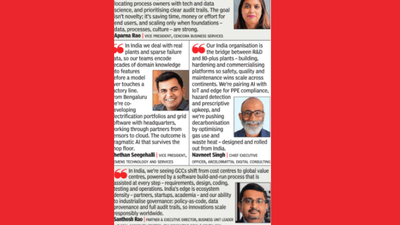
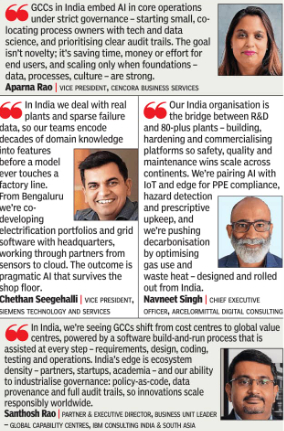
In developing practical AI solutions, the center of innovation is shifting to where the talent is. And India, with its deep pool of engineers and global competency centers, is a beneficiary of this trend. This is what experts working in some of India’s major GCCs told us in a webinar held in partnership with IBM last week.“Our team based in India does not create a proof of concept and then deliver it,” said Chesan Seegehari, vice president of Siemens Technology and Services. “From here, we co-develop world-class products and solutions with our headquarters and partners, and ship them to customers around the world. The rules we follow on the ground in India are simple: AI must be robust, democratized, and purposeful.” You can’t put experimental code on a factory line. We design for serviceability over replacement, build energy-efficient controls for buildings and data centers, and create software that can be used by both field technicians and configuration engineers.”
He added that India’s contribution will be within strict guardrails. “Our center is working on non-negotiables like accountability, accountability, safety, security, data governance and responsible use. Smart demos are the easy part, but thanks to our efforts in India, we are taking it to a production-grade level with guardrails,” he said.
–
Cutting carbon with software
From heavy industry, the achievements built and strengthened in India were highlighted. “We are not pursuing AI for AI’s sake,” said Navneet Singh, CEO of ArcelorMittal Digital Consulting, the steelmaker’s in-house technology consulting and delivery arm. “In our Indian organization, we are leveraging AI in our factories, combining it with IoT, cloud, and edge. Computer vision checks basic PPE (personal protective equipment) and assists crane operators in hot areas, vision systems catch surface defects early in the line, and prescriptive models reduce mean time to repair and increase uptime for operations that must operate 24/7. ” he said.All of these features have a significant impact on a steel mill’s carbon footprint. “If we treated steel mills as a ‘country’, they would rank as one of the largest emitters. We will use AI to optimize gas usage and waste heat recovery, and our team in India will build and commercialize the platform, allowing us to deploy the benefits to dozens of sites. That is the power that we can provide here at GCC,” said Singh.Agent AI systems are also being developed in these GCCs, but these powerful capabilities are still being piloted in India and incorporated into real-world workflows. “Agents will operate within clearly defined boundaries and people will oversee exceptions,” Singh said. “We perform human-involved proofing for finance, supply chain, and HR. No one allows agents to post directly to core ERP until accuracy and reliability exceed very high standards and cybersecurity and SOX controls are met.”Santhosh Rao, partner, executive director and business unit leader, GCC, IBM Consulting India & South Asia, said there is a parallel shift in the way software is built and managed from centers in India. “We are moving our clients from a standard software development lifecycle to an assisted lifecycle. Our India team’s goal is to help business analysts do more, help developers do more, and help testers do more. This is a massive expansion.””He emphasized that governance is built in when building enterprise-grade software and systems and is non-negotiable. “Responsible AI is a system, not a checklist. Fairness, robustness, privacy, data quality, provenance, and transparency must exist within the workflow. Clients want to know what data came from, who changed it, and why the model behaved the way it did. Our delivery team in India is operationalizing this with policies, audit trails, and controls as code running in our CI/CD pipeline,” he said.Aparna Rao, Vice President, Cencora Business Services, said that across the GCC, real initiatives in India include embedding AI in core operations and executing them responsibly. Cecora is a global healthcare company that markets pharmaceutical products and provides services that span logistics, market access, and patient solutions. In India, GCC acts as a hub for digital and technology services, where process owners work alongside data scientists and engineering teams to industrialize use cases under strict governance. “Our job in India is to co-locate process owners, technology teams and data scientists to ensure that models are trained on the right problems and change management is kept abreast. “The aim is not to chase novelty, but to ensure that AI saves end users time, money and effort, and leaves a clear audit trail for every decision,” Rao said.She cautioned against expecting AI to fix weak foundations. “If the delivery model is broken or the culture is misaligned, AI will only magnify the dysfunction. Indian centers are putting as much effort into the foundations – data preparation, process quality and people – as they are into the model.”