Agent-based systems in artificial intelligence are systems in which AI agents autonomously perform tasks within a digital environment. Developing intelligent agents that can understand complex instructions and dynamically interact with their environment poses significant technical challenges. A common problem in agent design is the reliance on advanced programming techniques. Traditionally, agents have been built using code-intensive methods that require familiarity with specific APIs and often limit flexibility. Such approaches can stifle innovation and accessibility, and limit the potential applications of AI agents outside their specialized areas.
Existing research includes the integration of LLMs such as GPT-4 and thought chain prompts in agent systems to enhance planning and interaction. Frameworks like LangChain refine agent behavior and enable more responsive task management. Innovations by researchers used structured prompts to effectively guide agent behavior and applied these models to complex scenarios such as open-world games. These models and frameworks demonstrate a significant shift toward more adaptive and intuitive AI architectures, facilitating dynamic responses and detailed task execution in a variety of environments.

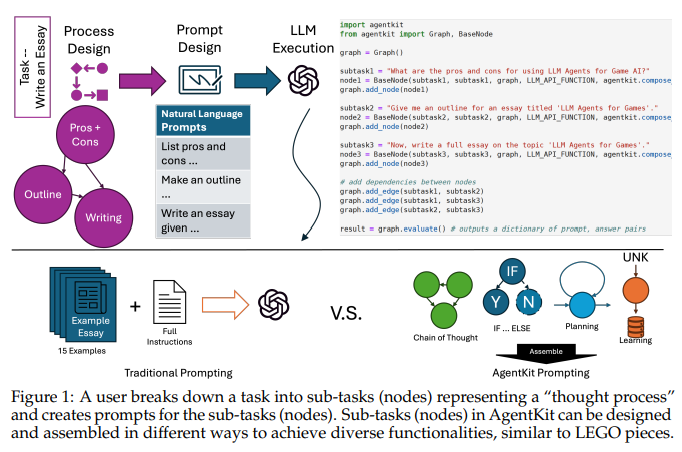
In a joint effort, researchers from Carnegie Mellon University, NVIDIA, Microsoft, and Boston University have introduced AgentKit, a framework that allows users to build AI agents using natural language instead of code. This method is unique because it employs a graph-based design, where each node represents a subtask defined by a linguistic prompt. This structure allows complex agent behaviors to be combined in an intuitive manner, increasing user accessibility and system flexibility.

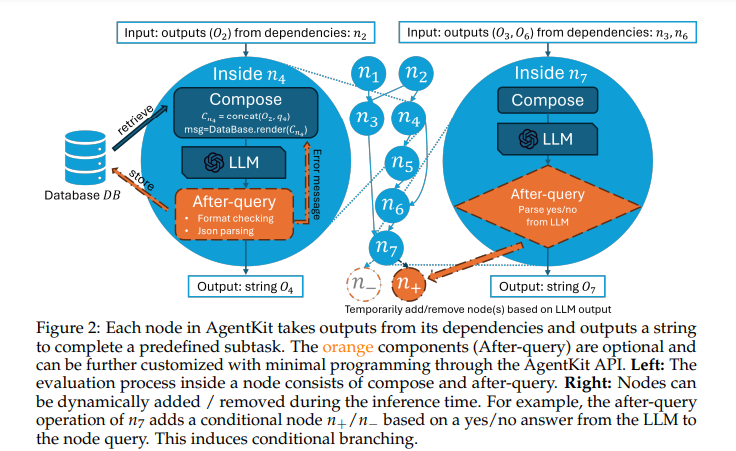
AgentKit employs a structured methodology to map each task to a directed acyclic graph (DAG) node. These nodes, representing individual tasks, are interconnected based on task dependencies to ensure logical progression and systematic execution. As mentioned earlier, nodes utilize LLM, specifically GPT-4, to interpret natural language prompts and generate responses. The framework dynamically adjusts these nodes during execution, allowing them to respond to changes in the environment and task demands in real time. The output of each node is fed to subsequent nodes to maintain a continuous and efficient workflow. This methodology aims at both flexibility in task management and accuracy in performing complex sequences of operations.
In testing, AgentKit significantly improved task efficiency and adaptability. For example, the Crafter game simulation improved his task completion by 80% compared to existing methods. In the WebShop scenario, AgentKit achieved 5% higher performance than state-of-the-art models, demonstrating its effectiveness in a real-time decision-making environment. These results confirm AgentKit's ability to manage complex tasks through an intuitive setup. They demonstrate real-world applicability across different application domains, achieving robust and visible improvements in agent-based task execution.

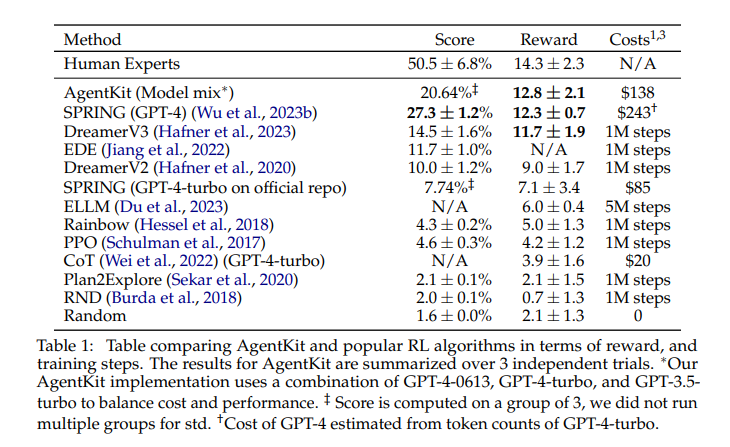
In conclusion, AgentKit represents a significant advance in AI agent development, simplifying the creation of complex agents through natural language prompts rather than traditional coding. AgentKit allows users to dynamically build and modify AI behavior by integrating graph-based design with large-scale language models such as his GPT-4. This framework has been successfully applied to various scenarios such as gaming and e-commerce, demonstrating its effectiveness and versatility. This study highlights the potential for intuitive and accessible AI technology to be widely adopted across a variety of industries.
Please check Paper and Github. All credit for this study goes to the researchers of this project.Don't forget to follow us twitter.Please join us telegram channel, Discord channeland linkedin groupsHmm.
If you like what we do, you'll love Newsletter..
Don't forget to join us 40,000+ ML subreddits
Learn more about content partnerships here Please fill out the form here.


Nikhil is an intern consultant at Marktechpost. He is pursuing an integrated dual degree in materials from the Indian Institute of Technology, Kharagpur. Nikhil is an AI/ML enthusiast and is constantly researching applications in areas such as biomaterials and biomedicine. With a strong background in materials science, he explores new advances and creates opportunities to contribute.