Analysis of the video revealed several visual discrepancies and patterns consistent with AI generation
Since Thursday, multiple users, mostly believed to be pro-Iranian accounts, have been sharing videos claiming that an Iranian attack caused an explosion at the headquarters of Israel’s elite foreign intelligence agency Mossad in Tel Aviv. However, the clips are generated by AI.
The Middle East war has entered its 35th day with no signs of slowing down. The conflict began on February 28, 2026, when the United States and Israel conducted coordinated airstrikes targeting Iranian military infrastructure, including missile systems and nuclear facilities. The strike marked a significant escalation in tensions between the two countries following growing instability in the region and past conflicts.
Iran responded with missile and drone strikes targeting Israel, U.S. military bases and other locations in the region. On March 17, 2026, several senior Iranian officials were killed in targeted attacks, including National Security Secretary Ali Larijani and Basij commander Gholamreza Soleimani.
How it all started
On April 2nd, the X account, which frequently shares AI-generated content based on past posts, shared a video of huge smoke billowing from a skyscraper. “Breaking news: Mossad headquarters in Tel Aviv completely evaporated,” the caption reads.
The post received over 2 million views.
A pro-Iranian account also shared the same video with the caption: “For the love of all the Holy Ones, please tell me this is true.”
The post received 1.7 million views.
The post was further amplified by multiple other accounts on X, as seen here , here , here , and here , garnering more than 18,000 views in total.
Iranian state media Tasnim News Agency He also shared the same video with the caption, “Mossad headquarters in Tel Aviv destroyed. Iranian forces destroy Mossad headquarters in Tel Aviv with precise strikes.”
The post garnered over 15,000 views.
methodology
A fact-check has been initiated to determine the veracity of this claim. This is due to the widespread nature of the claims and the strong public interest in the ongoing conflicts in the Middle East.
Analysis of the video revealed several visual discrepancies. First, in the viral clip, the car is seen moving unaffected by such a large explosion. Second, the smoke column rises in a very uniform formation without natural dispersion. This conflicts with the dynamics of real-world fires.
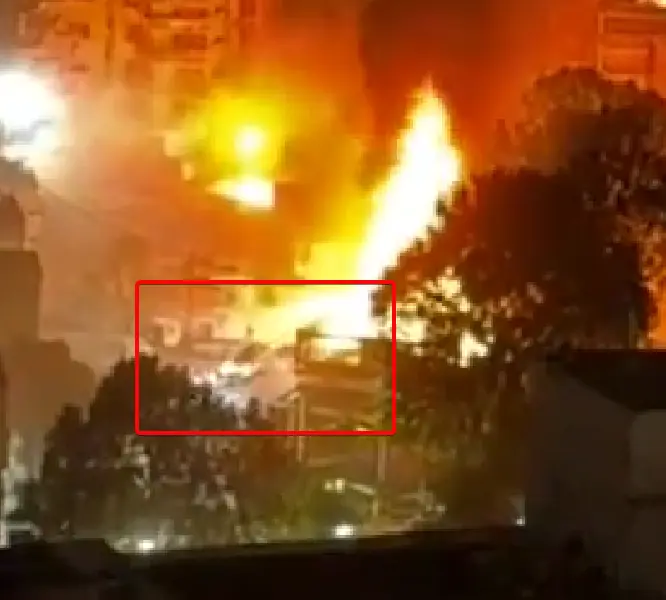
Additionally, as seen in the viral video, an explosion this intense can cause stronger lighting changes and flickering reflections across multiple surfaces, all of which are absent from the clip.
When I ran this clip through an AI detection tool, Undetectable AI flagged it as 96% AI-generated, while Detect Video returned inconclusive results.

A reverse image search of this clip found an Instagram post dated March 4, 2026 that shared the same video.

“Breaking News: New shelling was reported in Tehran, with explosions echoing in multiple neighborhoods overnight. Thick smoke is rising over parts of the horizon as authorities assess the extent of the damage.
The caption reads: “Details of casualties have not yet been officially confirmed and the situation remains fluid.”
Further results led to an X post dated March 1, 2026, by an Israeli journalist, featuring images from the same video and titled “Hit Tel Aviv and Haifa. Casualties. Huge boom in Jerusalem.”
The same clip was also found in a threaded post dated February 28, 2026, where the same video was shared. However, the video was missing the same detail as the viral clip: the building was missing.
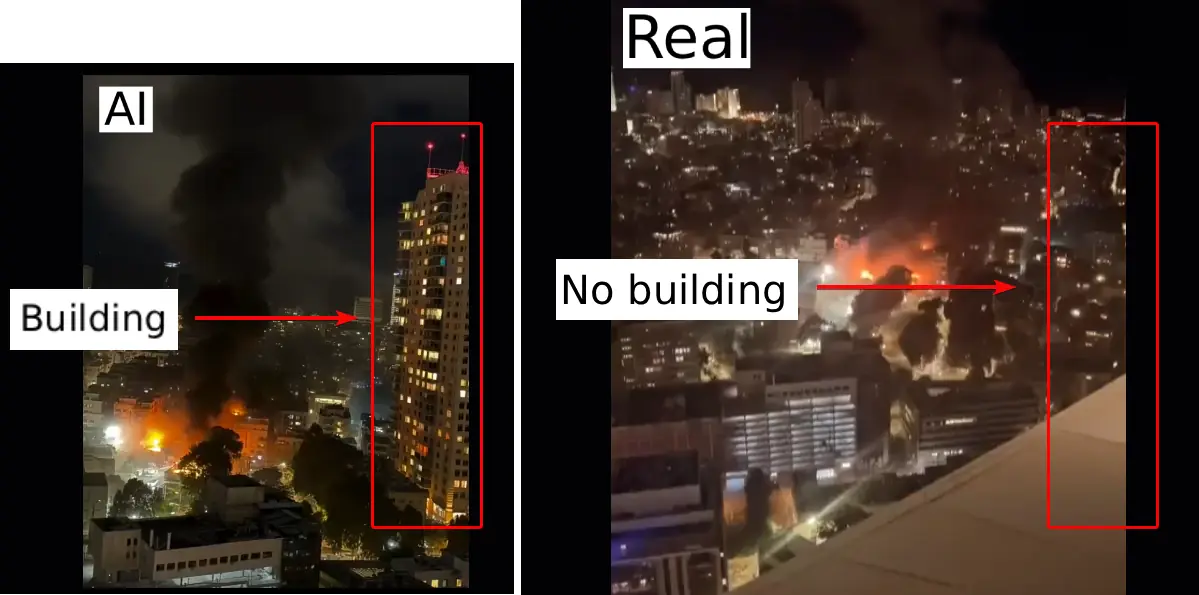 This proved that videos circulating on X since April 2nd exhibited visual patterns consistent with AI generation.
Furthermore, a keyword search did not reveal any reliable international media reports reporting the attack on Mossad headquarters.
Fact check status: False
The claim that there is a viral clip showing an explosion at Mossad headquarters in Tel Aviv is false.
The video is generated by AI.
————————
This fact check was originally published by iVerify Pakistan, a project of CEJ-IBA and UNDP.