
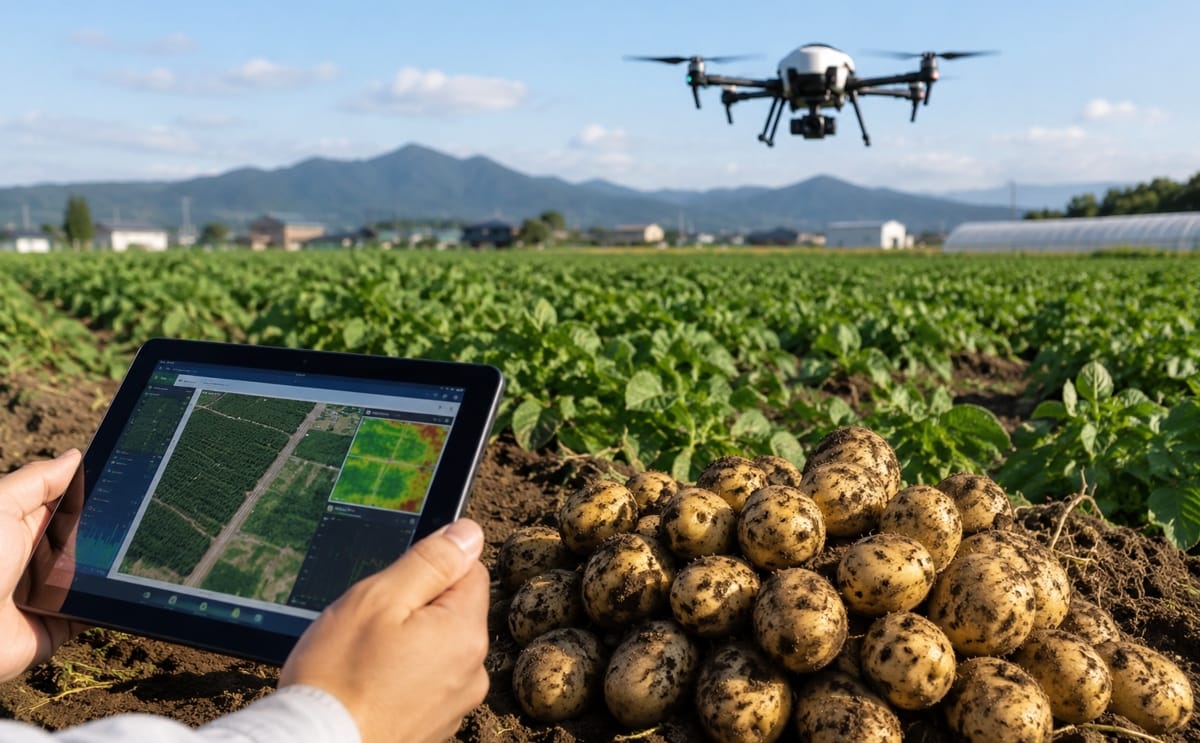
Researchers at the University of Tokyo Graduate School of Agricultural and Life Sciences and Kubota Corporation have developed a new phenotyping method that uses drones, artificial intelligence (AI), and crop growth modeling to predict potato yield before harvest. The technology allows researchers and growers to estimate underground tuber biomass without digging up the plants, providing a non-destructive approach to yield prediction and precision agriculture.
This study combines drone-based remote sensing, machine learning, and a time-series growth model to estimate potato tuber development throughout the growing season. This project, carried out under a joint initiative of the Kubota University of Tokyo Laboratory, demonstrates the potential of AI-based field phenotyping for crops with underground harvest organs.
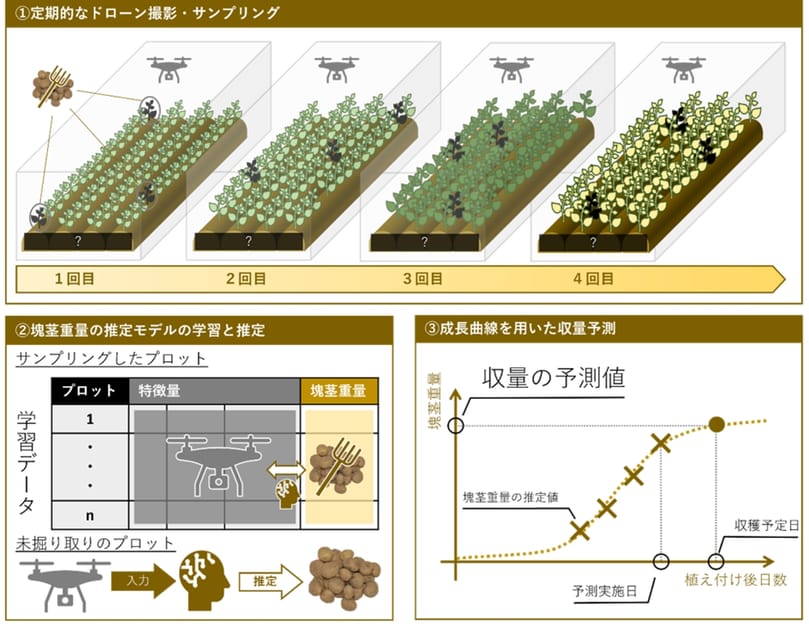
Pipeline for predicting tuber yield
Drone imagery combined with machine learning
As part of the study, drones equipped with RGB and multispectral cameras regularly photographed potato fields during the growing season. The researchers extracted several crop growth indicators from the images at the plot level, including:
- Plant coverage
- canopy height
- color index
- vegetation index
These image features were combined with belowground tuber biomass measurements collected by field sampling to train a machine learning model. Once trained, the model estimated tuber biomass in unharvested plots using only drone-derived image data.
According to the researchers, this approach provides a practical alternative to traditional destructive sampling methods that require digging up plants to estimate yield.
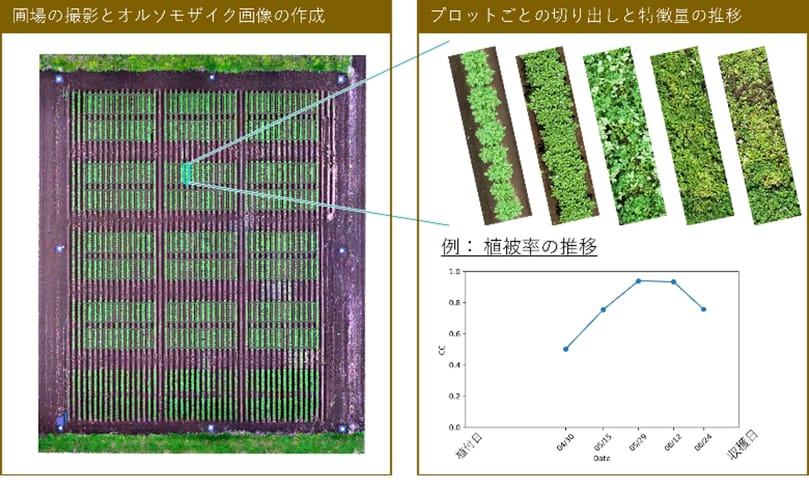
Observation of potato fields using drone images RGB and multispectral images from drones were used to obtain growth indicators such as vegetation coverage, canopy height, and vegetation index at the field scale.
Yield prediction is possible using a growth curve model
To predict final yield, the estimated belowground biomass data were integrated into a Gompertz growth curve, an S-shaped mathematical model commonly used to describe biological growth over time.
By applying time series estimates generated through machine learning to a growth model, researchers were able to predict potato yields before harvest while accounting for crop development throughout the season.
This study demonstrates that combining remote sensing and growth modeling can improve the accuracy of preharvest yield estimation and support more informed crop management decisions.
Two years of field trials show promising results
The study was conducted at the University of Tokyo Field Science Center in Nishitokyo during the 2023 and 2024 growing seasons. Multiple treatment plots with different planting densities and seed potato conditions were evaluated to test the system under different cultivation methods.
According to the research team,
- Correlation coefficients above 0.8 were obtained for tuber biomass estimation.
- Final yield prediction using growth curves resulted in correlation coefficients greater than 0.7.
These results confirm that combining ground drone observations and AI-based analysis can accurately estimate below-ground potato yields before harvest.
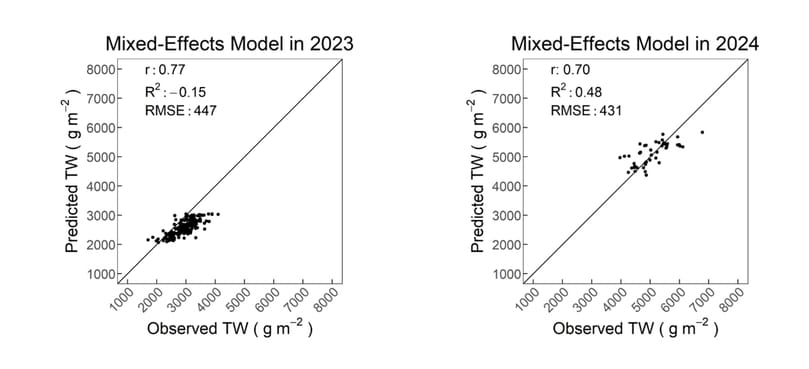
Verification of yield prediction accuracy using growth curves Comparison results between tuber weights estimated from growth curves and true values measured at harvest.
Supporting smart agriculture
Potatoes are one of the world’s most important food crops, but because the tubers develop underground, yield monitoring during the growing season has traditionally relied on destructive sampling. The newly developed method provides a non-destructive alternative to capture spatial changes across the field while preserving the crop.
Researchers believe this technology could support a variety of precision agriculture applications, including:
- Pre-harvest yield prediction
- Optimization of cultivation management
- Improved field monitoring
- Recommended harvest time
- AI-based crop phenotyping
The researchers also noted that the approach could be applied to other crops with harvestable organs below ground, potentially expanding the use of drone-based remote sensing and AI in smart agriculture.
research team
This research was led by University of Tokyo doctoral student Hiroto Imachi, Professor Hiroyoshi Iwata, and Associate Professor Guo Wei, and was conducted jointly by researchers from Kubota Corporation’s Next Generation Research Department, Masahiro Okada of Sarabetsu Forecasting Co., Ltd., and Peter M. Block, a former University of Tokyo project assistant professor currently affiliated with Eindhoven University of Technology.
The researchers expect this technology to contribute to more accurate pre-harvest yield predictions, improved cultivation management, and the continued advancement of AI-enabled precision agriculture in potato production.


