


Software pricing is the most obvious part of AI Video Pilot. This will appear on your pricing page, invoice, or credit balance.
The less visible costs begin when the first results arrive.
The marketing manager must determine whether the scene represents the overview. Brand critics look at people, settings, and implicit claims. Someone has requested another version. The editor prepares the approved draft for the live channel. The final approver will ask which files are current and what has changed between versions.
Work does not disappear because it was quick or cheap to produce. For companies deciding whether to scale AI video, the useful question is not “How much does one clip cost?” It’s, “What do I need to create one approved asset for this particular job?”
Pilot ledger contains 5 costs
Small pilots require a complete ledger rather than subscriptions and credits.
The initial cost is easy preparation. The team must define the audience, message, source material, visual boundaries, and prohibited details. A weak draft will move these decisions to the generator, where they will be difficult to control.
The second one is generation. Records model, mode, settings, number of runs, and credits consumed. Failed outputs remain part of the cost even if they never reach the approver.
The third one is review. Someone needs to examine the visual claims implied by people, products, text, locations, sequences, and scenes. A 5-second clip may include some decisions the brand would never have made.
The fourth one is revision. This may include new prompts, different source images, different generations, or legacy edits. “One More Version” is not free just because you have a sufficient credit balance.
The fifth one is production takeover. Selected drafts may require verified text, captions, sound, branding, different aspect ratios, poster frames, and channel approval.
Pilots that only record secondary costs measure tools, not business processes.
Two-prompt test shows where problems appear
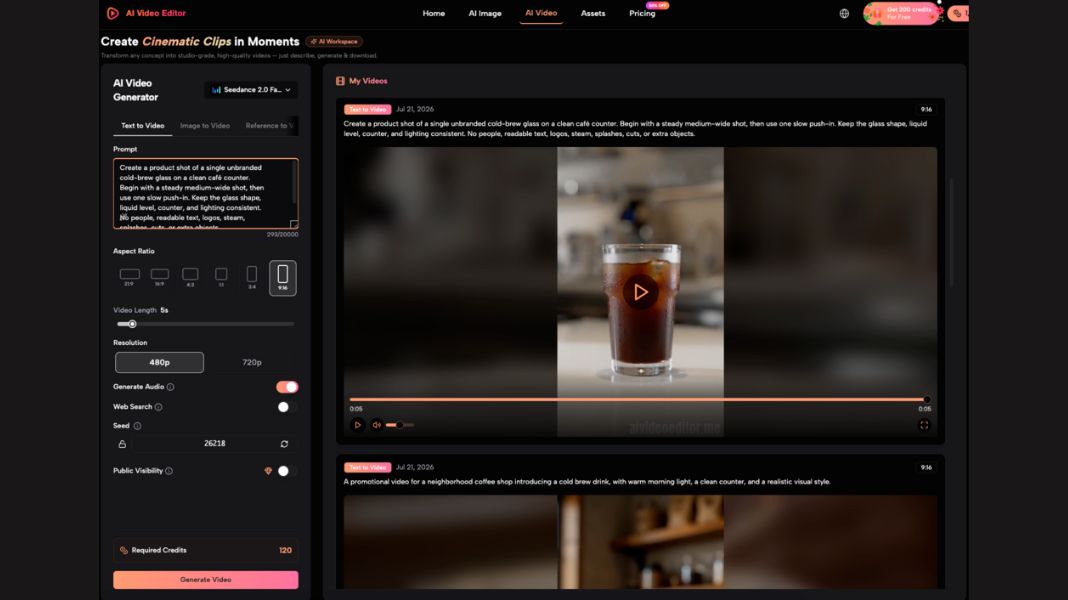
For our hypothetical neighborhood coffee shop pair test, we used the AI video editor’s Text to Video mode for both outputs, Seedance 2.0 Fast, 9:16 setting, 5 seconds duration, and 480p option in the interface. This test cannot substantiate cost-per-video claims because exact credits and production times are not recorded.
The initial prompts were broad-based.
A promotional video for a neighborhood coffee shop showcasing warm morning light, clean counters, and cold brew drinks in a realistic visual style.
As a result, the “promotional video” was interpreted as a small production sequence. It showed a hand operating the pour-over setup, coffee beans being added, coffee being poured over ice, and a hand holding out the finished glass. The warm atmosphere and cold beer theme matched the brief. The generator also selected people, props, actions, shot changes, and preparatory stories.
These choices are not automatically flawed. Cafes may like human preparation sequences. Another brand might reject it because the process doesn’t match their recipe, it requires hand approval, or the campaign requires a simple product photo.
The second prompt describes more narrow requirements.
Create a product shot of a single unbranded cold brew glass on a clean cafe counter. Start with a steady medium wide shot, then use one slow push-in. Keep the shape of the glass, liquid level, counter, and lighting constant. No people, readable text, logos, steam, splashes, cuts, or extraneous objects.
In the second output, a single glass was placed in the center of the counter and gradually moved closer. No people, readable text, logos, steam, splashes, cuts, or extra foreground objects were visible throughout the samples taken throughout the clip. The glass, liquid level, counter, and background remained visually stable, but small ice details were still worth checking as the camera approached.
A useful finding is that longer prompts do not always produce better videos. That is, the two prompts created different approval tasks. The broader version required teams to evaluate the invented stories. The constrained version required a more specific overview and another generation, but produced a narrower object to review in this test.
That trade-off is documented in the ledger.
 Budget approval paths before scaling
Before the marketing team decides edit videos online As part of your regular workflow, you need to identify people between draft and publication.
A simple responsibility map can prevent hidden queues.
- Marketing owners approve messages and channels.
- Brand owner approves visual identity and prohibited elements.
- Subject matter experts review the impact of the facts.
- The editor prepares channel-enabled assets.
- The final approver approves or rejects the version.
Not every 5-second social concept requires 5 meetings. The key is knowing what decisions exist and who owns them. If one person is responsible for multiple roles, record that as well. Small teams aren’t exempt from approval work either. They just focus it.
Set up revision rules. For example, allow two planned generations and one backup run in case of technical failures. If neither planning result meets the acceptance criteria, stop and reconsider the outline instead of generating endless variations.
Stopping rules protect both credit and attention. It also prevents pilots from being judged solely by the best-looking output found after an unknown number of attempts.
Report business decisions
At the end of the pilot, administrators should receive more than just a folder of clips. The report should give you an answer like this:
- Which content jobs were tested?
- How many planned and unplanned generations were needed?
- Which review issue did you see?
- What manual production work remains?
- What claims or forms were excluded?
- Should the workflow scale, remain conceptually limited, or stop?
The paired coffee test confirms the cautious conclusion. In one documented case, adding constraints changed the review burden. It does not prove universal productivity gains, guaranteed cost savings, or superior performance over other platforms.
It is important to suppress it. The purpose of the pilot is not to justify purchases that have already been made. The idea is to expose the complete process early enough so that companies can decide whether it’s worth repeating the workflow.


