

Bullish on AI opportunities in 2026

At a recent sharing session on “Technology Empowerment and Capital Breakthrough” hosted by Gelonghui, Mr. Kong Rong, Deputy Director and Overseas Research Chief Analyst of Guolian Minsheng Research Institute, provided an in-depth analysis on global AI development trends, major technological advances, and market opportunities.
He pointed out that despite recent market concerns and divisions such as whether AI is in a bubble and whether capital investment can be sustained, he remains optimistic about the direction of AI development from 2026 onwards, based on continued observations of overseas technology frontiers and China's AI ecosystem.
01. AI competition will intensify next year!
 Is there a bubble in AI? What are the opportunities for next year? These are the most discussed questions in the market over the past two months.
The correction in stock prices brought about by the US earnings season has raised questions in the market about the sustainability of increased capital spending from 2025 to 2027.
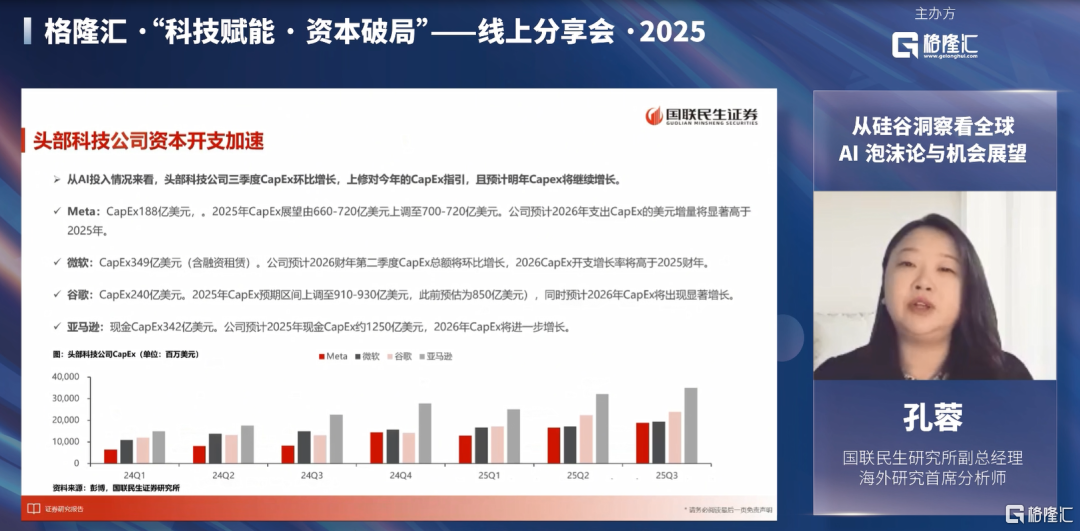
Kong Rong said he remains optimistic about AI opportunities in 2026 and beyond, based on continued observations of overseas technology frontiers and China's AI ecosystem.
This year, breakthroughs in multimodal models, represented by Google's Gemini series, have injected strong confidence into the market through continuous model iteration.
Among them, Google, with its full-stack self-research ability, long-term technology accumulation, and abundant capital resources, has great staying power in this marathon.
Meta experienced organizational restructuring and personnel adjustment in 2025, resulting in insufficient market confidence, but after consolidating resources and hiring top AI talent, it is expected to introduce a competitive model in 2026, which has become a key focus.
Microsoft has begun developing its own models while maintaining its partnership with OpenAI. We should pay attention to the opportunities arising from subsequent efforts in large-scale models combined with Microsoft's ecosystem.
Although xAI started relatively late, its rapid development momentum and quick model iterations make it an important variable that cannot be ignored.
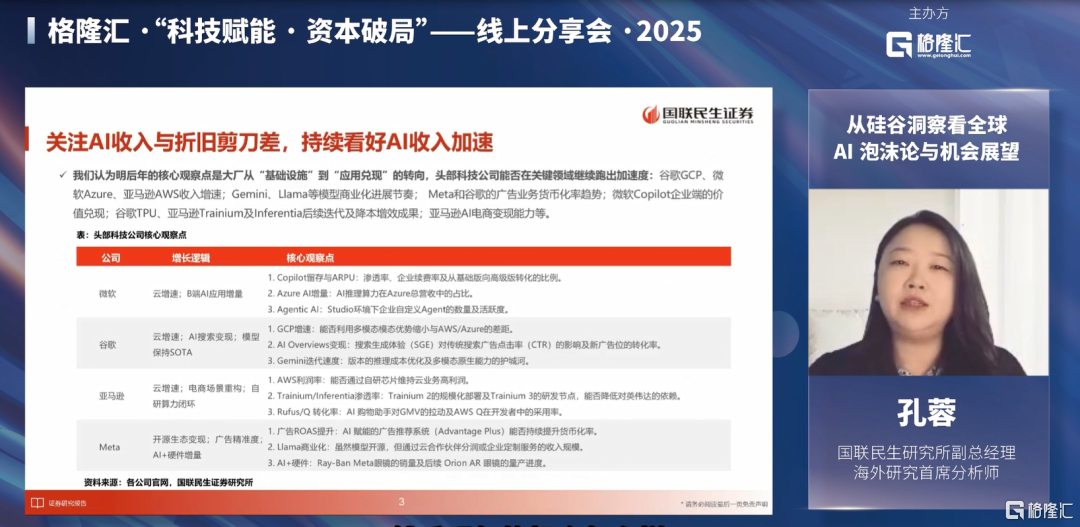
The pace of release of large models is expected to further accelerate next year. Industry giants such as OpenAI, xAI, Meta, Microsoft, and Google will continue to roll out new models, increasing competition within the industry.
Kong Rong predicts that rapid model iteration and continued improvements in computing power will provide a solid foundation for overall advancements in model capabilities by 2026.
However, we also emphasized that a fast pace and large number of releases do not necessarily lead to a strong model. Enhancements to computing support are expected in 2026, and the market is increasingly focused on continued improvements in the capabilities of large models.
02, two important elements
In 2026, the continued evolution of model capabilities will be particularly important in two aspects.
The first is enhanced multimodal functionality.
This feature is not only a core element of content creation for movies, television, and short videos, but its scope extends far beyond that.
On the other hand, enhanced multimodal understanding and generation capabilities will revolutionize content production models and the efficiency of advertising and e-commerce.
More importantly, it is also the key to upgrading the experience and expanding the market for end-user devices such as AI hardware and AR/VR glasses.
Previously constrained by poor multimodal capabilities and a lack of hardware content ecosystem, these enhancements will significantly enhance the user experience and accelerate hardware adoption.
Looking ahead to 2027, improvements in multimodal capabilities will lead to stronger potential capabilities on the device side and in the evolution of AI, which will also improve the user experience and create opportunities across directions and sectors.
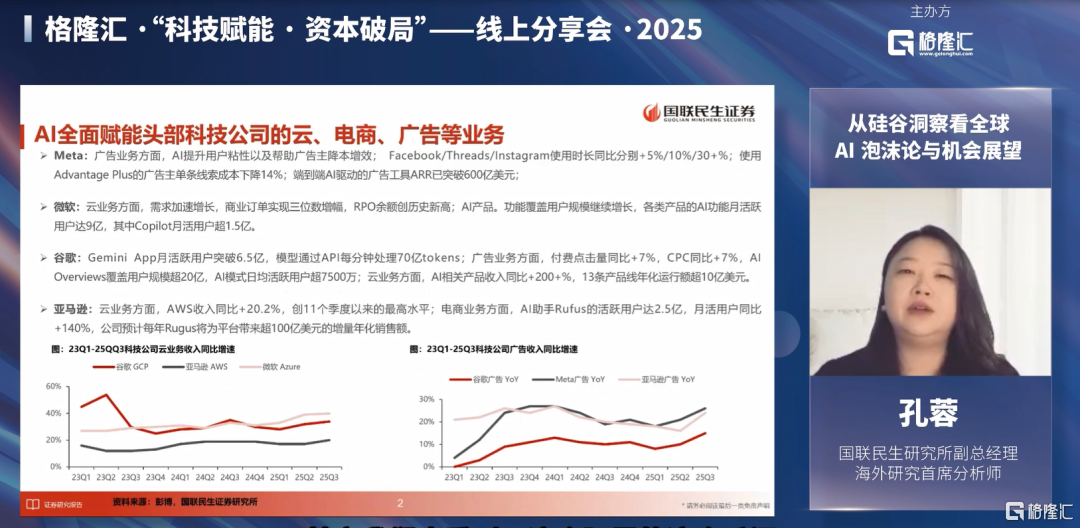
The second breakthrough involves memory and personalization capabilities.
AI is evolving from a general-purpose tool to a “personal assistant.” Enhancements to the model's memory capabilities (long context, personalized memory) allow us to provide more customized and personalized services that better meet user needs.
This will significantly improve application scenarios, user retention, usage frequency, and adoption rates, directly driving increased token consumption and providing a clear path to commercial returns for the large capital expenditures previously made.
Improving model capabilities is fundamental to driving commercial implementation of AI.
Commercial opportunities increase as AI generates more implementable scenarios, and integration with different scenarios makes implementation opportunities increasingly clear.
This year, everyone has already witnessed that the market space is larger than expected.
Leading model companies continue to focus on and invest heavily in this area, which is expected to become one of their core implementation directions with a high degree of certainty by 2026.
03, Another important main thread
As the capabilities of models improve, application scenarios for AI are expanding from virtual content to the broader physical world.
Autonomous driving is also a relatively important major theme.
Large model technology is accelerating the process of achieving highly automated driving. Taking Tesla FSD as an example, the experience has become increasingly smooth and reliable, and unmanned operation in localized areas (e.g., eliminating the safety driver) has begun.
Directions regarding autonomous driving will therefore also be a key focus in the coming year.
Looking ahead to next year, it will be a gradual and gradual process, whether it's the speed of model releases, improving model functionality, or the range of model application scenarios.
How do market rhythms change during this process?
Overall expectations are likely to continue to rise as more models are released. Investments are in the driver's seat, continuously driving expectations and valuations higher.
However, industrial development is a gradual process and adjustments may occur along the way.
Industry progress continues despite market concerns, and new opportunities may emerge once the market corrects.
Kong Rong believes that there is a rhythm gap between market sentiment and industry development, and that this wave of AI development will not happen overnight.
Its development path is different from the “explosive growth” of the Internet era. This resembles a step-by-step, gradual process that unfolds sequentially across different scenarios.
04. China's opportunities
Kong Rong expressed strong optimism regarding China's AI ecosystem and investment opportunities.
In the global AI race, China has demonstrated the competitiveness and unique advantages of its robust ecosystem.
First, the capabilities of domestic large-scale models are widely recognized internationally. Open source models such as DeepSeek and Alibaba's Qwen have received high praise from the global developer community, demonstrating the high level of technological capabilities of domestically produced models.
Second, big technology companies are firmly committed to long-term investments. Companies such as Alibaba and Tencent not only disclosed their future AI capital investment prospects in their financial reports, but also implemented corresponding organizational restructuring, reflecting their commitment to sustained investment.
Additionally, China boasts the world's largest pool of engineers, a culture of rapid product iteration, and rich application scenarios. The “application innovation'' capability proven in the mobile Internet era is expected to be replicated in areas such as content, hardware, and autonomous driving in the AI era, creating a wealth of investment opportunities.
Finally, valuation has its benefits. Compared to their US peers, the current valuations of Chinese AI-related companies are more reasonable and even relatively low, providing a better margin of safety for investment.
Whether viewed in terms of current infrastructure, computing power, or scenario-based applications, China's performance in looking to future opportunities is commendable.
In the cycle of industrial development, in the era of the Internet and mobile Internet, Chinese enterprises have finally enjoyed more prosperous opportunities.
Kong Rong frankly stated that China has more engineers, faster product iteration cycles, and coupled with the continuous improvement of model capabilities, the opportunities for AI applications in China will also increase significantly.


