- STMicro expects revenue of $17 billion to $17.8 billion in 2023, representing growth of 5% to 10% over 2022.
- The Silicon Carbide (SiC) substrate manufacturing facility in Catania will meet the continued demand as silicon carbide (SiC) for EVs is growing significantly.
- By 2023, revenue from SiC is expected to be around $1.2 billion, and by 2024 the majority of substrates will be sourced internally.
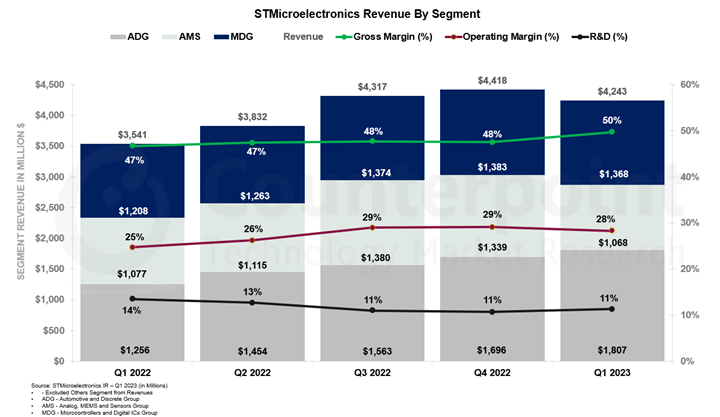
STMicro’s Q1 2023 Net Revenues of $4.25 Billion, Up 19.8% Year-Over-Year, Driven Primarily by Strong Demand from Automotive and Industrial Segments, Partially Offset by Lower Personal Electronics Revenues reached. Revenues from factory automation, robotics and building management increased and new orders normalized. STMicro plans to source the majority of its substrates in-house by 2024 as it continues to ramp up production of silicon carbide front-end devices at its Singapore facility. The company’s gross margin improved to 300bps year-on-year in Q1 2023, and QoQ improved to his 220bps. This was net of hedging due to favorable pricing and improved product mix, partially offset by higher manufacturing input costs.
- car: The automotive sector continues to gain momentum, fueled by EV adoption and a surge in semiconductor integration. STMicro has won multiple design contracts for SiC, silicon MOSFET, on-board charging MCU and zone controller solutions from multiple electric vehicle manufacturers. STMicro has won several design contracts for SPC5 microcontrollers for vehicle dynamics, airbag, anti-theft applications, and body control in the traditional automotive sector. The traditional automotive sector remains dynamic for now, as silicon integration continues to expand.
- Industrial: In the industrial segment, demand surged due to the digitization of devices and the need for improved power and energy efficiency. STMicro has won multiple design contracts in the industrial sector, providing system solutions consisting of power discrete, power management and STM32 microcontrollers used in renewable energy applications, smart meters, smart grid applications, intelligent power switches, motor drivers, Industrial sensors and safety solutions for applications such as industrial automation, asset tracking and server power. STMicro also introduced the MCU Edge-AI Developer Cloud, which includes an online benchmarking service for Edge-AI models on STM32 boards.
- Personal Electronics: STMicro’s products such as NFC controllers, secure elements, wireless charging, MEMS sensors and time-of-flight sensors are the choice of leading smartphone and wearable device manufacturers. In the communications and computer equipment sector, STMicro has won several design contracts for LEO satellites and computer peripherals such as secure solutions, time-of-flight sensors, microcontrollers and ASICs for communications infrastructure.
Segment profit
- Automotive and Discrete (ADG): First quarter 2023 revenue was $1.807 billion, up 43.9% year over year across both the automotive and power discrete segments.
- Analog, MEMS, Sensors (AMS): Q1 2023 revenue was $1,068 million, down slightly 0.9% year-over-year in the Analog, MEMS and Imaging segments.
- Microcontrollers and Digital ICs (MDG): Q1 2023 revenue was $1,368 million, with 13.2% year-over-year growth in both the microcontroller and RF communications segments.
- forecastQ2 2023 Net Sales Projected at Approximately $4.28 Billion, Up 0.8% in QoQ, a Potential Deviation of 350 Basis Points. Additionally, forecast revenue for 2023 is expected to be $17.0 billion to $17.8 billion, reflecting 5% to 10% year-over-year growth, driven primarily by the automotive and industrial sectors.
- Supply and demand: High demand in the automotive, industrial power and energy sectors continued in Q1 2023. This was driven by the continued consolidation of semiconductors and the normalization of orders from the factory and automation sectors. However, at the end of the first quarter of 2023, he had $2.87 billion in inventory, compared to $2.15 billion in the same period last year. Days of inventory sales at the end of the quarter were 122 compared to 104 in Q1 2022. In the automotive segment, demand surged across all regions, primarily due to increased use and restocking of semiconductors. The backlog is now up to about six quarters by the midpoint of 2023, which is higher than usual but consistent with diverse end-market segments.
- Capital expenditures and investments: Capital spending was $1.09 billion in the first quarter of 2023, up from $840 million in the year-ago quarter. The company plans to invest approximately $4 billion, with 80% of the investment going toward expanding his 300mm wafer production and continuing to ramp up his SiC front-end device manufacturing in Catania and Singapore. The company also plans to increase its back-end manufacturing capacity in Morocco and China.
Conclusion
Despite supply chain constraints, STMicro has made great strides leveraging its impressive portfolio and capitalizing on strong demand in the automotive sector. The partnership between STMicro and Global Foundries is expected to increase production capacity to 620,000 wafers per year by 2026. In addition, STMicro has signed a multi-year supply agreement with ZF to provide silicon carbide for its modular inverter architecture, which is scheduled to go into production in 2020. 2025. To further diversify raw material procurement, STMicro implements smart technology to reduce the cost of solutions at the board level.