
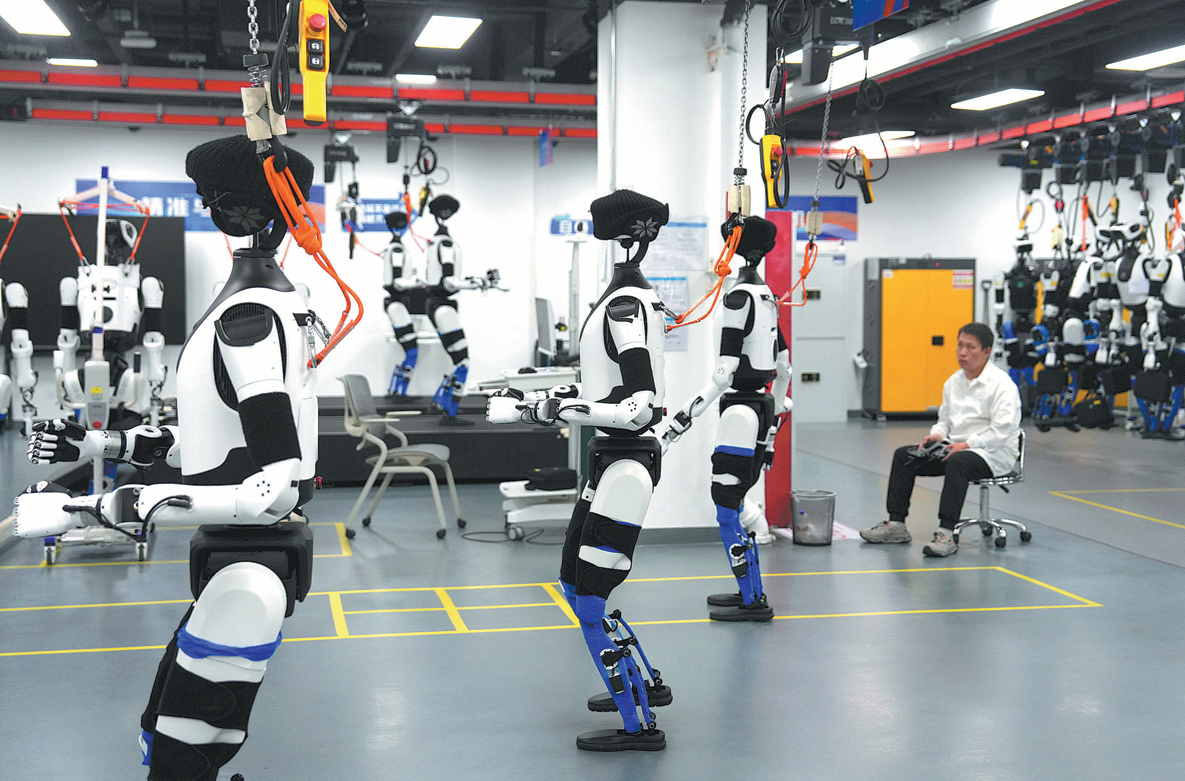
On June 12, a humanoid robot was tested at the Beijing Humanoid Robot Innovation Center in the Beijing Economic and Technological Development Zone. [HE GUANXIN/FOR CHINA DAILY]
Artificial intelligence has evolved from machine learning to deep learning, becoming a transformative force that is increasingly shaping our society. However, this also raises concerns about ethics, governance, and human rights.
At the AI Impact Summit held in New Delhi, India in February, we considered the problems brought about by the rapid spread of AI from the perspective of democratizing access to AI resources, which can be considered a new right. According to this new right, AI must have a clear social orientation towards fundamental areas such as education, health and agriculture, and technological security must regulate applications that pose existential risks.
It was in this context that UN Secretary-General António Guterres said: “The future of artificial intelligence will not be decided by a few countries or left to the whims of a few billionaires.”
The human side of this debate is the focus of Pope Leo
He warns that “never before have humans had such power over themselves,” as emerging technologies are woven into the fabric of everyday life, shaping decision-making processes and deeply influencing our collective imagination.
This is already a reality, thanks to the opening of new technologies, which the Pope described as “horizons expanding in directions that can be imagined but not yet fully foreseen,” affecting national security, industrial policy, and trade, and shaping a new geopolitical scenario: the New World Order.
The impact of AI on human rights is therefore one of the defining challenges of our time.
International and regional frameworks such as UNESCO’s Recommendations on the Ethics of Artificial Intelligence, the Organization for Economic Co-operation and Development’s AI Principles, and the European Parliament’s Guidance consistently emphasize human rights, non-discrimination, transparency, accountability and respect for human dignity throughout the AI lifecycle.
However, significant challenges still remain. There is currently no universal regulatory framework for the use of AI. Regulatory initiatives like the European Union’s AI law are important. China has also contributed to international discussions through the Global AI Governance Initiative, which emphasizes human-centered approaches and international cooperation. In Latin America, further regulations governing AI are being adopted at the national level.
However, the reality is that AI crosses borders in the digital realm, and the limits of AI applications will ultimately be determined by the introduction of more advanced AI systems.
Under the influence of algorithms and AI decisions, human rights can be subordinated to efficiency, algorithmic bias, and false perceptions of objectivity.
The protection of human rights depends on the ability and willingness of states and their governments to exercise their power in this regard. However, humanity appears to be losing its ability to make decisions, resolve conflicts, and prevent environmental catastrophe. We are in danger of shifting power to those who control technology, or worse, allowing technology itself to decide what is best for humanity.
The next question is whether robots should be given “human” rights, or whether, as some researchers predict, humanity is destined or destined to evolve into a race of humans and machines, or machines and humans, modeling new societies that incorporate new rights, new personalities, and thus a new intelligent social contract, replacing the traditional Rousseauian social contract and replacing existing moral, legal, social, economic, and political norms.
Given these scenarios, the real challenges posed by the rise of AI are not just technical, but deeply human. This means ensuring that the expansion of AI strengthens individuals and contributes to the common good, without compromising human dignity, individual autonomy, democratic values, the essence of the nation, and the fundamental rights that are the foundation of society.
The author is a former Prime Minister and former Minister of Justice and Human Rights of the Republic of Peru.
The views do not necessarily reflect those of China Daily.
If you have specific expertise or would like to share your opinion about our articles, please send your articles to opinion@chinadaily.com.cn and comment@chinadaily.com.cn.


