
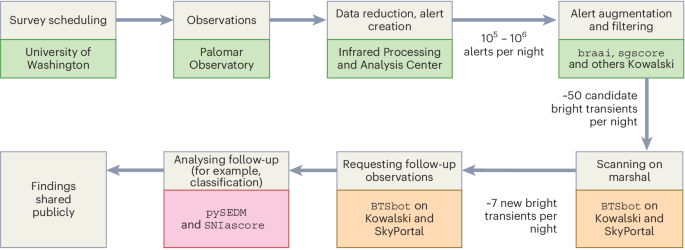
Bellm, E. C. et al. The Zwicky Transient Facility: system overview, performance, and first results. Publ. Astron. Soc. Pac. 131, 018002 (2019).
Google Scholar
Tonry, J. L. et al. ATLAS: a high-cadence all-sky survey system. Publ. Astron. Soc. Pac. 130, 064505 (2018).
Google Scholar
Smith, K. W. et al. Design and operation of the ATLAS transient science server. Publ. Astron. Soc. Pac. 132, 085002 (2020).
Google Scholar
Ivezić, Žea LSST: from science drivers to reference design and anticipated data products. Astrophys. J. 873, 111 (2019).
Google Scholar
Bloom, J. S. et al. Automating discovery and classification of transients and variable stars in the synoptic survey era. Publ. Astron. Soc. Pac. 124, 1175 (2012).
Google Scholar
Brink, H. et al. Using machine learning for discovery in synoptic survey imaging data. Mon. Not. R. Astron. Soc. 435, 1047–1060 (2013).
Google Scholar
Wright, D. E. et al. Machine learning for transient discovery in Pan-STARRS1 difference imaging. Mon. Not. R. Astron. Soc. 449, 451–466 (2015).
Google Scholar
Goldstein, D. A. et al. Automated transient identification in the Dark Energy Survey. Astron. J. 150, 82 (2015).
Google Scholar
Duev, D. A. et al. Real-bogus classification for the Zwicky Transient Facility using deep learning. Mon. Not. R. Astron. Soc. 489, 3582–3590 (2019).
Google Scholar
Ayyar, V., Knop, R., Awbrey, A., Andersen, A. & Nugent, P. Identifying transient candidates in the Dark Energy Survey using convolutional neural networks. Publ. Astron. Soc. Pac. 134, 094501 (2022).
Google Scholar
Chen, Z. et al. TransientViT: a novel CNN-vision transformer hybrid real/bogus transient classifier for the Kilodegree Automatic Transient Survey. Preprint at https://arxiv.org/abs/2309.09937 (2023).
Kim, D.-W., Yeo, D., Bailer-Jones, C. A. L. & Lee, G. Deep transfer learning for the classification of variable sources. Astron. Astrophys. 653, A22 (2021).
Google Scholar
Cabrera-Vives, G. et al. Domain adaptation via minimax entropy for real/bogus classification of astronomical alerts. Preprint at https://arxiv.org/abs/2308.07538 (2023).
Gupta, R., Muthukrishna, D., Rehemtulla, N. & Shah, V. Transfer learning for transient classification: from simulations to real data and ZTF to LSST. Mon. Not. R. Astron. Soc. 542, L132–L138 (2025).
Google Scholar
Moreno-Cartagena, D. et al. Leveraging pre-trained visual transformers for multi-band photometric light curve classification. Preprint at https://arxiv.org/abs/2502.20479 (2025).
Akeson, R. et al. The Wide Field Infrared Survey Telescope: 100 Hubbles for the 2020s. Preprint at https://arxiv.org/abs/1902.05569 (2019).
Miller, A. A. et al. The La Silla Schmidt Southern Survey. Publ. Astron. Soc. Pac. 137, 094204 (2025).
Google Scholar
Förster, F. et al. The Automatic Learning for the Rapid Classification of Events (ALeRCE) alert broker. Astron. J. 161, 242 (2021).
Google Scholar
Möller, A. et al. FINK, a new generation of broker for the LSST community. Mon. Not. R. Astron. Soc. 501, 3272–3288 (2021).
Google Scholar
Fraga, B. M. O. et al. Transient classifiers for Fink: benchmarks for LSST. Astron. Astrophys. 692, A208 (2024).
Google Scholar
Matheson, T. et al. The ANTARES astronomical time-domain event broker. Astron. J. 161, 107 (2021).
Google Scholar
Nordin, J. et al. Transient processing and analysis using AMPEL: alert management, photometry, and evaluation of light curves. Astron. Astrophys. 631, A147 (2019).
Google Scholar
Williams, R. D. et al. Enabling science from the Rubin alert stream with Lasair. RAS Technol. Instrum. 3, 362–371 (2024).
Google Scholar
Tachibana, Y. & Miller, A. A. A morphological classification model to identify unresolved PanSTARRS1 sources: application in the ZTF real-time pipeline. Publ. Astron. Soc. Pac. 130, 128001 (2018).
Google Scholar
Andreoni, I. et al. Fast-transient searches in real time with ZTFReST: identification of three optically discovered gamma-ray burst afterglows and new constraints on the kilonova rate. Astrophys. J. 918, 63 (2021).
Google Scholar
Smith, K. W. et al. Lasair: the transient alert broker for LSST:UK. Res. Notes Am. Astron. Soc. 3, 26 (2019).
Google Scholar
Street, R. A., Bowman, M., Saunders, E. S. & Boroson, T. General-purpose software for managing astronomical observing programs in the LSST era. Proc. SPIE 10707, 1070711 (2018).
Coulter, D. A. et al. YSE-PZ: a transient survey management platform that empowers the human-in-the-loop. Publ. Astron. Soc. Pac. 135, 064501 (2023).
Google Scholar
van der Walt, S. J., Crellin-Quick, A. & Bloom, J. S. SkyPortal: an astronomical data platform. J. Open Source Softw. 4, 1247 (2019).
Google Scholar
Coughlin, M. W. et al. A data science platform to enable time-domain astronomy. Astrophys. J. Suppl. Ser. 267, 31 (2023).
Google Scholar
Gomez, S. et al. FLEET: a redshift-agnostic machine learning pipeline to rapidly identify hydrogen-poor superluminous supernovae. Astrophys. J. 904, 74 (2020).
Google Scholar
Gomez, S. et al. Identifying tidal disruption events with an expansion of the FLEET machine-learning algorithm. Astrophys. J. 949, 113 (2023).
Google Scholar
Stein, R. et al. tdescore: an accurate photometric classifier for tidal disruption events. Astrophys. J. Lett. 965, L14 (2024).
Google Scholar
Sheng, X. et al. NEural Engine for Discovering Luminous Events (NEEDLE): identifying rare transient candidates in real time from host galaxy images. Mon. Not. R. Astron. Soc. 531, 2474–2492 (2024).
Google Scholar
Stevance, H. F. et al. The ATLAS virtual research assistant. Astrophys. J. 990, 201 (2025).
Google Scholar
Rehemtulla, N. et al. The Zwicky Transient Facility Bright Transient Survey. III. BTSbot: automated identification and follow-up of bright transients with deep learning. Astrophys. J. 972, 7 (2024).
Google Scholar
Steeghs, D. et al. The Gravitational-wave Optical Transient Observer (GOTO): prototype performance and prospects for transient science. Mon. Not. R. Astron. Soc. 511, 2405–2422 (2022).
Google Scholar
Killestein, T. L. et al. Kilonova seekers: the GOTO project for real-time citizen science in time-domain astrophysics. Mon. Not. R. Astron. Soc. 533, 2113–2132 (2024).
Google Scholar
Guidorzi, C. et al. The automatic real-time gamma-ray burst pipeline of the 2 m Liverpool Telescope. Publ. Astron. Soc. Pac. 118, 288–296 (2006).
Google Scholar
Cenko, S. B. et al. The automated Palomar 60 inch telescope. Publ. Astron. Soc. Pac. 118, 1396–1406 (2006).
Google Scholar
Miranda, N. et al. SNGuess: a method for the selection of young extragalactic transients. Astron. Astrophys. 665, A99 (2022).
Google Scholar
Rehemtulla, N. et al. The BTSbot-nearby discovery of SN 2024jlf: rapid, autonomous follow-up probes interaction in an 18.5 Mpc type IIP supernova. Astrophys. J. 985, 241 (2025).
Google Scholar
Gehrels, N. et al. The Swift gamma-ray burst mission. Astrophys. J. 611, 1005–1020 (2004).
Google Scholar
Soumagnac, M. T. et al. The MOST hosts survey: spectroscopic observation of the host galaxies of ~40,000 transients Using DESI. Astrophys. J. Suppl. Ser. 275, 22 (2024).
Google Scholar
Frohmaier, C. et al. Tides: The 4MOST time domain extragalactic survey. Astrophys. J. 992, 158 (2025).
Google Scholar
DESI Collaboration et al. The DESI Experiment part I: science, targeting, and survey design. Preprint at https://arxiv.org/abs/1611.00036 (2016).
de Jong, R. S. et al. 4MOST: project overview and information for the first call for proposals. Messenger 175, 3–11 (2019).
Google Scholar
Boone, K. Avocado: photometric classification of astronomical transients with Gaussian process augmentation. Astron. J. 158, 257 (2019).
Google Scholar
Muthukrishna, D., Narayan, G., Mandel, K. S., Biswas, R. & Hložek, R. RAPID: early classification of explosive transients using deep learning. Publ. Astron. Soc. Pac. 131, 118002 (2019).
Google Scholar
Villar, V. A. et al. SuperRAENN: a semisupervised supernova photometric classification pipeline trained on Pan-STARRS1 medium-deep survey supernovae. Astrophys. J. 905, 94 (2020).
Google Scholar
Qu, H., Sako, M., Möller, A. & Doux, C. SCONE: supernova classification with a convolutional neural network. Astron. J. 162, 67 (2021).
Google Scholar
Gagliano, A., Contardo, G., Foreman-Mackey, D., Malz, A. I. & Aleo, P. D. First impressions: early-time classification of supernovae using host-galaxy information and shallow learning. Astrophys. J. 954, 6 (2023).
Google Scholar
Shah, V. G., Gagliano, A., Malanchev, K., Narayan, G. & The LSST Dark Energy Science Collaboration. ORACLE: a real-time, hierarchical, deep-learning photometric classifier for the LSST. Preprint at https://arxiv.org/abs/2501.01496 (2025).
Möller, A. & de Boissière, T. SuperNNova: an open-source framework for Bayesian, neural network-based supernova classification. Mon. Not. R. Astron. Soc. 491, 4277–4293 (2020).
Google Scholar
Möller, A. et al. The Dark Energy Survey 5-yr photometrically classified type Ia supernovae without host-galaxy redshifts. Mon. Not. R. Astron. Soc. 533, 2073–2088 (2024).
Google Scholar
The PLAsTiCC team et al. The Photometric LSST Astronomical Time-series Classification Challenge (PLAsTiCC): data set. Preprint at https://arxiv.org/abs/1810.00001 (2018).
Kessler, R. et al. Models and Simulations for the Photometric LSST Astronomical Time Series Classification Challenge (PLAsTiCC). Publ. Astron. Soc. Pac. 131, 094501 (2019).
Google Scholar
Narayan, G. & ELAsTiCC Team. The Extended LSST Astronomical Time-series Classification Challenge (ELAsTiCC). In American Astronomical Society Meeting Abstracts Vol. 241, 117.01 (The American Astronomical Society, 2023).
Li, W. et al. StarEmbed: benchmarking time series foundation models on astronomical observations of variable stars. Preprint at https://arxiv.org/abs/2510.06200 (2025).
Fremling, C. et al. The Zwicky Transient Facility Bright Transient Survey. I. Spectroscopic classification and the redshift completeness of local galaxy catalogs. Astrophys. J. 895, 32 (2020).
Google Scholar
Perley, D. A. et al. The Zwicky Transient Facility Bright Transient Survey. II. A public statistical sample for exploring supernova demographics. Astrophys. J. 904, 35 (2020).
Google Scholar
Bellm, E. C. et al. The Zwicky Transient Facility: surveys and scheduler. Publ. Astron. Soc. Pac. 131, 068003 (2019).
Google Scholar
Masci, F. J. et al. The Zwicky Transient Facility: data processing, products, and archive. Publ. Astron. Soc. Pac. 131, 018003 (2019).
Google Scholar
Mahabal, A. et al. Machine learning for the Zwicky Transient Facility. Publ. Astron. Soc. Pac. 131, 038002 (2019).
Google Scholar
Patterson, M. T. et al. The Zwicky Transient Facility alert distribution system. Publ. Astron. Soc. Pac. 131, 018001 (2019).
Google Scholar
Ben-Ami, S. et al. The SED Machine: a dedicated transient IFU spectrograph. Proc. SPIE 8446, 844686 (2012).
Blagorodnova, N. et al. The SED machine: a robotic spectrograph for fast transient classification. Publ. Astron. Soc. Pac. 130, 035003 (2018).
Google Scholar
Kim, Y. L. et al. New modules for the SEDMachine to remove contaminations from cosmic rays and non-target light: BYECR and CONTSEP. Publ. Astron. Soc. Pac. 134, 024505 (2022).
Google Scholar
Rigault, M. et al. Fully automated integral field spectrograph pipeline for the SEDMachine: pysedm. Astron. Astrophys. 627, A115 (2019).
Google Scholar
Fremling, C. et al. SNIascore: deep-learning classification of low-resolution supernova spectra. Astrophys. J. Lett. 917, L2 (2021).
Google Scholar
Chaudhary, S. S. et al. Low-latency gravitational wave alert products and their performance at the time of the fourth LIGO-Virgo-KAGRA observing run. Proc. Natl Acad. Sci. USA 121, e2316474121 (2024).
Google Scholar
Kiendrebeogo, R. W. et al. Updated observing scenarios and multimessenger implications for the international gravitational-wave networks O4 and O5. Astrophys. J. 958, 158 (2023).
Google Scholar
Coughlin, M. W. et al. Optimizing searches for electromagnetic counterparts of gravitational wave triggers. Mon. Not. R. Astron. Soc. 478, 692–702 (2018).
Google Scholar
Coughlin, M. W. Lessons from counterpart searches in LIGO and Virgo’s third observing campaign. Nat. Astron. 4, 550–552 (2020).
Google Scholar
Wyatt, S. D. et al. The gravitational wave treasure map: a tool to coordinate, visualize, and assess the electromagnetic follow-up of gravitational-wave events. Astrophys. J. 894, 127 (2020).
Google Scholar
Tartaglia, L. et al. The early detection and follow-up of the highly obscured type II supernova 2016ija/DLT16am. Astrophys. J. 853, 62 (2018).
Google Scholar
Shrestha, M. et al. Extended shock breakout and early circumstellar interaction in SN 2024ggi. Astrophys. J. Lett. 972, L15 (2024).
Google Scholar
Rehemtulla, N. et al. Swift/UVOT observations of SN 2025qtt 6 minutes after its automatic discovery by BTSbot-nearby. Transient Name Server AstroNote 209 (2025).
Tohuvavohu, A. et al. Swiftly chasing gravitational waves across the sky in real time. Astrophys. J. Lett. 975, L19 (2024).
Google Scholar
Street, R. A. et al. The Astrophysical Events Observatories Network (AEON). Proc. SPIE 11449, 1144925 (2020).
Brown, T. M. et al. Las Cumbres Observatory Global Telescope network. Publ. Astron. Soc. Pac. 125, 1031 (2013).
Google Scholar
Steele, I. A. et al. The Liverpool Telescope: performance and first results. Proc. SPIE 5489, 679–692 (2004).
Kumar, H. et al. India’s first robotic eye for time-domain astrophysics: the GROWTH-India telescope. Astron. J. 164, 90 (2022).
Google Scholar
Huppenkothen, D. et al. Constructing impactful machine learning research for astronomy: best practices for researchers and reviewers. Preprint at https://arxiv.org/abs/2310.12528 (2023).


