
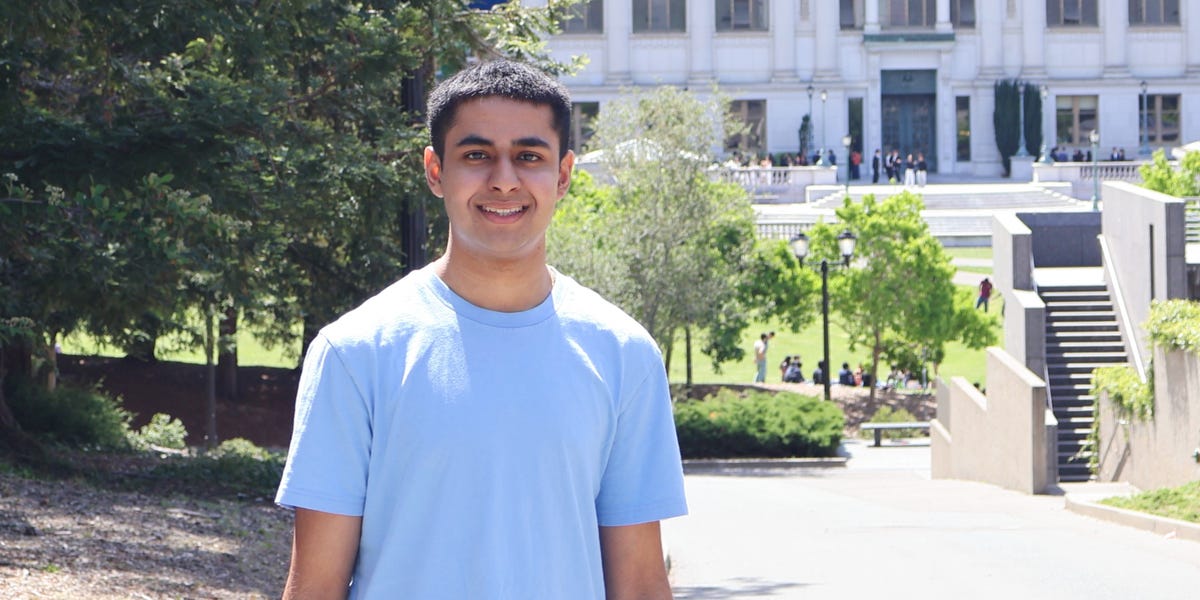
This told essay is based on a conversation with Adrit Rao, a freshman at the University of California, Berkeley. Before stepping foot on campus, he took a full-time job at Cognita, an AI medical company. His identity and employment have been confirmed by Business Insider. This story has been edited for length and clarity.
I was 8 years old when I discovered Scratch, a block-based programming language. I love playing video games and being able to put these blocks together and see my simple games come to life. I was immediately hooked.
Four years later, the pandemic was underway and school went online. I had a lot of free time, so I taught myself how to create apps by watching YouTube videos. A big thank you to all the content creators who have created these tutorials. You can learn anything online for free.
Once I got the hang of it, I realized that building apps was my passion. Around this time, Apple introduced the Swift Student Challenge, an annual app creation competition for students around the world. Even though I was completely new to Apple’s Swift programming language, I decided to give it a try anyway.
To my surprise, I was one of 350 winners and the youngest. I got to meet Tim Cook, CEO of Apple, and it was the most exciting and motivating experience. I told him about my projects, including an app I was building called ShopQuik to help my elderly neighbors avoid long waits at the grocery store.
Due to COVID-19, we spoke virtually, but he said he thought my app would have a big impact and wanted to meet in person someday.
Screenshot of a video chat between Apple’s 2020 Swift Student Challenge winner and CEO Tim Cook. Adrit Rao is second row, third from the left. apple
From there, we published five apps to the App Store. Age was not a barrier. It didn’t really matter that I was 12 years old, as long as I had a computer and a desire to solve problems. I didn’t have to rely on anyone. No investment was required. It was really a solo operation, so I was really excited.
The cold email that changed everything
I’ve always been interested in healthcare, so a year later I emailed Oliver Alami, a professor at Stanford University who has developed many healthcare apps. I told him that I am an app developer and that I would like to work with him. To my surprise, he wrote back the next morning and agreed.
For the next five years, I spent my free time working as a teaching assistant at Stanford University, helping undergraduate and graduate students build apps. We also collaborated with Stanford University researchers on two major projects, including an FDA-approved algorithm for detecting aneurysms in patients. Louis Blankemeyer, the CEO of the company I currently work for, was part of the team that built this company. He had a Ph.D. student at the time.
In the fall of 2025, when I was a high school senior, Louis sent me a Slack message telling me he was starting a company called Cognita that would build AI models, or “co-pilots,” to help radiologists do their jobs faster. He wanted to know if I would be interested in working there.
By then, I knew how to build AI models. I learned a lot from my research experience at Stanford University, reading research reports, and watching YouTube videos. I said I wanted to hear more. Professor Aalami took me to Cognita’s office, and he, Louis, and I discussed my future. Later that day, I got a call from Louis offering me a job. I accepted, but told him I was still going to college.
Dealing with rejection from Stanford University
I thought I would get into Stanford. I applied for a limited early action program and was denied. I felt like my dream had been shattered. Then I realized how random this college application process was. Too many qualified students are turned away.
In the end, it worked out because I got into Berkeley. You can always have your dream school, but life has many different paths. It’s not always best to have a predetermined path just because it’s comfortable. At Berkeley, I realized that I could explore new environments. If I had gone to Stanford, I would not have met the wonderful people I met across the bay. So now I’m at Berkeley and Stanford.
Currently, I’m a full-time technical product lead at Cognita and a freshman in college. It was very difficult to do both at first, but I found a way to make it work. Most students prefer afternoon and evening classes, so I signed up for the early morning class. After class, I have lunch and go to work until late at night, but I take a break to hang out with friends or play basketball.
Overall, my experience has shown me that immersing yourself in something you’re passionate about at a young age provides a very good foundation for the future. That, along with support from mentors like Professor Aalami, helped accelerate my career.
It is also important to focus on the present. I had no idea what would happen in the future. Good things happen when you are serious about learning something new. I’m kind of a lifelong learner. I started on YouTube and now I’m at Cognita and Berkeley.