When Reuben Birch describes the moment when artificial intelligence ceased to be theoretical, he begins on a tarmac in Memphis.
As chief engineer at FedEx Express in 2014, Birch helped launch one of the company’s first self-driving vehicle programs, a “sandbox autonomy” experiment focused on route planning and collision avoidance between planes, packages and people at FedEx’s largest hubs. This work put him on the cutting edge of machine learning before the term became a boardroom staple.
Now TCU’s vice president for research, Birch brings that perspective to TCU.
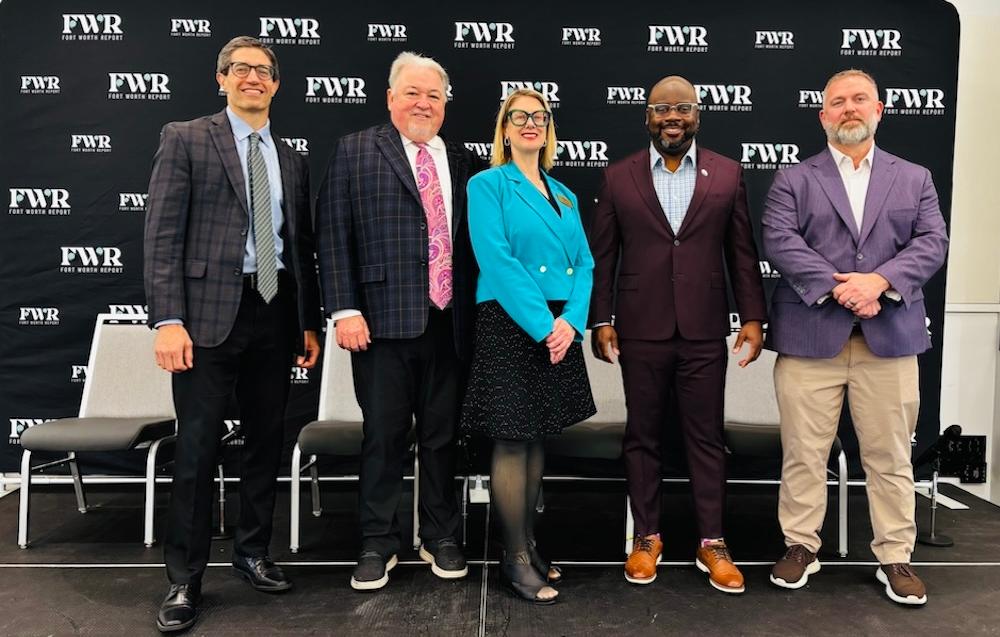
“Before I entered academia, everyone was panicking about what robots were going to do,” Birch told the audience at a spring AI panel he hosted. fort worth report. “I’ve spent a large part of my career explaining that we don’t want to take your job away, we want to give you a better job. And this is where AI comes in again.”
TCU’s response is AI², the university’s new artificial intelligence supercomputing infrastructure, which will provide all faculty and students with access to high-performance AI computing through a $10 million partnership with Dell and AWS.
Preparing students for the rapid economic landscape
The “Candid Conversations” panel featured a wide range of conversations about how Fort Worth educational institutions are positioning for an AI-driven future. Education featured throughout the discussion, with Birch arguing that the risks to students are immediate and real.
“If someone who knows AI is going to take your job, we’re all here because we want TCU students to get that job because they’re already blending and embedding AI into the classroom experience,” he said.
He considered promoting fluency to be a universal professional skill rather than a technical specialty.
“The one who prompts the best wins,” he said. “You don’t have to have a STEM degree to understand how prompts can impact your career.”
Birch spoke candidly about the responsibilities that come with that ability. He said teaching students how to use AI is similar to teaching them to drive a car, a powerful tool that requires ethics, judgment and an understanding of data privacy.
“There are many types of data, and if you accidentally share them, whether intentionally or not, you could get in trouble with the federal government.”
Students need to learn how to validate AI-generated answers instead of accepting them.
“Trust, but always check.”
Notes regarding promises
Burch issued a sharp warning to any organization moving toward AI adoption. This conversation cannot happen without a parallel conversation about cybersecurity.
“If you’re having a discussion about AI without having a cyber discussion, the outcome is not going to be positive,” he said, noting that many software packages incorporate AI through routine updates that organizations may not be aware of.
He also raised a concern that he said was, in his personal opinion, worth taking seriously: that as AI compresses schedules and raises expectations, high-performing employees could face accelerated burnout.
“Unlike before, we had to analyze the data, which could take days,” he said. “Now we have instant analysis, which puts our best talent at risk.”
Fort Worth as a test case
The panel moderator is fort worth report Editor Bob Francis also took advantage of Fort Worth’s public infrastructure. Kelly Baggett, Innovation Coordinator for the City of Fort Worth, outlined the city’s growing footprint in drone delivery and autonomous logistics. Birch’s background at FedEx provides a natural research relationship with TCU in this area. Fort Worth is one of the few cities that has already begun offering on-demand drone deliveries to residential areas.
“All deliveries by drone take cars off the road,” Baggett said. “Less traffic, fewer deaths, fewer carbon emissions, these have a synergistic effect.”
Carlo Capua ’00, former director of strategy and innovation for the city and current senior principal at the Rainwater Charitable Foundation, brought a philanthropic perspective to the conversation to consider how foundations and civic partners can work together to ensure that the introduction of AI does not exacerbate existing inequalities. He offered a complex defense of the change, citing research that shows young people are increasingly relying on AI rather than adults for emotional support.
“If young people had a choice between taking an AI class or having no one to listen to them, I would take an AI class every day,” Capua said. “But if you don’t train your human muscles, they will never develop.”
Adam Powell, president and CEO of United Way of Tarrant County, said the role of AI in the nonprofit sector is growing, including the potential to extend services to communities that have not previously had access to them. He ended the discussion by objecting to the occasion.
“We can be a thermometer, or we can be a thermostat,” Powell said. “We can focus on AI and these innovations, and if we do that well, I think we can make Fort Worth the most innovative city in the country.”
Throughout the discussion, Birch returned to the principles he follows both on the factory floor and in his research office. The idea was to start with the problem, not the technology.
“What problem are you trying to solve?” he said. “So, is it safe to use?”
For TCU, the $10 million investment in AI² is less a bet on technology and more a decision about how and where to lead.
–caroline collier