Business intelligence is now moving to bridge the gap between curious business users and data through AI-powered agents. This transformation is expected to remove traditional barriers that have plagued analytics for decades. We spoke to Matthew Miller, VP of Product Management at Tableau/Salesforce, about something called Tableau Next.
Miller, who has worked in and around the field of analytics for 27 years, describes what he calls a pivotal moment in the analytics world. “Data has traditionally been difficult; business stakeholders have no access to it,” he explains of the promise that has defined the industry since the late 1990s. “We’ve been chasing the dream of bridging the gap between curious people asking questions and the ability to actually get answers.”
Despite decades of innovation, this fundamental challenge still exists. Miller recalls working for a medical technology company in the Netherlands. There, business users and the people managing the data were separated by more than eight layers of bureaucracy. That complexity created bottlenecks rather than solutions, keeping valuable insights out of reach.
The new version of the Tableau platform, named Tableau Next, directly addresses this issue by embedding AI into the fabric of analytics, rethinking how organizations interact with data and how insights flow across the enterprise.
Capturing organizational knowledge through the semantic layer
One of the biggest barriers to data democratization is the loss of institutional knowledge. During a customer visit to Arendonck, Belgium, Miller met a veteran employee who had spent 25 years intuitively understanding what data actually meant. “As the dashboard was loading, this old guy said, ‘Do you want that table? No, no, that’s not it. We need to exclude code 999. That’s a test code,'” Miller recalls. “How could I have known that?”
It’s exactly this kind of tacit expertise that Tableau wants to capture and encode. The goal is to ensure that critical knowledge doesn’t remain locked in the heads of long-tenured employees. That’s where Tableau Next’s semantic layer comes into play.
Tableau Semantics forms the foundation of the platform’s intelligence capabilities. Enrich raw data with context and ensure cross-functional users speak the same business language. Clarify how data is generated, processed, and displayed through metadata modeling. Therefore, it builds trust in the analytical process and establishes a common ground for interpretation. “Essentially, we want to find that old guy among all our customers, translate everything he knows into semantics, and train that into a model,” Miller says.
Agent architecture with skills and semantics
The backbone of Tableau’s AI-driven approach is what Miller describes as “skills within the agent.” This architecture is structured to reflect the way humans naturally ask questions and perform tasks. Skills contain topics, topics contain actions, and actions are deterministic in nature. This layered setup allows the system to handle complex queries while remaining predictable and compliant.
“The power of large-scale language models is that these huge statistical models can pick up on inaccuracies in the language,” Miller explains. Whether a user is retrieving information or updating a record, agents understand their intent, even when expressed in natural conversational language.
Importantly, the agent framework respects the rules that organizations should follow. “Even when dealing with government compliance, agents follow policies around table joins and revenue recognition,” Miller emphasizes. The goal is not to bypass the process, but to intelligently navigate it.
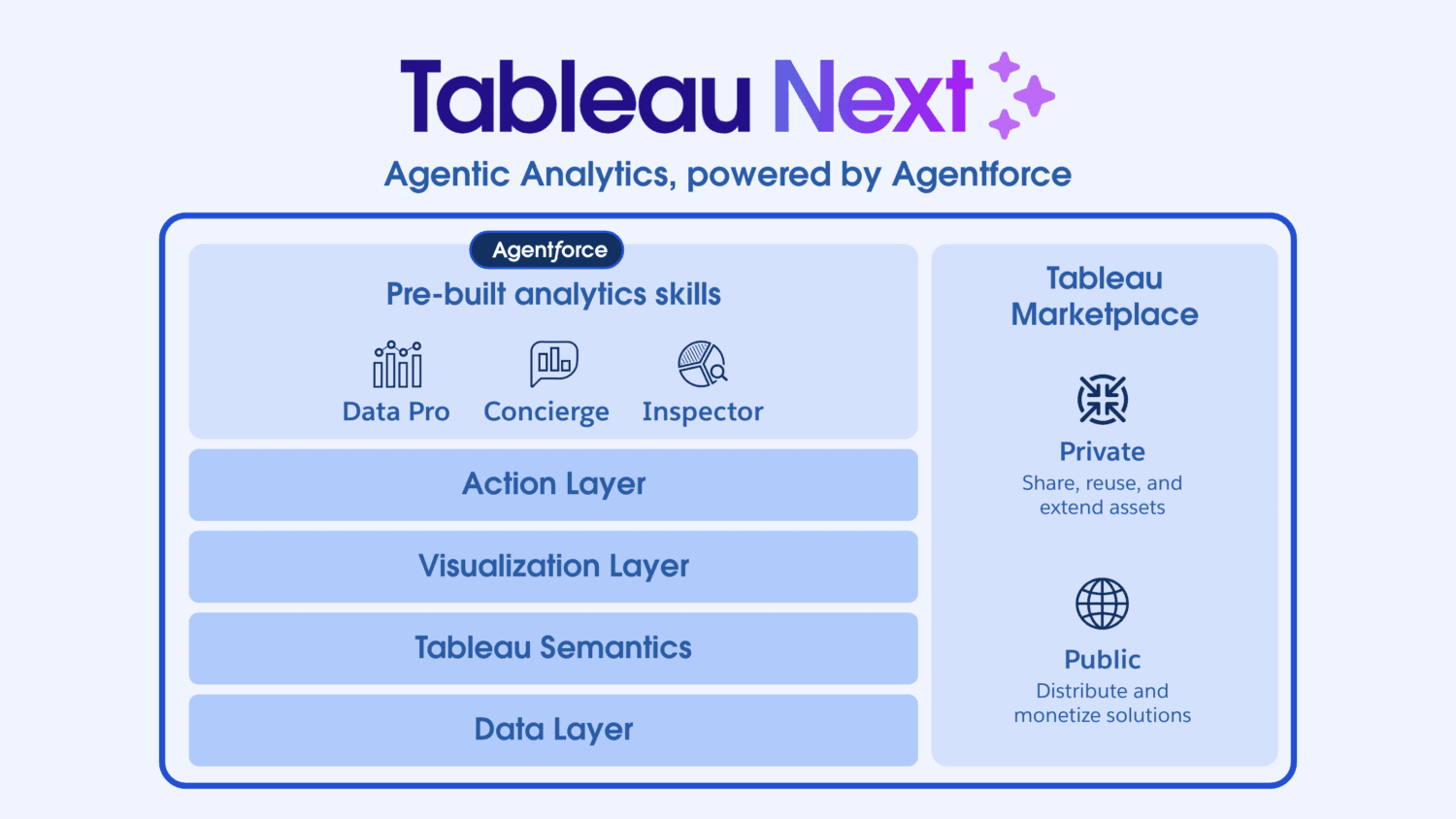
This is also where Tableau Next’s architecture shows its enterprise maturity. This includes data lineage tools that visualize the journey from raw input to finished dashboards and support transparency and governance. Combined with Salesforce Data Cloud and MuleSoft integration, this platform provides real-time insights across hybrid environments without organizations having to move or replicate data. This is exactly where the benefits of being a Salesforce company come into play. Tableau Next is for businesses using Salesforce. And for businesses that don’t use Salesforce, there’s Tableau Cloud or Tableau Server.
Ending ad-hoc analytics and dashboard fatigue
As part of a broader transformation, Tableau is challenging its traditional reliance on static dashboards. Miller estimates that up to 50% of today’s dashboards could be replaced by what he calls “metrics-centric experiences.” These experiences dynamically uncover insights in response to business questions, rather than through predefined visual templates.
At the heart of this change is Tableau Pulse, a system that generates on-demand visualizations based on certified metrics. Users can subscribe to metrics just like following people on social media. When changes occur, such as sales pipeline or supply chain delays, the system pushes customized updates directly to users. “If you’re an executive who says it’s going to take two months to get a new dashboard, forget it,” says Miller. “Now you can build.”
These visuals are temporary by design. “If you have a question about the supply chain and we generate a new visual that answers your question and allows you to make a decision, we may not need to keep it,” Miller added. This idea of ephemeral analytics challenges long-held conventions and provides more fluid, mobile-friendly, and contextual insights that better reflect the dynamic nature of modern business.
Make your insights not just accessible, but actionable
Even the most insightful data is worthless if it doesn’t get to the right people at the right time. That’s where Tableau’s use of AI agents is transformative. These agents operate within the flow of daily work, proactively uncovering trends and recommending actions before users formulate appropriate queries.
Tableau Next combines generative and predictive AI to predict future states and suggest next steps. Users no longer need to pull reports or explore dashboards. Instead, insights are gained in context within the tools you already use. Tableau aims to make it easier for everyone in your organization to act on valuable information by building contextual, AI-powered insights directly into your work flows.
Embrace platform extensibility and reuse
To support enterprise-scale collaboration, Tableau Next also introduces a component marketplace that allows teams to share reusable assets across departments or organizations. Publish and reuse dashboards, data models, and custom applications to accelerate development cycles and enforce best practices.
The API-first architecture supports extensibility, allowing you to embed Tableau functionality within third-party applications. Whether through Slack, a CRM system, or an industry-specific platform, data insights need to become a native part of business workflows. This configurable analysis approach reflects a broader trend in enterprise software. That means building once, deploying many times, and meeting users where they are.
A realistic view of the adoption curve
Despite the potential for change, Miller clearly recognizes the current situation in many organizations. Having lived in the Netherlands for nearly a decade, he understands the cautious pace that characterizes European IT adoption. “We still have customers who use Microsoft Access, but they are large enterprises,” he points out. “In 2018, we helped a global company migrate from Lotus Notes to Tableau.”
That’s why Tableau values freedom, flexibility, and choice in deployment. The shift to AI-powered conversational analytics won’t happen overnight. Traditional dashboards and reports remain relevant, especially for organizations whose data infrastructures are still maturing. “We’re not going to take them out of your hands,” Miller says. “We give you a way to evolve at your own pace.”
Perhaps the biggest change is what this means for the analytical profession itself. As agents take over basic query construction and visualization tasks, the analyst’s role shifts to semantic modeling, prompt design, and quality control. Analysts aren’t going away. They become the custodians of the system, ensuring that models reflect business logic, outputs are reliable, and prompts provide value. The semantic layer becomes the canvas and the AI agent becomes the expression tool. “The goal is not to eliminate analysts,” Miller concluded. “It’s about improving their work and bringing them closer to the core of the business.”
Please also read: Tableau maintains business intelligence (BI)