

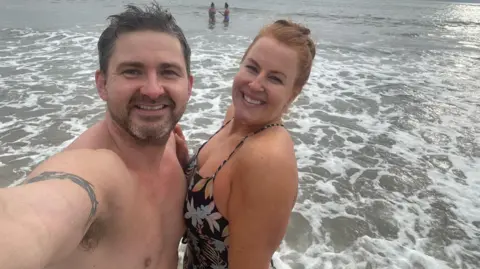
When Dan Richards went for a New Year's Eve swim in 2023, he never imagined his life would change so dramatically.
He suffered a neck injury in a freak accident when he was flipped over by a wave and hit the sand at Langland Bay in Swansea.
“I knew right away that I was paralyzed,” said the 37-year-old.
“I couldn't move anything.”
Doctors told him he would be bedridden, but two years later he used a wheelchair and was able to move his arms and fingers.
He has also walked in Wales and Germany with the help of artificial intelligence (AI) technology.
Dan and his partner Anna, 40, were celebrating the New Year by soaking in cold water when the accident happened.
“Unfortunately, I remember everything. Being pulled out. And then everything changed,” Dunn said.
“The wave hit me, flipped me over and bent me backwards, breaking my neck. I knew this was bad.”

 anna thomas
Anna recalled hearing Dan's cries for help as he tried to get into the water.
“I just remember looking back and seeing Dan's head go up and then go back down,” she said.
“We dragged him out, but he was just dead weight and the sea was coming in really fast.
“We were waiting for the emergency services and then… [I remember] I begged to be put on a helicopter. It was scary. ”
The couple, from Swansea, received life-changing news after being taken to hospital in Bristol.
 anna thomas
Mr Dunn said he was told there was a “high possibility” he would be bedridden for the rest of his life as he was paralyzed from the neck down and unable to move.
Anna, who had only started dating Dan a few months before the accident, had to make a frightening phone call to her family.
“It was New Year's Eve and I was put in a room by myself, but I could hear people laughing and joking, so I had to tell Dan's parents.
“How do you call someone's mother and tell her that her son is paralyzed?”
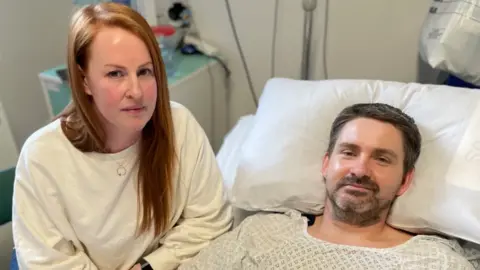
Anna said every day since the accident has brought new challenges.
“This is our reality. Until you find yourself in this situation…you don't realize how much you've lost.”
But in the months following the accident, when Dan was in the hospital, even the slightest movement of his toes gave the couple hope that things would change.
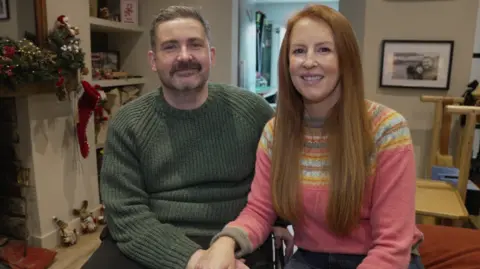
“Fortunately, I’m pretty stubborn,” Dan said.
“I just wanted to see a physical therapist as soon as possible. I wanted to work. I just couldn't accept what they were saying.
“I'm proud of my progress. It's been a long time since I laid in bed in Bristol, that's for sure.”
He continued: “The sensation in my toes changed to the sensation in my whole foot, and my right leg started to move a little.” [and] The core strength that was said to have been lost began to return. Ability to move arms and fingers and hold objects.
“I'm still hopeful and positive. With modern technology, I won't give up.”
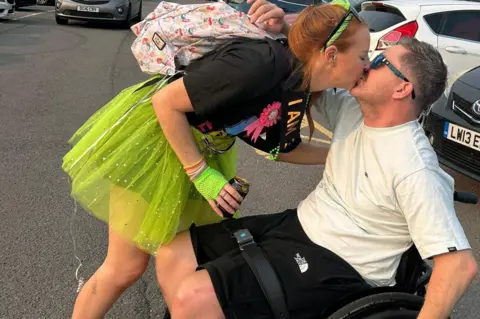
Dan underwent private physiotherapy at a specialist clinic in south Wales, using the world's first multi-modal treatment using a machine to help him walk.
 anna thomas
Jacko Brouwers, a neurological physical therapist at the Morello Clinic in Newport, said that when he visited Mr. Dunn after he was discharged from the hospital, he was “a very motivated guy.''
“There are two elements to this technology,” he explained.
“The first part that Dan and I tested was the robot, which mimics the way a normal human walks as closely as possible.
“Another part of the system we developed is a stimulation suit with sensors. Electrodes are also attached to the pants, allowing us to stimulate muscle activity at the right time.
“Through a bit of algorithm, dare I say AI, the development of the gait pattern begins.
“It's very exciting. You don't often see things like this in Wales.”
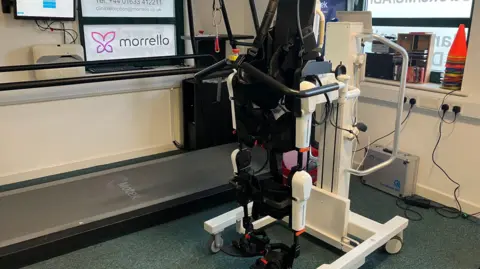
Dunn said the experience was “surreal” but “felt great.”
“It made me want to try harder. It's so close here in Wales that it inspired me to do some research and other things.”
However, private physical therapy and innovative treatments are expensive.
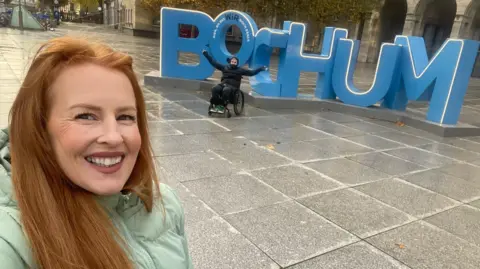
From raffles to ultra-marathons and charity nights, family and friends raised money that will enable Dan and Anna to leave for their overseas trial in October.
 anna thomas
Dunn explained that Germany is trying two different treatments at the same time. The treatment involves injecting stem cells directly into the spinal cord and using a hybrid assistive limb (HAL) suit, a machine that interacts with brain waves.
“This is one of the first times this has ever been done,” he said.
“The sensor converts the signal into movement, which moves my legs and starts walking.
“The more you do it, the stronger the signal becomes, the faster you go, and eventually you'll be able to walk without a suit.”
Dan still has six weeks of treatment left in Germany in the new year and must apply for an EU medical visa, but he said he is determined to overcome this too.
He doesn't know what the future holds, but he is determined not to give up.
“Technology is advancing rapidly and things are different than they were 10 years ago.
“New research is amazing. There are no limits. I don't want to set any limits.
“The more progress I make now, the better our future will be.”


