


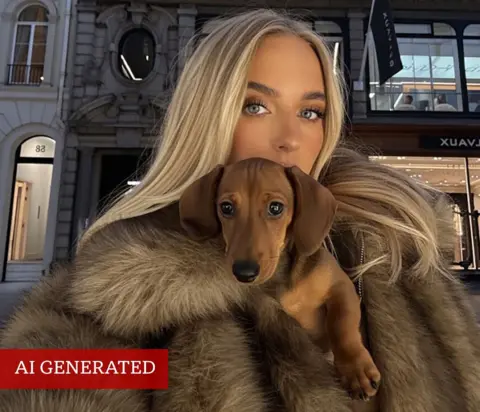
 @zoeilanahill
Warning: All photos featuring animals are created using AI
If you’ve been scrolling through social media lately, you may have noticed a post that seems a little… out of place.
Grainy CCTV footage of a dog rescuing a child from a bear attack, footage of a wild rabbit riding a trampoline, and photos of the Christmas market outside Buckingham Palace.
All of this is generated by AI, and its low quality and unreliability have led to the stigma of AI being “sloppy.”
Social media users and content creators alike say they’re worried that AI-powered feeds are diminishing the authentic online experience and drowning out real posts.
However, the new trend of adding AI-generated animals to original photos has led some content creators to embrace AI.
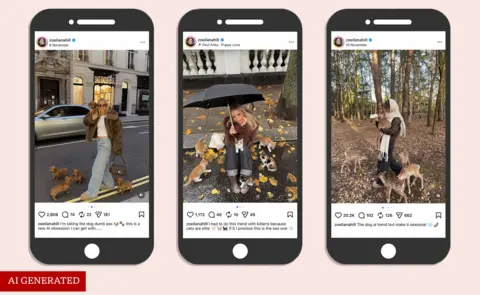 @zoeilanahill
“I thought it was a real niche because it looked so real,” says influencer Zoe Ilana Hill.
The 26-year-old jumped on the trend after being impressed by other content creators’ imaginative ways to leverage AI, such as editing an original photo and adding an AI dog.
“I don’t want to see it. [AI] It’s not a threat to my career, but I like to see it as something I can work with,” says the full-time influencer.
Zoe, who has 82,000 followers, says she feels platforms like Facebook, Instagram and TikTok are trying to “impose” and “enforce AI” on users, and has seen her own feed cut down significantly.
But she sees potential in the AI animal trend, adding that she thinks the post will work because social media users will think, “Oh my god, I’m holding a deer.”
“Deer have seasons, so being able to go and see them in person is very rare,” she says.
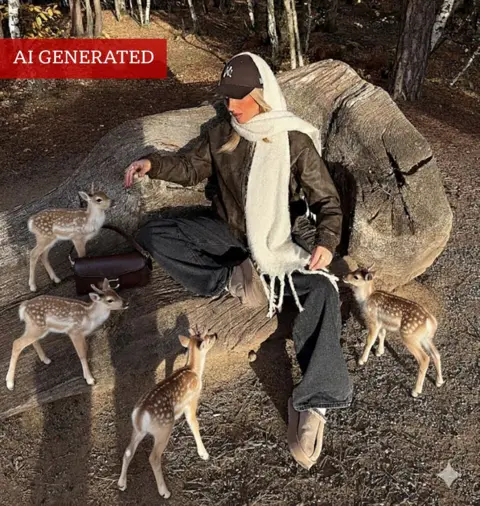 @zoeilanahill
Zoe said her post was a success, receiving over 20,000 likes and comments such as “I can’t stop, the cutest thing ever” and “This trend is so cute!!!”
Whenever Zoe posts an AI-generated photo, she likes to make it clear that it’s a generated image. “There’s actually a tag.” [on Instagram] We can say that this photo was created by AI. ”
“I don’t think it’s fair for people to think something is real when it’s not.”
If influencers don’t disclose their use of AI, confusion can ensue.
Such was the case when a German influencer with 900,000 followers posted a photo of dozens of AI Dalmatians with the caption, “I’m the only one living the dream.”
One user commented, “Is this AI? I saw posts like this 3 times today.”
Another said they were worried about the welfare of the animals produced, adding: “There are a lot of dogs sitting in animal shelters hoping for a nice home.”
 @clarainvogue
“Sexy girls are starting to use AI,” wrote one X user in a post that has been viewed about 27 million times, sharing photos of animals from various influencers and discussing the trend.
But not everyone sees using AI in this way as harmless fun.
Another X user replied, “It’s not hot because it’s using AI to do mindless tasks that could easily be done by hand in Photoshop.”
Clara Sandel, a marketing expert and digital creator from Finland, joined the trend after seeing it “everywhere” and finding the posts “so cute.”
“I put my own twist on it. [on the trend]I used my spirit animal and my favorite animal,” the 38-year-old added.
Clara posted a photo on Instagram of a merry-go-round featuring a tiger, a moose, a horse, a cat and a dog.
Reactions to the photo were positive, with many people calling the post “chic” and “beautiful.”
When asked if she would participate in future AI trends, she answered, “It depends on how cute the trend is,” and if it is transparent and “you can see the AI being used.”
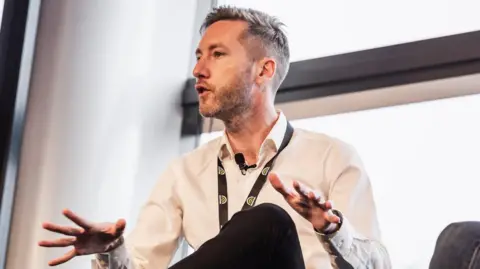 matt navarra
Social media consultant Matt Navarra believes that for content creators who want to create high-quality images, AI will make it easier to create “fantastic, shiny” and “beautiful” content for influencers, “from wildlife-generated to more believable.”
While some of the AI content you see online is unrealistic and clearly not real, Navarra says, “Most people who are serious about becoming creators and influencers want to maintain their reputation.”
He believes many creators are “doubling down on reality” to secure a place on their feeds in a “sea of flooded, or AI-generated content, aka AI slop.”
The consultant said he predicts 2026 will be the year of AI-dominated content on social media, adding: “If you think AI animal content is outlandish, I think you should buckle up.”
 Maddie Mathers
However, not everyone will be happy to hear this.
“I love you, but not the AI,” Melbourne tattoo artist Maddy Mathers commented on a post by a German influencer who created an AI Dalmatian.
Commenting is something Maddy doesn’t normally do, as she describes herself as a “very quiet social media user.”
But when the tattoo artist first saw the photo, he previously believed it was real, but as he scrolled through the posts, he realized the cute Dalmatian was “obviously fake.”
“Honestly, it’s very simple, but when AI fools you, you feel stupid,” the 25-year-old explains.
Maddy says that AI posts like this create an element of distrust because when you’re an influencer, “it’s really important to be true to yourself and show your true personality.”
She believes that when creators put out content that isn’t real, it can “damage their careers” because viewers “don’t know what to believe.”
 Katina Bajaj
AI lag isn’t necessarily a bad thing. Creative health scientist Katina Bajaj is concerned, however, about the “speed and volume of what we are creating.”
“When we create and consume AI-generated content at such a rapid pace, our brains are not given enough time to digest it,” Bajaj says.
From her perspective, she explains, the solution to AI slop is not to ban AI or “look down on AI tools,” but to “prioritize and value our creative health over endlessly producing content.”
According to Meta’s policy, there is currently no requirement on Instagram to “label images created or modified by AI.”
However, “if Meta’s system detects that the image was generated by AI, the image will still be labeled.”
TikTok recently released new tools that allow users to tweak their feeds. This includes being able to display content that is more or less generated by AI.
The “Manage Topics” feature is intended to allow users to customize their “For You” page to ensure that users see a variety of content within their feed, rather than removing or replacing content entirely.
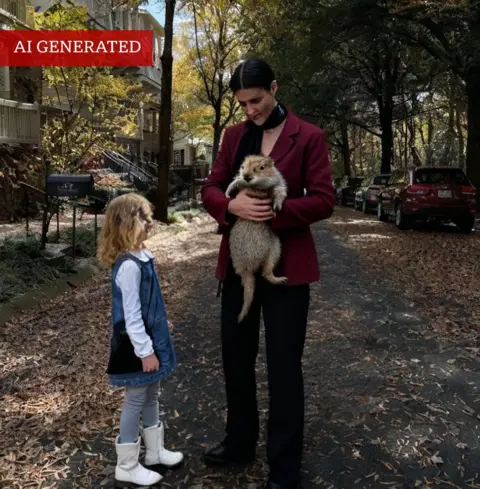 Emily Manns
There are many AI softwares that can be used to create this trend, but not all can create the perfect content portrayed on social media.
American fashion content creator Emily Manns bought multiple AI apps to participate in the trend, but had no idea what she had bargained for when she received what was supposed to be an aesthetic photo with “a rodent” in it.
“I don’t even know what it is. [the animal] ” said the 34-year-old man.
“that [the photo] It took about 2 minutes to load, and when it did I was laughing and peeing. ”
The app also added extra fingers to the influencer’s hands, distorting her face.
Emily said she posted the photo on Instagram but “deleted it immediately” because the content was not very appealing.


