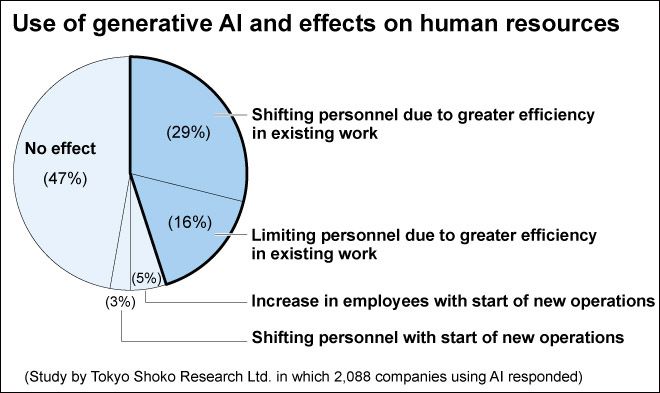
According to the survey, approximately half of companies said that the introduction of generative artificial intelligence will change the way they utilize human resources, such as personnel transfers and hiring freezes.
This tendency is more pronounced in larger companies.
Tokyo Shoko Research conducted a survey this month targeting 6,327 companies, of which 2,088 responded that they were actively working on introducing generative AI into the workplace.
29% of 2,088 companies said the efficiency gains brought about by generative AI will make their employees more likely to move to other departments over the next five years.
Of those, 16% said their total number of employees may be limited during that period.
Among large companies with capital of 100 million yen or more, 47% said they were likely to change staffing, and 11% said they would reduce the total number of employees.
However, only about 4% of companies mentioned the possibility of early retirement recruitment for white-collar workers.
Kosuke Honma, a researcher at Tokyo Shoko Research, who conducted the survey, said, “The impact of AI on employment will be more pronounced among white-collar workers at large companies.”
Of the 6,327 companies surveyed, 34% said they are promoting the use of generative AI in business operations across the company or in specific departments.
For large companies, the figure was 59%.
A similar survey conducted in August 2025 found that 25% of all companies and 43% of large companies were promoting the use of AI.
The latest results show significant changes in the use of AI within a year.