

This article first appeared in Digital Edge, The Edge Malaysia Weekly on September 11, 2023 – September 17, 2023
In 2018, before the Covid-19 pandemic, Sunway Group embarked on a search for a partner that would transition the company’s operations to the cloud. This was one of the many digital transformation strategies that the company had pursued since 2000, says its chief innovation officer Kevin Khoo. It wanted to move anything that it possibly could to the cloud because of the realised benefits.
That is when Huawei Technologies (Malaysia) came into the mix and introduced its cloud platform, which was relatively new at the time. “We found that [Huawei’s solutions] met our purpose and needs. It had a local data centre here in partnership with TM (Telekom Malaysia) at the time and a local, strong support team of 2,000 engineers who helped us on our journey,” Khoo says.
“It had all the technical expertise here and brought in its extensive partner ecosystem, one of which we’re using for the Sunway Super App.”
Being a China-based company and coming from a country where technological advancements are ahead of the curve, Huawei provided consultation and advice, and shared expertise with them, according to Khoo. This included technical aspects such as how Sunway should move forward in terms of its technology stack.
Sunway’s partnership with Huawei expanded to include the Digital Innovation Programme (DIP) 1.0 in 2021, which enhanced Sunway’s artificial intelligence (AI) and machine learning (ML) capabilities and led to the launch of the Sunway Super App, among other projects.
In April, they agreed to continue working together for DIP 2.0, which will further advance Sunway’s digital innovation and cloud modernisation journey, as well as strengthen the collaboration across Sunway’s business divisions in Asean.
“[When it comes to] the development of super apps, China was the first in the world to do so and it has a lot of good practice, which is why we wanted to leverage Huawei’s know-how,” says Evan Cheah, group CEO of digital and strategic investments at Sunway Group.
Khoo explains that some of the areas where Huawei’s expertise is utilised are cloud modernisation and application containerisation. These allow apps to be developed and go to market faster, and they are more agile and cheaper to develop.
Cloud app modernisation is the ongoing process of taking legacy applications and updating their features, architecture or infrastructure to ensure that they are optimised for operating in cloud environments. Containerisation is operating system-level virtualisation or application-level virtualisation over multiple network resources so that software applications can run in isolated user spaces called containers in any cloud or non-cloud environment, regardless of type or vendor.
“We use the micro services Huawei has on the cloud. For example, if we want to collect data, traditionally we would have to build a form that enables us to get that information, where users will fill in their name, phone number, date of birth and what not for registration purposes,” Khoo explains.
“We then build that module inside every app. With Huawei, the components are already available and we don’t have to develop them [from scratch]. We just need to call for this feature and adapt the functions on it — it makes the development faster, and enables us to pick and choose what we want in the form. We can configure these micro services, and a form is just one aspect of it.”
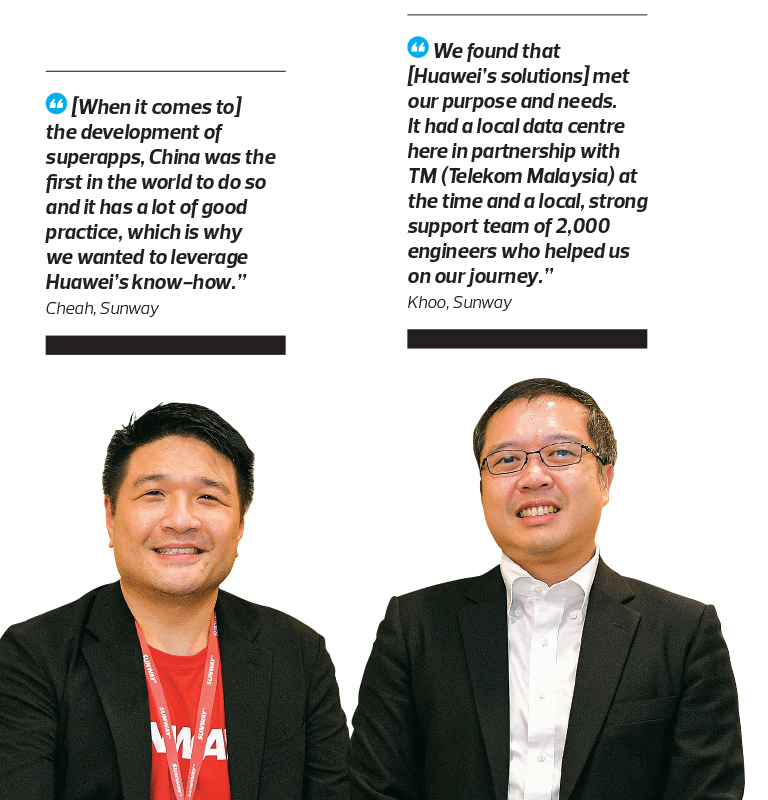
(Photo by Shahrill Basri/The Edge)
Testing before implementing
When new technologies come to market, they become so widely used that most companies jump on the bandwagon to adopt them without trying them out. At Sunway, however, Khoo says it tests out the technology internally to see whether it brings value to its businesses.
For example, the company took a look at blockchain technology and did extensive research on how it could bring value to its businesses. After doing the relevant testing, it discovered that at this moment, blockchain may not bring a lot of value and put it on the backburner.
But AI and ML are technologies that Khoo believes are going to stay for a while. “We even created a team to look at generative AI technology, to study how it can help our business divisions.
“We brought in a team of AI and ML experts and created our own algorithm or AI model. Through many use cases, we know that AI can be very helpful because it can detect things that humans can’t.
“We are working very closely with our business divisions to look at security in terms of facial recognition, even for attendance. We’re also looking at having AI incorporated into our manufacturing plant to be able to pick up products that are faulty or not up to the standard. We are researching all these for our businesses.”
Solving the talent gap in the tech ecosystem
Khoo says Sunway’s technological adoption has been growing at a steady pace, but the challenge is the talent gap. Currently, it is difficult to get the right talent because almost every company is fighting for digital talents.
This is also why the team works closely with its education arm, Sunway Education Group, to bring talent into the group of companies, and established programmes like 42KL — a tuition-free, future-proof computer science school with a peer-to-peer learning environment that does not involve teachers and lecturers.
Cheah says 42KL is part of Sunway’s commitment to the United Nations Sustainable Development Goal 4, which touches on inclusive and equitable quality education and promotes lifelong learning opportunities for all. Typically, one would need to pay a few thousand ringgit to enrol in a coding school but 42KL is free for anyone above 18 years old.
“So far, some 30% of our cohort is from the B40 (low income) group and recently, we partnered with one of our government-linked investment funds to scale [the initiative] nationwide and set up 42Malaysia.
“It’s not to make a lot of money, but to support the programming talent that we need for the future of Malaysia because it’s very difficult to get capable talent. A lot of B40 are capable, but they don’t have access to quality education so this is how we try to even the playing field.”
Khoo adds that the company has been upskilling and reskilling talent as well. Since embarking on its robotic process automation journey in 2018, while creating over 100 robots to make processes easier, the company has also created future job opportunities for jobs that were affected.
At the end of the day, he says, these employees also do not want to do repetitive work. “All these robots are taking over the repetitive, mundane work and what we did is ensure that all the staff are retrained.
“Today, we have jobs called ‘robot owners’ and ‘robot processors’ to ensure that the jobs are not affected. In fact, they are doing more fun and interesting things that give them more income.”
Building Malaysia’s tech future
Right now, the industry is at a crossroads. On the one hand, tech talents say there are not enough job opportunities in the market. On the other hand, tech companies are complaining that there isn’t enough talent for the right job.
To overcome this chicken and egg situation, Cheah says both areas have to grow concurrently. From an ecosystem policy perspective, we need to look at other countries that have succeeded, such as Thailand, Indonesia and Singapore.
He adds that to grow the ecosystem, it has to include the concerted efforts of the government and private sector. Government agencies such as the Malaysian Communications and Multimedia Commission (MCMC) and government-linked investment companies need to be involved too.
“[This agenda] cannot only involve purely the private sector, which is why we are partnering with government bodies to create an ecosystem that is sustainable for the long term in this country. It’s still relatively small at the moment but we’re trying to do something.”
Considering that technological advancements are evolving at a rapid pace, Cheah says he hopes that the government will also adopt the culture of testing the business viability of technologies before deploying them to other sectors as a way of risk management.
“If nothing is done, we get left behind, but if a technology is used [without testing], it does have risks. So how can they measure risk when going into new areas? By testing it out.
“If somehow the government can think of ways to reduce risk, such as through policy setting [for venturing] into these new areas, we can then ensure that informed decisions are made.
“Before we [try something new], we talk to experts who are the best [in the field], and if it doesn’t work, at least it was an informed decision.”
Save by subscribing to us for your print and/or digital copy.
P/S: The Edge is also available on Apple’s App Store and Android’s Google Play.


