
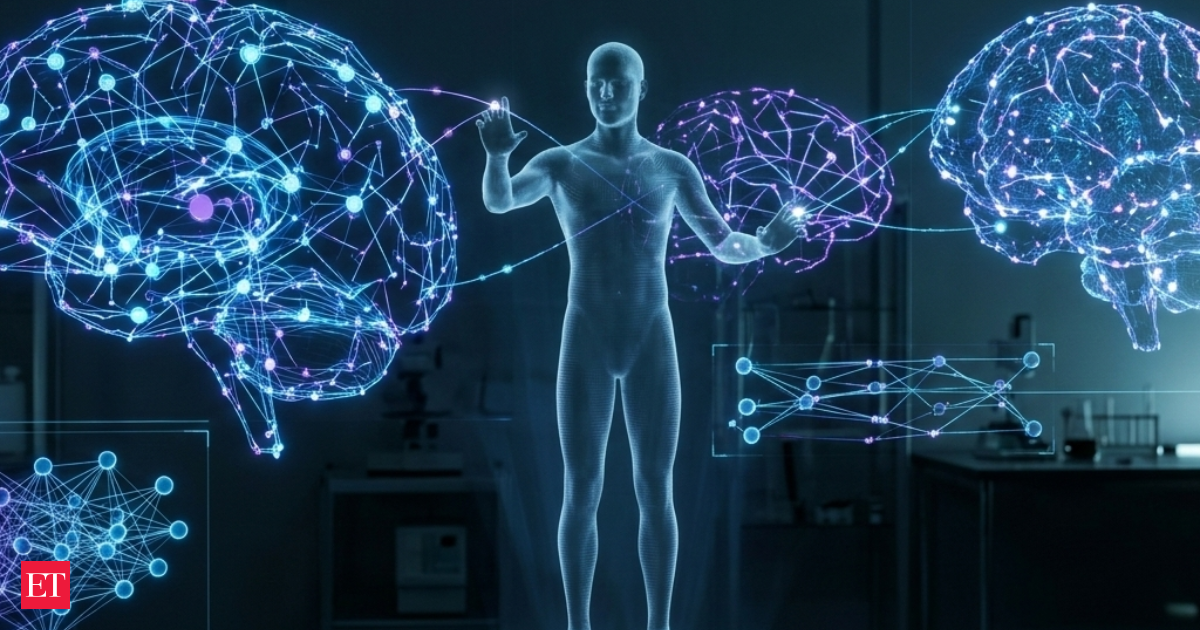

But now artificial intelligence researchers are starting to wonder if something similar happens within machine learning systems. A recent study by Robyn Wyrick published on the research archive site arXiv explored this possibility using artificial neural networks. Wyrick created a cooperative simulation called the “Frog and Toad” game in which AI agents have to coordinate their actions. Under certain conditions, the network began to develop internal representations that functioned like biological mirror neurons. Simply put, the network has learned to recognize its own actions and the actions of other agents in similar ways. This poses an interesting possibility. If AI systems can internalize the behavior of other agents, they may be able to more effectively predict and collaborate with humans. The system may be able to internalize more natural interaction patterns rather than following specific instructions.
Other researchers are exploring similar ideas from different angles. In another arXiv study, Wentao Zhu and colleagues proposed a way to connect the way AI systems represent observed actions with the actions they themselves perform. Their approach allows the system to recognize similarities between what it sees and what it does by mapping both forms of information onto a shared internal structure. This technique uses contrastive learning, which encourages the model to strengthen connections between related patterns. This concept is also being explored in robotics, with research published in Neurocomputing finding that robotic systems employing networks inspired by mirror neurons can coordinate behaviors such as taking turns during interactions. When robots are synchronized in this way, their reactions seem more natural and easier for humans to understand.
Another area where mirror systems are useful is called imitation learning. In their research published in Scientific Reports, Mohammadi and Ganjtabesh created a reinforcement learning-based model that uses imitative learning through neural mechanisms inspired by mirror neurons. Rather than learning through trial and error, AI learns by observing other agents perform tasks and replicating those actions. But even this theory is controversial among scientists, with some suggesting that mirror neurons cannot explain more complex human abilities such as empathy. In an arXiv analysis, researcher Jahan N. Schad argues that other mechanisms, such as a predictive visual system, can explain these abilities.

Despite these debates, the relationship between neuroscience and artificial intelligence appears to be strengthening, and as we learn more about how the brain works in social interactions, future AI may be able to collaborate with humans to achieve more capabilities. The idea is still in its infancy, but if these early studies are any indication, future AI could learn not only to observe its surroundings, but to interpret it in ways that are eerily similar to the human brain.


