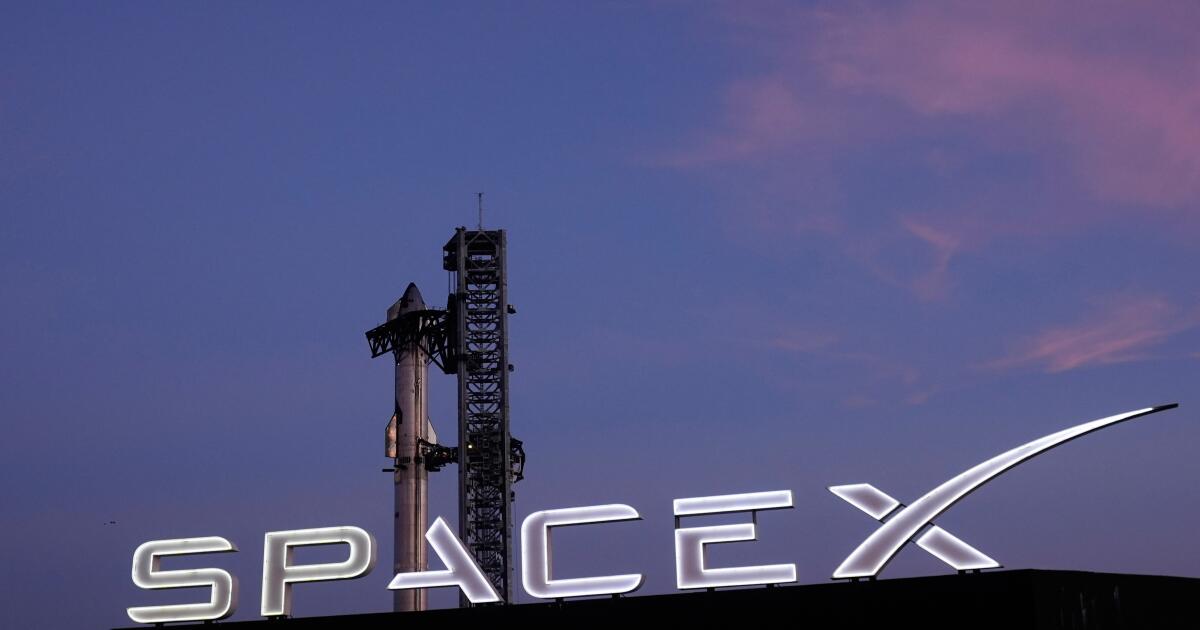
Elon Musk’s SpaceX acquired autonomous coding startup Cursor for $60 billion in an all-stock deal, allowing the space exploration and AI company to compete with rivals Anthropic and OpenAI after making its debut on Wall Street last week.
SpaceX said in April that it had the right to pay $10 billion to acquire Cursor or “work with” the company.
The cursor trade comes days after SpaceX saw its stock rise 20% in a blockbuster listing on Friday. SpaceX’s market capitalization reached $2.8 trillion on Tuesday, overtaking e-commerce giant Amazon and making SpaceX the fifth-largest publicly traded company.
San Francisco-based Cursor was launched by Anysphere, a software company founded in 2022 by four Massachusetts Institute of Technology graduates.
They built a very popular AI coding assistant. This allows engineers to instruct the software in English and then perform coding tasks autonomously.
This started the “vibe coding” phenomenon, where users without coding knowledge or software understanding can share verbal instructions and build apps and websites. Cursor’s growth exploded, reaching $4 billion in annual revenue.
However, there were pitfalls to its adoption. Cursor’s interface allows programmers to switch between multiple AI models, such as Anthropic and OpenAI, making it simply a platform for hosting other companies’ AI. This raised questions about Cursor’s ability to build an independent company on the model offered by its larger rivals.
To reduce dependence on competitors, Cursor introduced its own AI agent, Composer, in late 2025, alongside other third-party coding assistants. Cursor currently competes directly with Anthropic’s Claude Code and OpenAI’s Codex.
Despite Musk’s support, xAI’s chatbot Grok is still far behind Claude and ChatGPT. The deal with Cursor could improve xAI’s position in the market, allowing Musk to improve Grok with better coding capabilities and convince companies to adopt his company’s AI.
When SpaceX first announced the potential acquisition in April, Cursor said the partnership would allow the company to build future AI products using xAI’s large-scale AI data center complex, Colossus, based in Memphis, Tennessee.
Earlier Tuesday, SpaceX confirmed in an X post that the company and Cursor are jointly training an AI model that will be released in both Cursor and Grok Build, an AI coding agent built by xAI.
“This is the first but not the last major exit in the application layer of AI,” Chamath Palihapitiya, an early SpaceX investor, wrote in a post on X.
SpaceX said it expects the merger to close during the third quarter of 2026.
After a tumultuous split with OpenAI, Musk built one of the largest data center clusters to power rival chatbot Grok. But Grok’s slow adoption led SpaceX to lease spare data center capacity to third parties like Anthropic, which will pay $1.25 billion a month to run the chatbot through May 2029, according to its IPO filing.
Critics of the all-stock acquisition called it a buyout fueled by hype that lacked market fundamentals.
SpaceX went public, but only sold 4% of its shares, leaving very little supply of stock and huge consumer demand. Shares rose 20% on Monday and rose even more on Tuesday, closing at $201.80.
“In other words, thanks to the engineered scarcity that has driven stock prices up, acquisitions are now cheaper. That scarcity is paying the price for the big buys. A company that loses $4 billion a quarter is now buying AI startups on paper made from a 4% free float,” Zurich-based asset manager Thierry Borger posted on X.
SpaceX spent no cash on its $60 billion Cursor purchase. SpaceX raised $75 billion in cash by going public.
of The Associated Press contributed to this report.