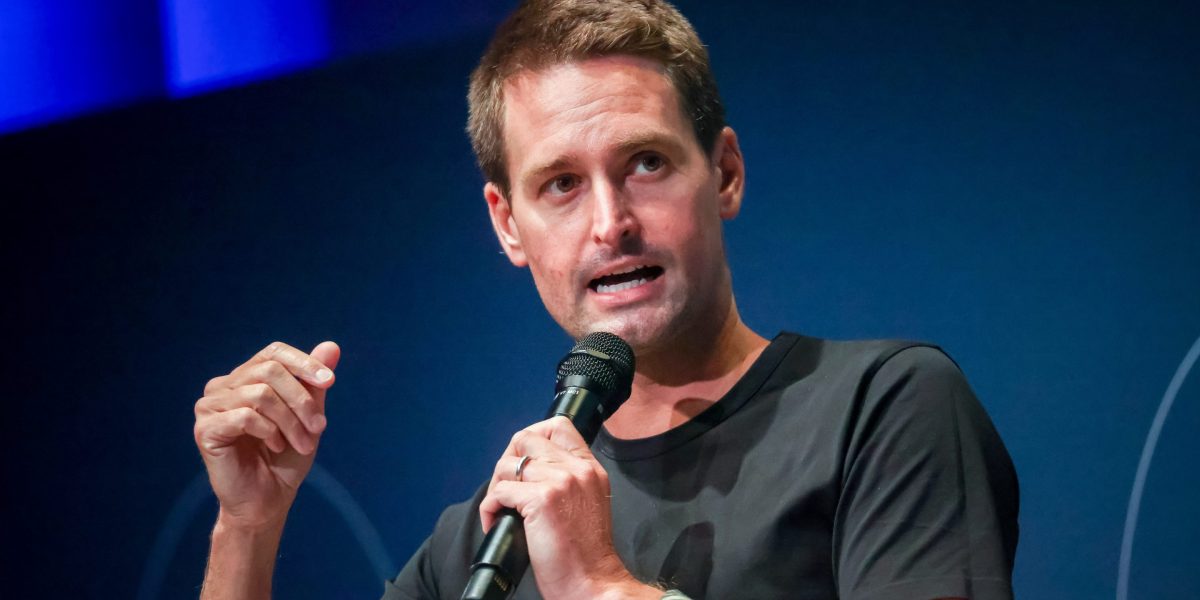
Snap, the technology company behind the social media app SnapChat, on Tuesday introduced AI Sponsored Snaps, an advertising tool that allows users to chat with AI bots from brands affiliated with the social media platform. This is one of the many ways the company has continued to lean into AI. But Snap CEO Evan Spiegel said the shift to new technology won’t necessarily help the company gain popularity points.
“I think technology leaders believe that every time a new technology comes out, people will blindly adopt it,” Spiegel said on an episode of Lenny’s Podcast earlier this week. “And I think we’re going to enter a period where there’s going to be a lot of social backlash against a lot of the changes that come with AI.”
Spiegel has touted Snap’s own ability to lean heavily into AI without alienating users, and the company now boasts 1 billion monthly users. The platform launched its chatbot My AI in February 2023, just months after the release of OpenAI’s ChatGPT. Earlier this month, Spiegel said AI was “probably the best thing that’s ever happened” to the company, saying it now writes two-thirds of the company’s code. Snap grew its subscriber count by 71% year over year in the last quarter of 2025 and now has more than 25 million paying subscribers. Revenue in 2025 increased 11% year over year to $5.9 billion.
An NBC News poll released in March found that just 26% of 1,000 registered voters had a positive view of AI, while 46% had a negative view. This makes AI only more popular than the Democratic Party, which received a 22-point negative net rating, or Iran, which received a 53-point negative net rating. Fear of technology has led some employees, especially young people, to even try to undermine AI deployment in the workplace. A survey of 2,400 knowledge workers by AI agency Writer and research firm Workplace Intelligence found that 29% of employees and 44% of Gen Z workers admitted that their employer had prevented them from implementing AI tools.
Despite intense criticism, Big Tech has poured $700 billion in capital investment into AI. The number of people using the technology continues to grow, with 57% of Americans using the technology and 40% reporting using generative AI more than a year ago, according to a report from the Brookings Institution.
But CEOs are also becoming more aware of how the general public feels about the technology. Sam Altman acknowledged in March that AI has become a bogeyman, warning that continued widespread surveillance could slow the technology’s growth.
“AI is not very popular in the U.S. right now,” he says.
Why do so many people hate AI?
Altman said the disapproval of AI is due to its association with data centers and rising electricity prices and widespread layoffs by employers, “regardless of whether or not it’s really about AI.” Snap announced in April that it would cut about 1,000 positions, or about 16% of its full-time staff, and cut about 300 positions it had planned to hire.
Despite the lack of evidence of widespread labor displacement as a result of AI, there remains uncertainty about the future of employment in an AI world. According to the 2026 AI Index Report from the Stanford Institute for Human-Centered Artificial Intelligence, in 205 years, nearly two-thirds of Americans believe AI will lead to fewer jobs, and only 5% expect it to increase the number of jobs.
The AI Index report similarly revealed significant distrust in the United States’ ability to regulate AI. The United States had the lowest level of trust in the government regulating technology, with less than a third of participants reporting trust, compared to a national average of 54%. Some AI leaders, including Anthropic CEO Dario Amodei and the “godfather of AI” Jeffrey Hinton, acknowledge that the technology needs higher guardrails to avoid leaving the world vulnerable to cyberattacks or, worse, AI takeover.
Spiegel’s own concerns about widespread AI adoption stem from similar concerns about AI companies prioritizing short-term profits over serving humanity’s best interests.
“Humanity is far more important than technological development, primarily because humanity determines how technology is adopted,” he said. “Much of our focus, not just as an industry but in the broader world, needs to put humanity first, and we need to ensure that the tools we are developing advance humanity’s goals in addition to business goals.”
At the same time, he suggested that technology industry leaders are in a difficult position.
“On the one hand, this is really dangerous…This is happening fast, it’s progressing fast, and people need to be aware of this,” Spiegel said. “On the other hand, how can we do it without scaring everyone or scaring everyone too much about what’s going to happen?”