BEIJING: Shanghai lawyer Xie Jingyi regularly uses artificial intelligence (AI) for work, even though she does not trust it entirely, wary of “hallucinations” or false information presented as fact.
She uses tools such as DeepSeek and Doubao for the efficiency gains. Instead of spending hours on an online database to find legal precedents, the 36-year-old now uses AI to do the trawling, which surfaces similar judgments in just seconds.
“It saves me an incredible amount of time,” said Ms Xie, who has been working as a commercial litigation lawyer since 2022.
While acknowledging that AI will make some of her work tasks obsolete, she is not worried about being replaced, as she believes lawyers can now focus more on critical work such as strategy and client service.
Xie is far from alone. Across China, workers are embracing the technology – however imperfect, for now – even as it reshapes their workflows and job scopes in the world’s second-largest economy.

China regularly touts its AI-related achievements, from robotics to driverless tech and chatbots. Beijing views AI as a potential technological revolution and aims to be at the forefront of such developments globally.
While its workers are not immune to anxiety about job replacement, interviews by The Straits Times’ China bureau found little sign of resistance to the national push to integrate AI across all sectors of the economy, unlike in the United States.
ST spoke to over 30 workers and job seekers across the country. Most of them are from some of the most developed cities – Beijing, Shanghai, Chongqing, Shenzhen, as well as Hong Kong – and are in industries such as tourism, media, law, consulting and marketing.
They are eager to adapt by using AI to improve their productivity, amid an influx of tools that can summarise, write, and design much faster than humans.
At the same time, the rise of AI has spurred the workers to improve themselves in other areas, such as interpersonal skills, customer service, strategy and leadership.
The interviews revealed mixed sentiments towards the steady encroachment of AI into the Chinese workplace – ranging from optimism about the country’s technological progress to resignation that adaptation may be unavoidable.
Such sentiments come as China has sent clear signals that jobs must be protected even as firms heed the call for AI adoption.
It is a stance rooted in the country’s socialist traditions and a recognition of the risk of social unrest if AI disruption is not managed carefully.
Signs of discontent
Tech-obsessed China is recognised as one of the world’s top two AI powerhouses, alongside the United States.
In 2025, China installed more industrial robots than the rest of the world combined, said Stanford University’s 2026 AI Index report released in April.
Baidu’s Apollo Go, one of the country’s top autonomous car operators, provided some 11 million fully driverless rides in 2025, a 175 per cent year-on-year increase.
China’s top general purpose AI chatbot, Doubao, had 345 million monthly active users domestically in March.
Such AI diffusion – the application of AI to industrial, business or consumer scenarios – was elevated to national priority when the State Council, or Cabinet, published an ambitious AI+ plan in August 2025.
The top-level policy document called for the promotion of “broad and deep integration of AI with industries and fields across the economy and society”.
Yet even in a relatively techno-optimistic society like China, where cashless payments and other tech-enabled conveniences are deeply embedded, there are signs of discontent over how AI has displaced jobs.
A 2025 survey of some 11,800 working professionals by Cheung Kong Graduate School of Business in Beijing found that 85.5 per cent of respondents indicated they might face unemployment within the next three years due to AI replacement.
In a March 2026 report, Chinese economic news outlet The Economic Observer told the story of Chen Yuxi, a short-drama actress whose gigs started to dry up about a year ago amid the rapid growth of apps using AI to generate videos.
Chen cut her fees by one-third, but production teams now offer only half her previous daily wage. Her bigger worry, however, is whether such short dramas may eventually no longer require human actors at all, said the report.
In a sign of the Chinese government’s concern, the Ministry of Human Resources and Social Security said in January 2026 that it will issue a guiding document to address the impact of AI on employment. It is not clear when this document will be ready.
Workers interviewed by ST spoke of a sense of dread that the AI tools that serve them today might one day replace them.
Joshua Zhang, 40, who has worked in software testing for 15 years, regularly uses his company’s self-developed AI models for work, including to generate procedures for test applications.
“I am worried, but worrying is useless. Replacement is inevitable. Maybe not in three years, but what about five? 10?” said Zhang, who is from Nanjing.
Shi Zhengdong, 29, a doctoral student in sociology at Nanjing University, said he was “definitely worried” about the impact of AI, though he acknowledged there is no way to stop its development.
He uses AI every day for academic work and as a search engine. He believes AI will deepen inequality or the “Matthew effect”, where those who are already better off get further ahead, while those worse off lose out even more.
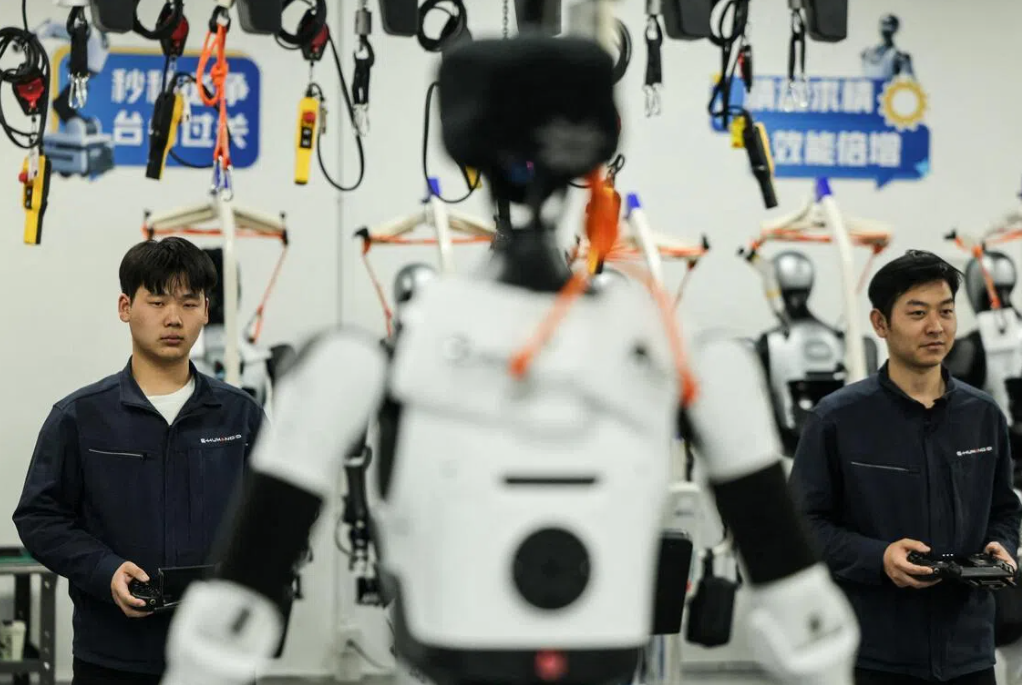
In September 2025, China’s largest humanoid robot training centre opened in Beijing, a 10,000 sq m facility meant to accelerate the deployment of robots in areas such as auto manufacturing and cardboard box packaging.
Footage from news reports show humans wearing VR headsets to “teach” robots how to fold clothes and retrieve items from shelves.
Pushed to adapt
The fears of redundancy are pushing workers to improve themselves in areas not yet replicated by AI.
Shi said: “I can only go and improve some abilities that can’t be easily replaced by AI, for example, interpersonal communication skills.”
Zhejiang-based Ma Yong, 45, who has worked in brand and packaging design for more than 20 years, said that many of his clients already use AI tools to create their own product mock-ups, as well as generate write-ups and short videos.
“To be honest, I am worried. In this efficiency-driven era, the only way is to continuously upgrade our understanding and use AI skills to make AI work for designers,” he said.
The Cheung Kong Graduate School of Business survey, which covered industries such as IT and communications, finance, trade, and services, found that 91 per cent of the respondents’ industries have already introduced AI.
The majority of Chinese workers interviewed by ST said that while they feel some level of anxiety, especially as they believe that the widespread adoption of AI cannot be stopped, they are also cognisant of the need to adapt.
Most are already using some form of AI daily, whether general-purpose chatbots for research, presentations, reports and e-mails, or more specialised applications for professional tasks, from coding to video generation.
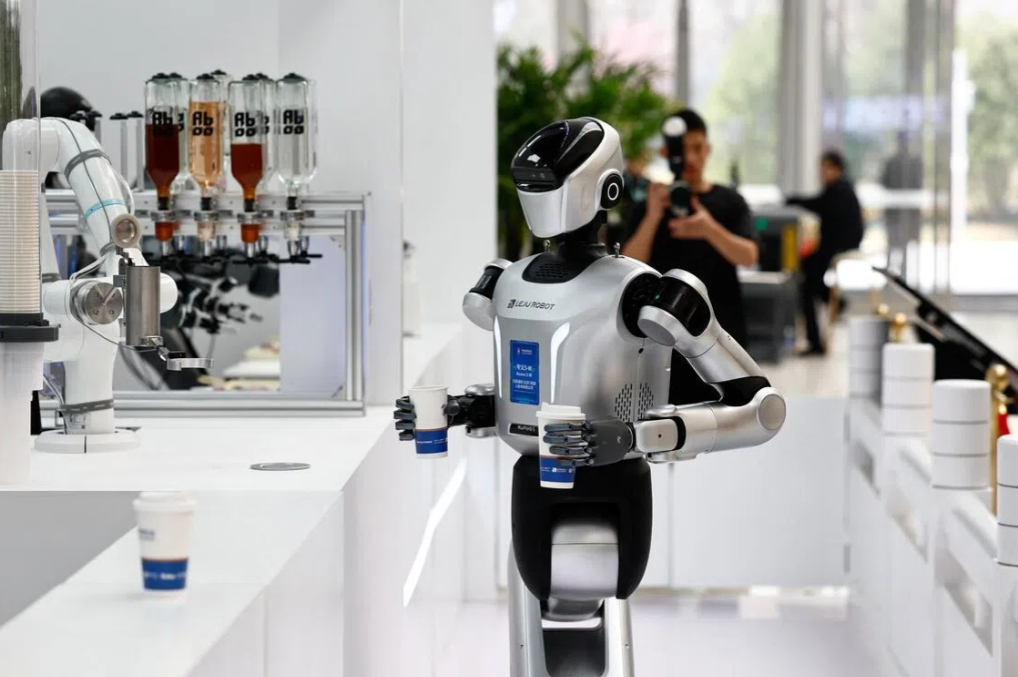
With government support, Chinese start-ups are racing to create AI-driven apps for every scenario.
During a media tour of Beijing’s tech development zone of Yizhuang in March, reporters were shown applications ranging from 3D modelling and digital avatars for live streaming to live translation glasses.
“Faster and more accurate than human engineers, and never absent,” said the headline of one presentation touting the use of AI agents for the semiconductor industry.
Yet the importance of face-to-face communication in Chinese society means that work involving relationship building with clients and interlocutors remains outside of AI’s purview, workers said.
Luo Yang from Beijing, who has worked as an interpreter for 19 years, is supportive of the government’s AI push. “Because it is an inevitable trend in technological development,” she noted.
Luo, 40, said she is not overly worried about being replaced, as her job is primarily about communication and requires human interaction.
Similarly, Shanghai-based Ms Candice Sun, who works in business development in the new energy industry, said her job requires extensive face-to-face communication, both within departments and with external clients.
“(These are) things AI can’t currently do for me. But AI has greatly improved my efficiency with some written tasks.”
She believes that when a new technology emerges, such as when assembly lines disrupted human jobs during industrialisation, people will inevitably be anxious.
“I think that while a new technology will replace some jobs, it will also create new ones; therefore, I maintain a relatively relaxed attitude towards AI.”
Techno optimism
Another driver of China’s relative techno-optimism may be the fear of being left behind – a mindset shaped by one of the fastest periods of economic and technological changes since the late 1970s, when the country embarked on historic market reforms.
Seen through this lens, the coming AI revolution may just be the latest in a series of transformations that China has to adapt to – from rapid urbanisation and a manufacturing boom that made China the world’s factory, to the ubiquitous use of smartphones today that enable everything from banking to government services, shopping and entertainment.
A 32-year-old software researcher based in Beijing, who wanted to be known only as Zheng, believes that AI “is the next Industrial Revolution”, and supports China’s large-scale investment in the technology. He is not authorised to speak to the media as he works in the state-owned sector.
He said that AI will both replace some jobs and create new ones. “(It’s) just like how horse-drawn carriage drivers can become car drivers,” said Zheng, who has developed software for the civil aviation industry for more than eight years.
“I think that regardless of AI, people always need to grow and change. As the old saying goes, ‘it’s never a burden to have more skills’.”
Professor Cao Xuenan, who researches the social impact of emerging technologies at San Francisco Bay University, said that studies have shown China and other East Asian countries having a more optimistic outlook towards AI than North America.
In China, workers have experienced rapid economic transformation only in the last 30 years or so, she noted.
“In that sense, AI is not really challenging their baseline as much as AI is doing right now for professionals in Europe and in the US,” she said.
Prof Cao also noted a difference between enterprise AI – or business-grade AI solutions that Silicon Valley has been pushing for – and personal uses of more general purpose AI tools to improve efficiency, which is common among many Chinese workers.
“Individuals using general purpose AI might find the technology less threatening, compared to an enterprise AI that is fully integrated and can fully automate workflows,” she added.
That contrast is visible in the United States, where sentiment towards AI has soured noticeably. Former Google CEO Eric Schmidt was repeatedly booed when he discussed the technology in a commencement speech at the University of Arizona in May.
Meta’s efforts to introduce AI, such as a monitoring tool for work devices, also triggered pushback from its workers in 2025, as it cut some 10 per cent of its global workforce, or 8,000 jobs, to pivot to AI.
Such resistance has potentially strategic implications: AI does not merely drive work productivity, it also plays a key role in the strategic competition between the US and China.
Both sides are vying for a greater foothold in the technology that they believe will lead to greater international prestige, economic strength and even military advantage.
In a September 2025 Foreign Affairs commentary, Professor Michael Horowitz from the Council on Foreign Relations think-tank urged the US government to focus more on adoption in the AI race with China, rather than simply on frontier innovation, such as achieving artificial general intelligence.
In China’s case, it may be too simplistic to frame the general optimism as the opposite of the negativity towards AI in the US. China still has to strike a balance between the pace of AI adoption at the workplace and the speed of workers’ adaptation.
A humanoid robot police officer deployed on May 3 in Hangzhou, China. A 2025 survey by the Cheung Kong Graduate School of Business in Beijing found that 91 per cent of the respondents’ industries have already introduced AI.
Acutely aware of the potential risk of social instability if widespread job losses happen, the Chinese government has signalled to firms – through recent cases of labour disputes – that enthusiasm for AI adoption must not come at the expense of workers’ welfare.
In one case at the Hangzhou Intermediate People’s Court released on April 30, a Hangzhou company demanded that a 35-year-old project manager’s salary be reduced from 25,000 yuan (US$3,700) to 15,000 yuan per month as his role could be replaced by AI.
After the project manager refused, the company terminated his employment contract. The court ruled that the termination was illegal, and the company was required to pay him 260,000 yuan in compensation.
Xu Zilin, who is assistant judge at the Hangzhou Intermediate People’s Court, said that the court does not deny enterprises their right to upgrade their technology, but the costs and risks of technological iteration cannot be simply resolved by terminating labour contracts.
In a China Youth Daily report on May 2, he said that enterprises should be more responsible by providing skills training, conducting internal job adjustments, and negotiating reasonable salary changes when faced with technological change.
A Xinhua commentary on March 26 said: “Companies that enjoy the dividends of AI must also fulfil their responsibility to protect workers’ employment.”
Soft skills, specialised knowledge matter
For now, AI’s deficiencies mean that human intervention, including via leadership, experience and judgment, will remain critical, those interviewed by ST said.
Pan Fei, 47, chief executive of marketing and communications firm BlueFocus, is a proponent of AI-driven efficiencies. “AI liberates my brain,” he said.
In 2023, his firm announced that it will stop outsourcing creative design, copywriting, creative solution or pitches. Such work is now done in-house by regular staff, with the help of AI.
BlueFocus CEO Pan Fei, a proponent of AI-driven efficiencies, does not worry that his own job as CEO will be replaced by the technology.
He believes the technology is a boon, and not a curse for workers, and he does not worry that his own job as CEO will be replaced by AI.
“I think it is very difficult to replace leadership. Leadership is about bringing people together around shared values and convincing them that, together, they can achieve something whose chances of success are uncertain.”
Beyond leadership, dealing with clients, and other soft skills, AI has also yet to fully master niche technical functions that require specialised workers.
A Hong Kong-based accountant, who only wanted to be known as Yiu as he was not authorised by his employer to speak to the media, said that while bookkeeping and journal entry have been automated by AI, the output remains unreliable.
Inaccuracies require manual adjustment during the month-end closing process, added the 30-year-old.
Chinese workers’ attitudes to AI replacement.
In many jobs, people holding professional licences are still required to provide their expertise, for instance, in signing off on legal documents, said Yiu, who has seven years of industry experience.
“You still need a doctor to carry out surgery in the operating theatre to remove a patient’s tumour or have a registered nurse to handle a patient’s IV drip,” he added.
And in service industries – which employs about half of the national workforce in China – physical tasks requiring human presence remain hard to replace.
Mike Zang, 45, who has been working as a security guard in a hotel in Beijing for 17 years, has had part of his job – delivering food to guest rooms – taken over by a robot that can take lifts autonomously.
But the native Beijinger said other tasks such as patrolling and keeping watch at the hotel door cannot be done by robots yet.
“At least not in the next 10 to 20 years. By then, it wouldn’t matter to me any more.” – The Straits Times/ANN
Additional reporting by Michelle Ng, Joyce ZK Lim, Aw Cheng Wei, Yew Lun Tian, Daryl Loo, Magdalene Fung, Miao Chunlei and Ingrid Yu.