Aggressive adoption of AI tools in Singapore companies
Enhance your current cybersecurity preparedness
Advanced adoption of AI increases productivity, but human oversight remains essential
Singapore, December 1, 2025 /PRNewswire/ — Singapore businesses are rapidly embracing digital transformation with strong adoption of artificial intelligence (AI) and data analytics tools, but continue to lag behind in cybersecurity maturity, according to a new study from global accounting professional body CPA Australia.
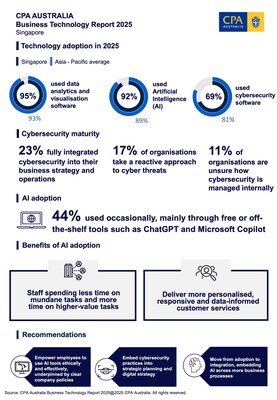
Technology adoption in Singapore businesses in 2025.
annual business technology research According to the survey, 95% of businesses in Singapore use data analysis and visualization software such as Python, Power BI, and Excel, slightly higher than the survey average of 93%.
Artificial intelligence (AI) adoption is close behind at 92%, which is also higher than the survey average of 89%. Nearly one in five organizations in Singapore has deeply embedded AI across their business operations, positioning Singapore as a frontrunner in strategic AI use.
However, the most common use of AI remains ad hoc and irregular deployments, reported by 44% of organizations. This typically involves deploying off-the-shelf AI tools like ChatGPT, Microsoft Copilot, Google Gemini, and using AI assistants built into productivity platforms like Microsoft 365 and Google Workspace.
“Singapore’s strong foothold in AI reflects the nation’s continued drive towards digital transformation and operational excellence. However, to unlock the full value of AI, businesses need to move beyond experimentation and strategically integrate AI across their functions,” said Greg Unsworth, Head of Chartered Accountants Australia and Singapore, PwC Singapore’s digital business and risk services leader.
Despite strong digital adoption, Singapore’s cybersecurity maturity remains a key vulnerability. Only 23% of companies fully integrate cybersecurity into their business strategy and operations, lower than the survey average of 28%.
Additionally, 69 percent of businesses report using cybersecurity software, lower than the survey average of 81 percent. This is deeply concerning, as organizations may be exposed to increasing risks as they expand their digital footprint.
The study found that 17% of organizations take a reactive approach to cyber threats, responding only to threats as they occur, rather than using structured defenses. Additionally, 11% are unsure of how cybersecurity is managed internally, citing gaps in governance and communication.
“Cybersecurity must be a strategic priority as digital adoption accelerates,” Unsworth said. “The rise of AI-powered threats, from advanced phishing to deepfake impersonation, makes it important for businesses to strengthen their cyber resilience. Trust must be earned and strengthened through every digital interaction.”
Respondents highlighted notable benefits from AI implementation. Over the past year, businesses in Singapore have been leveraging technology to streamline workflows, automate repetitive tasks, and improve the speed and accuracy of decision-making. These results have led to an improved employee experience, with staff spending less time on mundane tasks and more time on higher-value tasks. At the same time, the customer experience has also improved as organizations use AI to deliver more personalized, responsive, and data-driven services.
However, these benefits also come with challenges. Increasing reliance on AI raises concerns about human oversight and accountability, especially for decisions that require judgment and ethical considerations. Some organizations are experiencing job losses in routine and entry-level roles, and many continue to struggle with integrating AI into legacy systems.
Cultural and organizational barriers also impede adoption, including resistance to change, limited staff buy-in, and lack of understanding and trust in AI technology. These issues are further exacerbated by high implementation costs, uncertain return on investment, limited digital literacy among senior leaders, a lack of technology talent, and growing data privacy and security concerns.
Despite these hurdles, AI remains essential for companies that want to remain competitive.
Darryl Pereira, Member of CPA Australia and Director of OCISO and Head of Google Cloud at APJ, said: “Although the potential of AI is transformative, it remains a powerful collaborator rather than a replacement for human ingenuity. As we accelerate adoption, we must be intentional about retaining and improving valuable human skills. This change requires organizational leadership to proactively rethink roles, redesign workflows, and invest heavily in continuous learning. By prioritizing upskilling and development, cross-functional collaboration will help businesses stay competitive and enable teams to innovate responsibly.
As Singapore continues to lead in digital adoption, invest in cybersecurity maturity and foster a culture of responsible innovation, businesses can unlock the full potential of AI and data to drive sustainable growth and global competitiveness.
About the survey
CPA Australia’s fifth annual Business Technology Survey was conducted from July to September 2025. The study examines business technology trends across a variety of sectors, business sizes, and markets. The study included Australia, mainland China, hong kong special administrative regionMalaysia and Singapore. 44% of respondents worked for companies with 500 or more employees, 29% worked for companies with 50 to 499 employees, and 28% worked for companies with fewer than 50 employees.
About CPA Australia
CPA Australia is one of the world’s largest professional accounting bodies, with more than 175,000 members in more than 100 countries and territories, including more than 8,600 members in Singapore. CPA Australia has been active in Singapore since 1954 and opened its Singapore office in 1989. Our primary services include education, training, technical support, and advocacy. CPA Australia provides thought leadership on issues affecting the accountancy profession and the public interest. For more information, visit cpaaustralia.com.au.
Australian Chartered Accountant (PRNewsfoto/CPA Australia)
Sision
View original content to download multimedia: https://www.prnewswire.com/apac/news-releases/singapore-businesses-lead-in-ai-and-data-adoption-but-face-cybersecurity-challenges-302627415.html