Release date
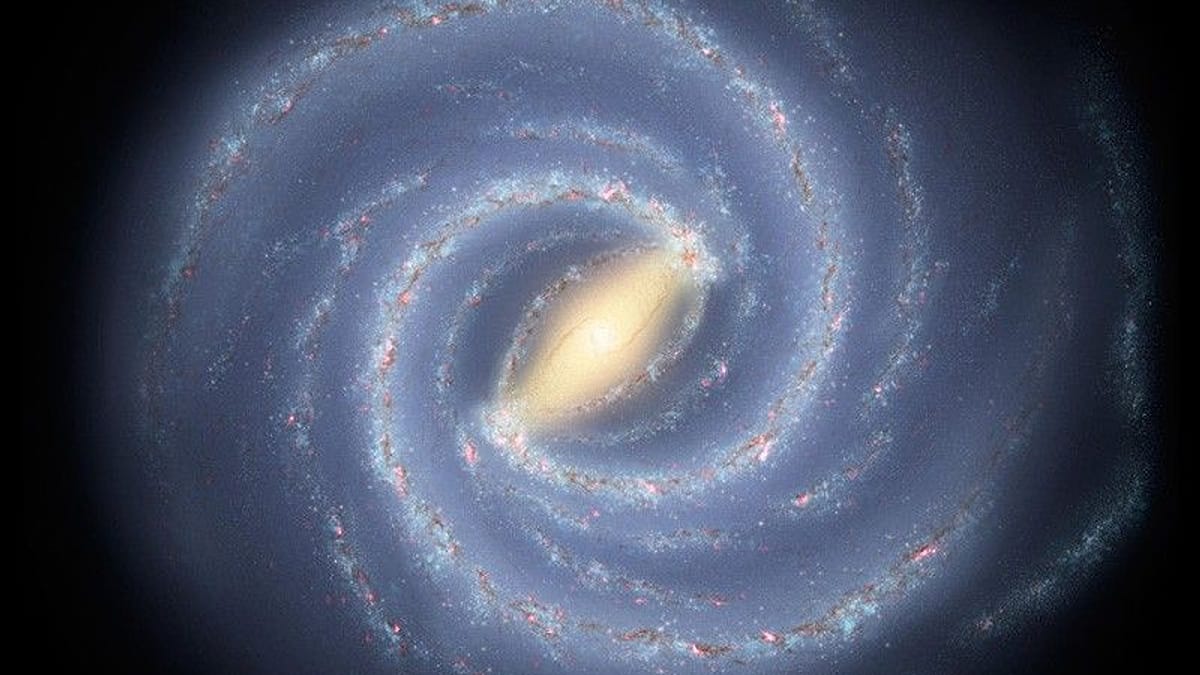
New breakthrough AI-assisted simulation milky way It is providing scientists with the most detailed study yet of how our galaxy evolves.
Tracking more than 100 billion individual stars through 10,000 years of evolution, the model provides an amazing level of resolution that astrophysicists have been pursuing for decades.
Until now, cutting-edge simulations have lumped stars into large groups and smoothed out the small-scale physical phenomena that shape galaxy growth and change.
The new method changes that completely. By blending deep learning Using traditional physics-based modeling, the team was able to generate galaxy-scale simulations 100 times faster than previous techniques, while using 100 times as many stars.
Why is simulating our galaxy so difficult?
To understand how the Milky Way formed and continues to evolve, scientists need models that capture everything from the galaxy’s vast spiral structure to the behavior of individuals. star And supernova.
But the physics involved, such as gravity, gas dynamics, chemical enrichment, and the explosive death of stars, unfold on vastly different time scales.
Capturing fast phenomena like supernova explosions requires simulations to be advanced in small increments, a process that is extremely computationally intensive and can take decades to model a billion-year history of a galaxy.
AI shortcuts
The project was led by Keiya Hirashima, a researcher at Japan’s RIKEN Center for Theoretical Mathematical Sciences (iTHEMS), in collaboration with colleagues from the University of Tokyo and the University of Barcelona. It was recently presented at SC’25 (International Conference on High Performance Computing, Networking, Storage, and Analytics).
Hirashima’s team solved this problem by introducing deep learning surrogate models. Trained on high-resolution simulations of supernova behavior, the AI learned how to predict how gas will spread during the 100,000 years after the explosion.
This allows the main simulation to proceed more quickly while preserving the details of individual supernova events. The approach was validated using data from the Japanese supercomputer Fugaku and the University of Tokyo’s Miyabi system.
The result is a full-fledged Milky Way simulation that achieves true individual star resolution and runs much more efficiently.
A million years of galaxy evolution takes only 2.78 hours. This means that one billion years can be simulated in about 115 days instead of 36 years.
“A true tool for scientific discovery”
While this result is a milestone for astrophysics, its implications go far beyond space science.
“A method similar to ours could be applied to simulating large-scale structure formation and black hole accretion in the universe, as well as simulating weather, climate, and turbulence,” the paper says.
Such hybrid AI physics methods could dramatically accelerate these models, making them faster and more accurate.
“I believe that the integration of AI and high-performance computing will fundamentally change the way we approach multiscale, multiphysics problems across computational science,” Hirashima said.
“This work also shows that AI-accelerated simulations can go beyond pattern recognition and become real tools for scientific discovery, helping us trace how the elements that form life itself emerged in our galaxy,” he added.
The team’s next step is to further expand this technology and consider its application to Earth system modeling.