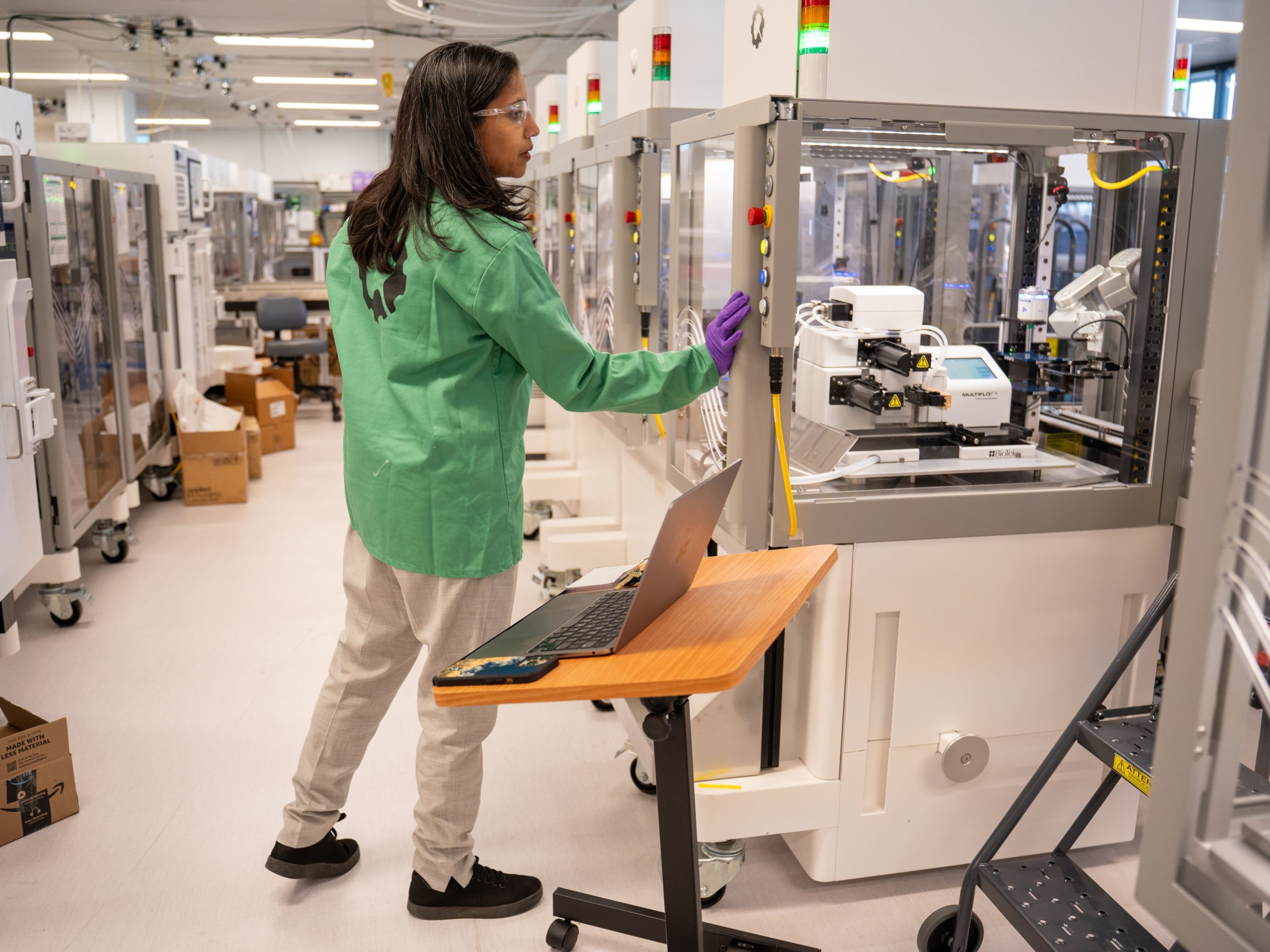
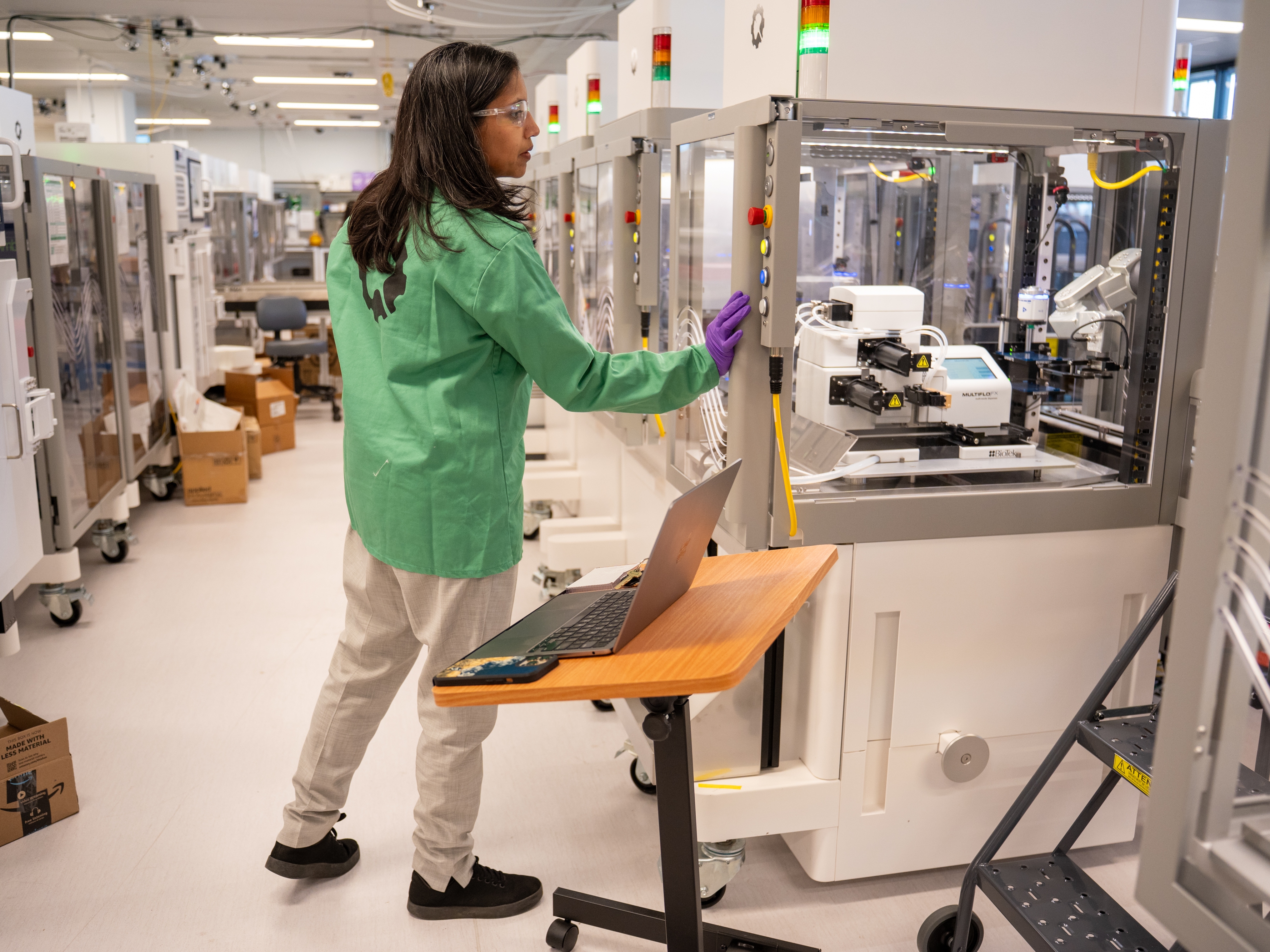
Reshma Shetty, co-founder and COO of Ginkgo Bioworks, walks around an autonomous laboratory where AI robots replace lab benches. Shetty says the use of AI has already fundamentally changed the way science is practiced. “The really exciting moment was when I first saw the lab notebook entries written by the models,” she says. Image: NPR’s Jodi Hilton/
Almost 20 years ago, four graduate students at MIT came together around a common idea. “We believed that programming cells would ultimately be more important than programming computers,” says Jason Kelly.
Want the latest articles on the science of healthy living? Subscribe to NPR health newsletter.
At the time, it felt like an outlandish gamble. Work such as gene editing and testing new molecules typically required hours spent in the lab. It was a labor-intensive process that involved carefully mixing hundreds of chemical cocktails by hand and pipetting them into Petri dishes.
They thought the first step was to speed up the process. So they started a company to replace human lab workers with robots.
Early potential investors weren’t thrilled, Kelly recalls.
“We were living off ramen noodles and buying equipment on eBay, but we couldn’t raise venture capital,” he says of his early days running a startup.
Then came the artificial intelligence boom. In 2014, about a year before founding OpenAI, Kelly remembers reading a blog post by Sam Altman. Kelly recalls that Attleman wrote about the possibility of automating biotechnology in the same way he imagined automating other types of technology. The two started talking.
“I was like, thank you for this blog post,” Kelly recalls. “We’ve been in business for five years. It’s impossible to raise money.”
Before long, Silicon Valley money started flowing.

“That’s it,” Kelly says, gesturing to a Petri dish being transferred from one robot to another. “It has actual living cells in it.”
To do this, scientists use AI to translate experimental plans into instructions for robots about the tasks they need to do in the lab.
Empowering robots as scientists
Recently, Gingko scientists have been experimenting with taking things a step further and giving robots the role of scientists.
“The really, really wild moment was when I first saw the lab notebook entries written by the models,” says Reshma Shetty, one of the founders.
Shetty recently worked on a collaboration with OpenAI. Through ChatGPT, they asked the bot to create a specific protein. This level of thinking is usually left to scientists, and is no different than writing a recipe and handing it to a robot to execute. They in turn asked the bot to write a recipe.
“We didn’t even know if it could make proteins,” Shetty says.
The bot performed better than expected. They concluded that protein synthesis could reduce costs by 40% compared to human work. More than 30,000 experiments were run over a six-month period. they published these resultHowever, this paper has not been peer-reviewed.
Both Shetty and Kelly emphasize that humans are still needed to ask the right questions and constraints on experiments. Still, Shetty says it has already fundamentally changed the way science is practiced.

“Usually I rush through the design of experiments because I need them to be completed so I can actually do all the pipetting in the lab and set everything up,” Shetty says.
She says she now spends more time designing experiments so that robots can perform them overnight.
New access to science comes with risks
Some warn that these new freedoms bring new dangers. Drew Endy, a bioengineering researcher at Stanford University, said artificial intelligence opens the door to the possibility that people with little scientific training can run experiments with questionable goals.
He and some colleagues recently wrote a paper that says: report It shows how artificial intelligence can be used to mass produce viruses and create other biosecurity threats.
Overall, Endy says, “As a researcher, I’m excited about AI and science right now,” but he’s also concerned about risks, such as the possibility of biological weapons programs in other countries. “I’m not excited about that.”
Regulations and policies to reduce these risks are within people’s reach, but they need to be prioritized well before biotechnology-induced disasters and wars occur, he said.
Up until now, biotech has been naturally insulated from these risks through intellectual gatekeeping, Endy said. “Biology has traditionally been difficult for people to really control,” he says. “AI could move a little more towards centralization of power.”
For better or worse, Jason Kelly said he foresees a day when the practice of science will be democratized.
“I think what happens when everyday people are able to ask scientific questions is a culture clash,” Kelly says.
audio transcript
Scott Detrow, host:
Researchers may be able to start experiments without ever setting foot in a lab. New technologies, including artificial intelligence, are making it possible to delegate all kinds of tasks, from repetitive lab work to design experiences. NPR’s Katia Riddle visited a Boston company that’s building something called an autonomous lab.
KATIA RIDLE, BYLINE: The origins of this company, Ginko Bioworks, begin with a few graduate students at MIT. It was almost 20 years ago that they came together around a common idea.
Jason Kelly: We wanted to make it easier to design biology, right? We believe that programming cells will ultimately be more important than programming computers.
Riddle: Jason Kelly was one of those students. Currently, he is one of the founders of the company. Tasks like gene editing and testing new molecules typically require hours of painstaking labor in the lab. These scientists wanted to replace humans performing these tasks with robots. Not everyone believed the idea would work.
Kelly: You know, we were living off ramen noodles and buying equipment on eBay and we couldn’t raise venture capital.
Riddle: Then came the AI boom. In 2014, Kelly remembers reading a blog post by someone named Sam Altman. He, of course, later founded the artificial intelligence company OpenAI. Altman thought about how to use AI to automate biotechnology. The two got in touch. Before long, Silicon Valley money started flowing. Today, Ginkgo Bioworks’ laboratory is located in a building overlooking Boston Harbor. These engineers and researchers believe they are building the science laboratory of the future.
Kelly: It’s done with a pipetting robot. I’ll show you where to do it.
Mystery: Kelly wanders through an automated laboratory. The glass-encased robots are all working on separate projects. A large screen displays a color-coded schedule of experiments to be performed on this day. Oversized toy track-like circuits run through the room, delivering materials from one robot to another.
KELLY: And then you pull up the plate. That arm lifts the plate and places it on the device.
Mystery: Using AI to direct robots, scientists do all kinds of work here, including researching new kinds of drugs…
KELLY: So there’s a deep well there, and it usually contains actual living cells.
Riddle: …also microbes for better fertilizers and the production of proteins to make snow and ice. Much of this work involves using AI to translate instructions to the robot. Recently, scientists here are going a step further and giving AI the role of scientist. Reshma Shetty is also one of the founders.
Reshma Shetty: A really, really wild moment was when I first saw the lab notebook entry that the model had written.
Mystery: Shetty recently collaborated with OpenAI, the company that created ChatGPT. They gave it a challenge.
Shetty: So we just said, take the off-the-shelf GPT-5 that everyone has access to and design a cell-free protein synthesis reaction. And we didn’t even know if it could make proteins, right?
Riddle: Usually they give the AI agent very specific instructions, like giving them a recipe. In this case, we asked ChatGPT to create their own recipe.
Shetty: It was about summarizing scientific data, analyzing it, and actually generating new hypotheses.
Mystery: Shetty says AI is already fundamentally changing the way science is practiced.
Shetty: Usually I’m really rushing through the design of experiments. Because you have to actually do all the pipetting in the lab so you can set everything up and get it done before you go home.
Riddle: Now she spends more time designing experiments so that robots can do them overnight. Some warn that these new scientific freedoms come with risks. Drew Endy studies bioengineering at Stanford University.
Drew Endy: The meta-risk is that we’re going to hand over science to AI and not be able to figure out how to do science, right?
Mystery: He warns that these types of labs could one day become available to people with little or no scientific training.
Endy: I’m not excited about that.
Mystery: Corrupt governments can generate viruses and other biosecurity threats, he says. Historically, Endy says, not many people understood how to manipulate biology. For this reason, weaponization has been difficult until now.
Endy: It was difficult for people to really control that. AI could move a little more toward centralization of power.
Mystery: Ginkgo Bioworks scientist Jason Kelly agrees. For better or worse, he foresees a day when everyone will be able to run experiments with these bots.
Kelly: And I think there’s going to be a culture clash about what happens when everyday people are allowed to ask scientific questions.
Riddles: Answer questions with the help of scientific robots and increasingly robot scientists. Katia Riddle, NPR News, Boston.
(SOUNDBITE OF THE DARE SONG “GIRLS”)