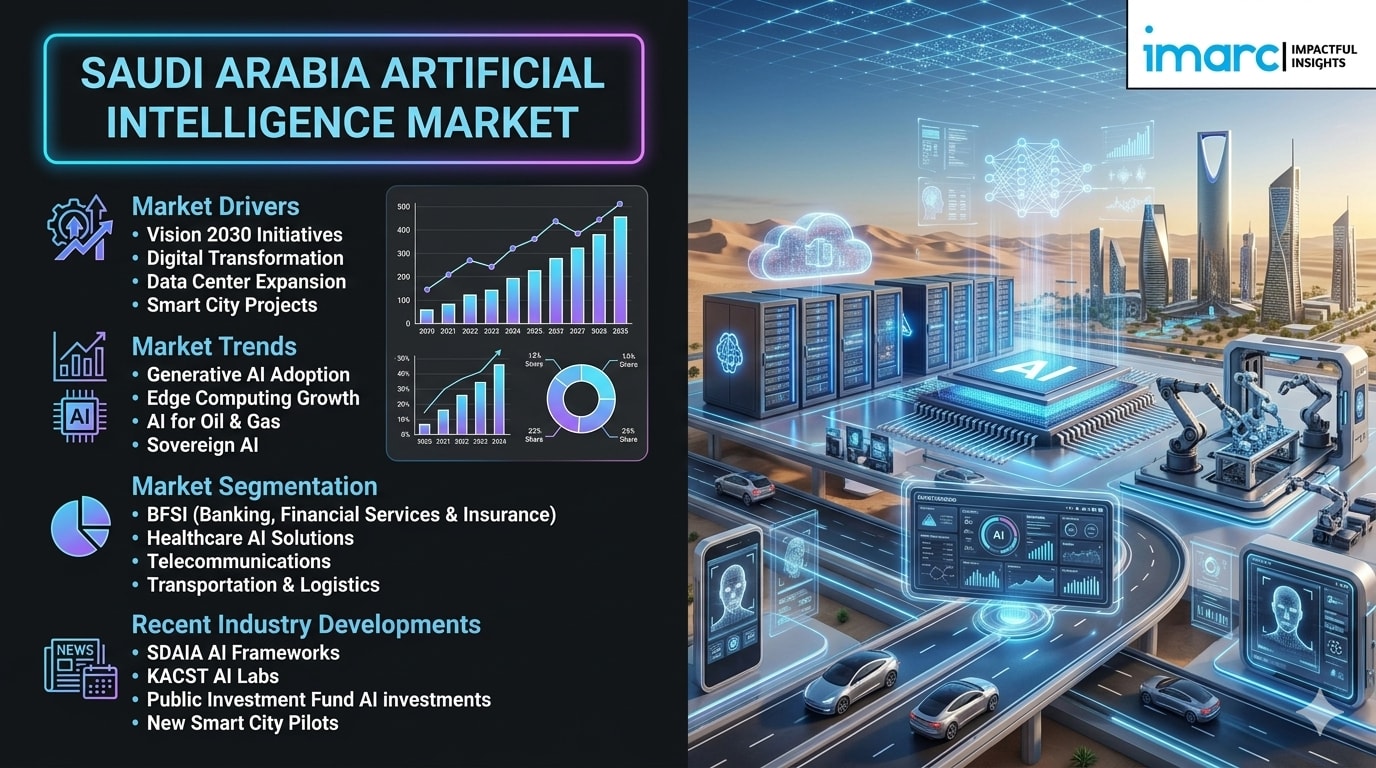
According to IMARC Group’s latest research publication, Saudi Arabia’s artificial intelligence market size is valued at USD 1,242.5 million in 2025. Looking ahead, IMARC Group projects the market to reach USD 4,374.5 million by 2034, growing at a CAGR of 15.01% from 2026 to 2034.
How AI will reshape the future of Saudi Arabia’s artificial intelligence market
- Smart City Infrastructure Development: AI powers NEOM’s autonomous systems, traffic management, and energy grid, with more than 90% of city operations designed for AI-driven automation, creating the world’s first cognitive urban environment.
- Medical diagnostic revolution: In Saudi hospitals, machine learning algorithms analyze medical images with 95% accuracy and reduce diagnosis time by 60%, supporting the kingdom’s goal of universally accessible predictive medicine.
- Automating financial services: Banks deploy AI chatbots that handle 70% of customer inquiries, and fraud detection systems process millions of transactions every day, reducing operational costs by 40% and increasing security.
- Oil and gas optimization: AI monitors more than 200 oil fields in real time, predicts equipment failures weeks in advance, and optimizes extraction processes, saving Aramco operations billions of dollars in maintenance costs.
- Arabic language processing: Natural language models trained on Arabic dialects power government e-services, reach 85% accuracy in understanding regional differences, and make digital services accessible to all citizens.
How Vision 2030 will transform Saudi Arabia’s artificial intelligence industry
Vision 2030 positions artificial intelligence as a cornerstone of Saudi Arabia’s economic transformation, with the kingdom investing more than US$20 billion in AI infrastructure and talent development. The Saudi Data and Artificial Intelligence Authority (SDAIA) is driving the implementation of a national AI strategy across more than 200 government agencies, digitizing services for 34 million residents and visitors. Key initiatives such as the National Strategy on Data and AI aim to contribute USD 50 billion to GDP through the adoption of AI. The government has established a specialized AI university to train more than 20,000 professionals and launched a regulatory sandbox that allows more than 100 startups to test AI solutions. A public-private partnership with a global tech giant has established advanced AI research centers in Riyadh and Jeddah. Meanwhile, the mandate for AI integration in Vision 2030 megaprojects is creating huge demand for intelligent automation across construction, tourism, entertainment, and logistics sectors.
Request a sample report with the latest data and forecasts
Trends and drivers of the Saudi Arabian artificial intelligence market:
The Saudi AI market is experiencing explosive growth due to unprecedented government support and investment in digital transformation. The Public Investment Fund allocated US$40 billion to technology ventures, with the majority going to AI startups and infrastructure. AI-powered chatbots and automation were integrated into over 300 government services, reducing processing times by 75% and improving public satisfaction scores. Smart city projects across five major city centers deploy AI for traffic optimization, waste management and public safety, with Riyadh’s intelligent transportation system reducing congestion by 30%. The establishment of an AI-focused free zone will offer 100% foreign ownership, zero corporate taxes for 50 years, streamlined licensing, and attract more than 150 international AI companies. Cloud computing adoption has reached 65% of Saudi businesses, providing the infrastructure backbone for AI deployment across industries.
Education and talent development are transforming Saudi Arabia into a regional AI powerhouse, with more than 50 universities offering AI and data science programs and enrolling more than 25,000 students annually. The National Center for AI has graduated 5,000 certified professionals and trained an additional 15,000 people in machine learning fundamentals through coding bootcamps. Female participation in technology increased to 35%, supported by government scholarships that sent more than 3,000 female students abroad to specialize in AI. A corporate training program by a leading company helped 40,000 employees improve their skills in AI tools and analytics. Through international partnerships, MIT, Stanford, and other leading institutions have established an AI research institute in Saudi Arabia, published more than 1,200 research papers, and filed more than 300 AI-related patents. Expanding the talent pool reduces dependence on foreign expertise and creates high-value jobs in line with economic diversification goals.
Deployments in oil and gas, healthcare, finance, retail, and manufacturing are driving continued market expansion, with companies allocating 15-20% of their IT budgets to AI implementation. Retail giant implements computer vision for inventory management in over 500 stores, reducing out-of-stocks by 45% and improving customer experience. Manufacturing facilities integrated predictive maintenance AI, increasing equipment uptime from 75% to 92% and reducing unplanned downtime costs by $200 million annually. Telecommunications provider uses AI to optimize network performance for 45 million mobile subscribers and increase efficiency in 5G deployment. The agriculture sector pilot leverages AI-powered precision agriculture across 50,000 hectares to reduce water consumption by 35% in an arid region. The government’s AI procurement mandate mandates 30% local AI content in public contracts, fostering domestic innovation and creating opportunities for more than 200 homegrown AI solution providers serving both government and the private sector.
Saudi Arabia Artificial Intelligence Industry Segmentation:
The report categorizes the market into following categories:
Providing insight:
- hardware
- software
- service
Technology insights:
- machine learning
- natural language processing
- computer vision
- others
Deployment mode insights:
Application insights:
- health care
- BFSI
- Retail and e-commerce
- manufacturing industry
- cars and transportation
- others
Competitive environment:
The competitive landscape of the industry was also investigated, along with the profiles of key companies.
Saudi Arabia Artificial Intelligence Market Recent News and Developments
- January 2025: The Saudi Data and Artificial Intelligence Authority (SDAIA) launches the National AI Governance Framework, which establishes ethical guidelines and compliance standards for AI deployment across more than 300 public sector and private companies.
- March 2025: Saudi Aramco announced a USD 1 billion AI Innovation Fund to partner with more than 50 startups to develop AI solutions for energy optimization, carbon capture analysis, and automated oilfield operations.
- June 2025: King Abdullah University of Science and Technology (KAUST) opens an advanced AI research center with 500 researchers focused on Arabic models, climate prediction AI, and quantum computing applications.
- September 2025: STC Group deploys AI-powered 5G network optimization to 95% of urban areas, uses machine learning to manage 50 million connected devices, and reduces network latency by 40%.
- December 2025: The Ministry of Health introduced an AI diagnostic system to more than 150 hospitals across the country, processing 2 million medical scans annually with 93% accuracy for early disease detection and treatment planning.
Note: If you require specific details, data, or insights that are not currently within the scope of this report, we would be happy to accommodate your request. As part of our customization services, we collect and provide any additional information necessary to meet your specific requirements. Please let us know your exact needs. We will ensure that your reports are updated to meet your expectations.