
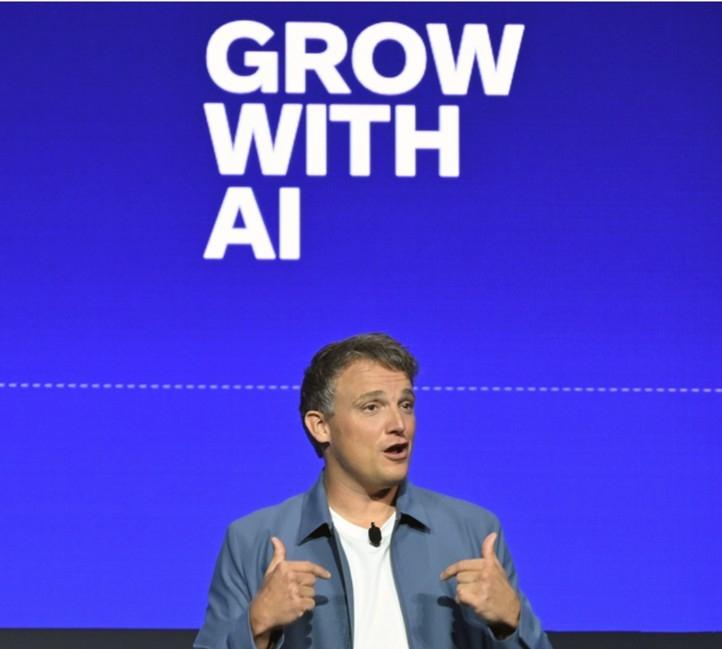

SAP CEO Christian Klein speaks at Sapphire. SAP is more than just an enterprise software company. We are an AI company.
SAP
The software sector was under tremendous pressure in 2026 as Wall Street panicked about the upcoming “SaaSpocalypse.” The idea was that AI based on large-scale language models would undermine traditional subscription-based business models. Billions of dollars in software market value disappeared within days. Enterprise software stocks were being treated like companies with an uncertain future.
It’s true that SAP’s stock price has fallen. SAP is the largest provider of enterprise software, the software that large companies use to run their businesses. Shares have fallen about 30% over the past year as cloud revenue fell short of expectations. These revenues are an indicator of future growth.
Address AI threats directly
SAP CEO Christian Klein addressed these issues directly with Sapphire. Sapphire is SAP’s flagship annual conference, bringing together thousands of business leaders, developers, and partners to hear about the latest products from SAP.
“A while back, when we started preparing this venue, I asked myself, ‘Is SAP really going to be a software company in the future?’ There’s no question that AI is changing everyone’s lives, including my own as a CEO. I use AI for all kinds of tasks.” But AI still makes mistakes. In business, being 80% correct is not enough.
“According to a recent Stanford AI study, nearly all companies are using AI, but many see little value,” Klein continued. “Large language models are getting better and better at tasks like generating text and images, and in specific areas like writing software. All of these use cases are related to public content that the modules are trained on. But when you move below the waterline, beyond the level of sales, and into the real business world, you find that none of these models are trained on business data or processes. Also, these AI agents are not trained on security compliance. They are not naturally compliant with governance requirements such as frameworks, dataset privacy requirements, and corporate identity authorization rules.
How does SAP increase AI trust and compliance?
The brain of every company is an enterprise resource planning system. SAP is the largest provider of ERP solutions. Since 1972, SAP has “developed ERP with incredible depth of process and data domain know-how,” the SAP CEO noted. “All governance requirements and customer-specific extensions are stored in ERP. ERP is the trusted execution system that runs the company. So how can we inject this deep business domain into our AI agents?”
Mr. Klein gave a demonstration on stage. He asked Joule (what they call Agent Framework) to write an update on the business’ annual financial projections based on the latest sales pipeline data, as well as a forecast of what the supply chain could actually produce.
“Prompts are being handled by a large language model and so far it’s working very well,” exclaimed the CEO. “But in the future, LLMs will access the brain of every company, the ERP, to first find the right process among the thousands of business processes within the company, and then knowledge graphselects exactly the right data from over 7 million data fields stored in your ERP landscape, and finally checks all identity and approval rules to ensure results are not only accurate but compliant before they are shared. ”
Let’s take a break. What is a knowledge graph? Why is it important? A knowledge graph is a system that structures and connects complex data into networks of meaning. For example, in the supply chain realm, we map real-world entities (such as parts as nodes, suppliers, shipments, locations, etc.) and their relationships (such as “supply”, “transit routes”, “dependencies” as edges). This allows you to create a digital twin of your supply chain based on data, rather than networks as humans think them.
Graph databases work best when the data being manipulated is highly connected with complex many-to-many relationships. This is an incredibly powerful tool that should have become a standard part of enterprise and supply chain solutions years ago. We hope that the AI will find the hidden links. Knowledge graphs are key to this.
At the heart of SAP’s Business AI platform is the context layer. “Here we infuse the AI agent with deep know-how of the ERP business domain through the knowledge graph,” the CEO continued. “Our AI agents are equipped with a compass and map to find the right processes and data within the ERP universe, giving them the right context.
These graphs are complemented by a new SAP domain model. These models are trained on SAP code to provide a deeper understanding of your company’s business logic. Additionally, SAP also has a contextualization solution called Reltio. This tool allows businesses to create a single gold record for all their master data end-to-end.
So SAP is “building a new SAP,” Klein proudly claimed. “By integrating our AI foundation with our business data cloud and business technology platform, we bring together LLM with 50 years of business know-how stored in ERP.”
SAP Business AI Platform
The new SAP Business AI platform forms the basis of SAP’s vision of an autonomous enterprise, where agents run jobs and managers can focus on more strategic issues.
SAP understands that large enterprises have heterogeneous IT environments. Agents also need to understand non-SAP data. “So we included SAP Business Data Cloud in our context layer to build one semantic data layer across SAP and non-SAP applications.”
Governance issues are important for large companies. Non-SAP agents must be placed in an SAP environment.
Next, SAP Chief Technology Officer Philipp Herzig spoke about expanding SAP’s business AI platform. “Before you start building something, it would be great to know what to build. What will have the biggest impact on your business? Previously, you would have to do time-consuming research and AI discovery workshops. Now it’s as easy as typing, ‘Show me your top three business challenges.'”
The IT giant has something called a “process consulting agent,” part of SAP’s Signavio solution, that dives deep into actual business processes to diagnose the biggest opportunities. Once identified, you can build the agent in Joule Studio.
“This is the place to extend, build, and integrate AI experiences like never before. Since its launch, our customers and partners have been building incredible things with Joule Studio,” said Hetzig. ABB currently automatically processes more than 15,000 RFQs each year, saving millions of euros.
The platform enables companies to move from AI pilots to deployed agents much more quickly and accurately than before.
Anthropic supports SAP’s AI strategy
Daniela Amodei, co-founder and president of Anthropic, spoke via video link at the event. She announced that SAP will integrate Anthropic’s Claude model into the newly launched SAP Business AI Platform. In my lifetime, no technology has captured the attention of business executives more than LLM AI. And no AI company is more respected or talked about than Anthropic.
There is a certain irony to Amodei’s talk at Sapphire. In February, Anthropic showed off a product demo that showed how quickly you can build enterprise applications. This triggered the SaaS apocalypse.
“We raise Claude,” Amodeo said. “It’s the AI that businesses trust most. At Anthropic, we build frontier AI systems, and we’ve learned that when the stakes are high, businesses reach for the AI they trust. We founded the company on the belief that as AI becomes more capable, businesses need to understand how AI makes decisions and know that AI will operate within the boundaries they set.
“Earning that trust comes at a cost. We delayed our launch due to safety concerns and published the study despite its controversy. These decisions are not easy in the fastest-changing industry on the planet, but we believe they are the right ones.”
“This brought us to SAP. The world’s largest companies run on SAP, and that’s exactly where Trusted AI belongs. By combining Claude with the depth and scale of SAP, we can help hundreds of thousands of organizations use AI in every part of their business.”
“Within Joule, Claude powers agents that take action across finance, HR, procurement, and supply chain. This allows AI to work within the systems you’ve already invested in and the processes your employees already rely on. SAP is a great example of a company bringing AI to the enterprise in a way that customers can actually trust.”


