
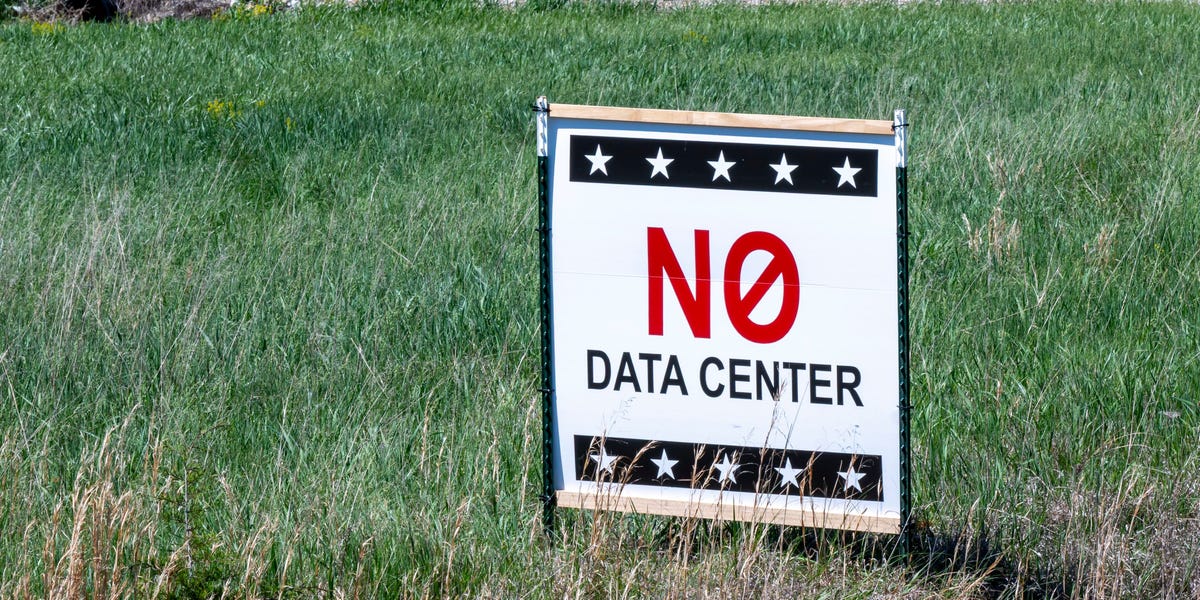
AI data center developers love rural America. However, the feelings are not mutual.
According to the Gardner Food and Agriculture Policy Survey, Americans living in rural areas are more concerned about the impact of AI data centers in their communities than Americans in urban and suburban areas.
That makes sense. Rural communities are at the forefront of the explosion of AI data centers. Pew Research Center reported in April that 87% of existing data centers are in urban areas, but 67% of planned data centers are in rural areas.
Business Insider reported in June that the majority of permits issued for new data centers in 2025 will be for regional cities. These new data centers are often designed to power AI and are orders of magnitude larger than older data centers built to support the internet and social media.
“For the average respondent, more than any other issue, data centers’ impact on electricity bills is of greatest concern,” the Gardner researchers wrote. “However, rural respondents were most concerned about rising electricity prices.”
Researchers at the University of Illinois conducted an online survey of about 1,000 Americans in February. They announced their results in June.
People in rural America also worry about how data centers will affect their agricultural land and water access. Researchers said the findings suggest that the biggest concern for rural residents is how their personal finances will be affected.
“Small communities do not want to miss out on these economic development opportunities, because some benefit from the contributions these developments make to local tax bases. But they also do not want to have to accept decisions that may negatively impact their futures,” the researchers wrote.
Technology companies need new data centers to support their AI products and are spending billions of dollars building them. They claim the facility will create jobs and promote economic growth in the communities in which it is built. However, a growing number of Americans are objecting to this. They are concerned that water resources will be depleted and air quality, the environment, and overall quality of life will deteriorate. Many of them simply don’t like AI.
This resistance to data centers is becoming harder for politicians to ignore, especially as the November midterm elections approach. For example, Texas Governor Greg Abbott said at a campaign event this week that building data centers in rural areas should be banned statewide.
“Even if they are thinking of an AI data event coming here, they need to do it in a way that brings their own money, brings their own power, reuses their own water, and lowers electricity bills for residents across the state,” Abbott said. “We must ban them from building AI data centers in rural Texas and eliminate the tax breaks they are getting.”
Mr. Abbott made the remarks Tuesday in Bullard, a rural Texas town of about 5,300 people. Texas is a popular destination for data center construction, along with states such as Virginia and California.
Mr. Abbott also last month directed the Public Utilities Commission of Texas and the Electric Reliability Council of Texas to take steps to protect residents from data center infrastructure costs.
“Governor Abbott’s position is clear: Data centers have no place in front of Texas families,” a spokesperson for Governor Abbott said in a statement. “Governor Abbott will work with legislators next legislative session to ensure data centers do not negatively impact local communities.”
Other prominent politicians have also proposed tougher policies. In March, Sens. Bernie Sander of Vermont and Alexandria Ocasio-Cortez of New York proposed a moratorium on AI data centers at the federal level. New York Governor Kathy Hochul is considering a one-year moratorium on AI data centers after the state Senate passed a bill. Many other communities are considering adding new restrictions or banning development altogether.
Meanwhile, the Trump administration has broadly supported building AI infrastructure, smoothing the way for efforts like Project Stargate, a $500 billion plan to build massive data centers across the country to support artificial intelligence. Many of these projects are carried out in rural areas.