
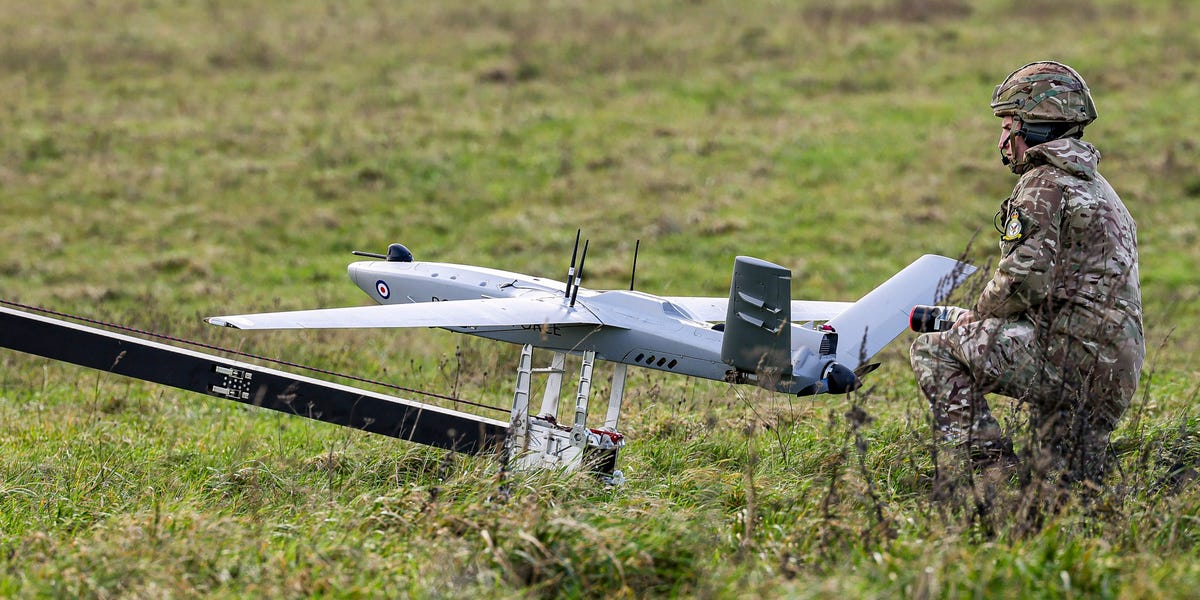
The UK’s vision for an AI-powered air force is no longer a future goal for the 2030s, but is here and needed now, a senior Royal Air Force official has said.
The head of the Royal Air Force, Air Chief Marshal Harvey Smith, said he initially thought the UK was about 10 years away from becoming what he called an “AI Air Force”, operating “robotic fighters” alongside traditional manned aircraft.
“We knew that was our future, but maybe two or three years ago we would have been talking about 2035 being the end point. I think that’s today,” Smith said. Chief of Air StaffHe spoke from inside a hangar at a Royal Air Force base in England, the location of which was not disclosed for security reasons.
The Royal Air Force is among Western air forces pursuing autonomous AI-powered drones, known by names such as “loyal wingman,” “cooperative fighter,” and “autonomous cooperative platform,” depending on the country and developer.
These unmanned systems are designed to fly alongside or ahead of manned fighter aircraft to augment overall air power. It can also be used to penetrate disputed high-threat areas without endangering human pilots.
One example of this new technology is Britain’s Stormshroud drone, which can jam enemy radars and clear the path of British F-35B and Typhoon fighter jets, which are vulnerable to surface-to-air missile attacks. The unmanned system began operations in May 2025.
The StormShroud drone is on display in 2025. Photo by Leon Neal/Getty Images
The Royal Air Force launched its Autonomous Cooperative Platform Strategy in 2024, outlining plans to integrate unmanned aerial vehicles into the force. The document detailing the strategy states that by 2030, “battle-winning ACP capabilities” will be an “integral part” of the UK military structure and routinely operate alongside maneuvering systems.
“In theory, we always knew this was a capability that would become a reality in the future,” Smith said of advanced unmanned aerial vehicles. “We expected it to really emerge within the next 10 years. In fact, it’s here today.”
The Royal Air Force Commander shared: “We are about to embark on work that will help the Air Force reconsider its combat aviation strategy and what role those kinds of capabilities could potentially play, much sooner than we previously thought.”
Smith said Britain accelerated these integration efforts in part because of the US and Israel’s war against Iran, which forced the military to rethink its approach to drone warfare. He said one of the most “interesting” and “exciting” changes for the RAF today was the switch to unmanned aircraft.
The development of loyal wingman-type drones has emerged as a priority for several countries. For example, in the United States, two designs, General Atomics and Anduril, became the first joint fighter concepts to receive the unmanned fighter designation.
Major US defense companies such as Lockheed Martin, Boeing, and Northrop Grumman are developing other new designs such as the Vectis aircraft, the MQ-28 Ghostbat, and the Talon drone. There are related efforts outside of this area, such as Shield AI’s X-BAT autonomous fighter jet and Boeing’s MQ-25A Stingray refueling drone.
Western militaries are developing loyal wingman-type drones, such as this joint fighter design being tested by the United States. usa air force photo
The UK, along with the US and other NATO allies, is pushing to integrate drones and AI more broadly into its military structure, as wars in Ukraine and the Middle East demonstrate the value of using cheap unmanned systems for offensive and defensive missions.
In Ukraine, for example, interceptor drones are being used to shoot down Russian attack drones, ground robots are being deployed to replace soldiers in some frontline areas, and AI is being used to accelerate decision-making and targeting.
However, the use of AI for military purposes has raised concerns about the potential for battlefield mistakes and accidental bombing of civilian areas.
Last week, the U.S. Department of Defense announced that it had signed contracts with several large tech companies, including Google, SpaceX and Microsoft, to use its AI on sensitive networks, sparking some backlash within Google.
The Pentagon said in a statement that the agreement will “accelerate the transformation” of the U.S. military into an “AI-first combat force.”