A single fall can turn independent living into a medical emergency, especially for older adults who live alone. To address this growing safety challenge, Cedarville University’s senior design team is developing an autonomous, voice-controlled assistive robot designed to help older adults live safely and independently in their own homes.
Support robot for the elderly aiming to support independent living
The robot, called Alfred, is being developed in response to the rapidly aging population and widening disparities in caregiving worldwide. In the United States alone, the number of adults 65 and older is projected to reach 82 million by 2050. At the same time, more than 8 million adults who require assistance with daily activities are currently not receiving in-home assistance, raising concerns among health care providers, policy makers, and families about how these needs will be met.
Addressing the shortage of caregivers with stationary aging technology
This growing gap cannot be filled by human caregivers alone. As the Cedarville team is discovering, advances in artificial intelligence (AI) and robotics can help provide scalable in-home assistance to older adults who want to age gracefully while preserving their dignity and autonomy.
This project is being developed as part of the student’s capstone design experience. Designed to assist users through natural voice interaction, Alfred helps with daily routine tasks while monitoring safety risks within the home.
Computer engineering students build Alfred assistive robot
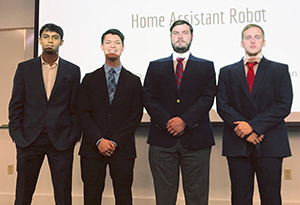 The senior design team includes Jonathan Clevenger of Washington, Pennsylvania; Loni Ebenezer of Eureka, Missouri; David Pascual of Hollidaysburg, Pennsylvania; and Ethan Wilson of Carneysville, West Virginia. All students are fourth-year students majoring in computer engineering.
Once complete, Alfred will be able to find and identify common household items, provide voice reminders for important tasks like taking medications, detect falls, and notify caregivers and emergency responders in the event of a fall. The team continues to test and refine the system to improve accuracy and reliability.
“There is a widening gap between the number of older adults who want to live independently and the support available to them,” said Ebenezer, the project’s team leader. “Projects like Alfred are one way to fill that gap. We focused on making Alfred as easy to use and accessible as possible. That’s why Alfred is primarily voice-controlled, so older adults don’t have to deal with touchscreens or complex interfaces.”
Comparison of household robots like Alfred and Amazon Astro
As part of the design process, the team looked at existing consumer robots on the market, such as Amazon’s Astro, which is primarily designed for home security and remote monitoring. Although these systems provide limited support, the Cedarville students concluded that many commercially available robots do not adequately address the safety needs of older adults living alone.
“When we looked at existing home robots, many focused on simple companion functions, but not enough safety considerations,” Ebenezer said. “Since our target users are elderly people who live alone, we thought we needed to prioritize features such as fall detection and danger detection.”
AI and robotics combine computer vision and audio processing.
To achieve these goals, the team integrated multiple forms of artificial intelligence into Alfred’s system. The robot combines high-performance AI computing with flexible embedded controls, using computer vision and audio processing to recognize objects, identify hazards, and determine the direction of a speaker’s voice.
Although Alfred is still a prototype, this project highlights how Cedarville students are applying advanced engineering skills to real-world challenges with global relevance. By combining technical expertise and a human-centered design approach, the team has the experience to contribute to the future of assistive technology, healthcare innovation, and in-place aging solutions.
About Cedarville University
Cedarville University, an evangelical Christian institution in southwestern Ohio, offers undergraduate and graduate residential and online programs across the arts, sciences, and professional fields. With 7,265 students, the university is one of the largest private universities in Ohio and ranked among the top five evangelical universities in the nation on the Wall Street Journal’s “America’s Best Colleges 2026.” Cedarville is also known for its vibrant Christian community, challenging academics, and high graduation and retention rates. For more information, visit siderville.edu.