The Taipei German Trade Bureau today announced that 2025/2026 Business Sentiment Survey Reportindicating that German companies in Taiwan achieved strong operating results in 2025 despite heightened global economic uncertainty. While overall satisfaction fell to its lowest level in five years (52.1%), 65.7% of businesses met or exceeded their annual business goals, marking the third highest performance in the past eight years.
The study further shows that 40.8% of companies reported an increase in revenue, 40.0% of companies achieved higher EBIT margins, and 37.1% of companies outperformed their respective markets, particularly driven by machinery and electronics. This strong company-level performance corresponds to strong bilateral economic fundamentals. In 2025, the total trade between Taiwan and Germany will reach US$21.7 billion, an increase of 6.0% over the previous year, and bilateral trade exceeded the US$20 billion threshold for the fifth consecutive year. These numbers highlight the resilience of Taiwan’s economic fundamentals and demonstrate that businesses continue to achieve stable growth despite external challenges.
Dr. Eva Langerbeck, Chief Representative and Executive Director of the Taipei German Trade Bureau, said: “Although overall satisfaction levels have declined slightly, both operating results and bilateral trade data confirm that German companies in Taiwan remain highly competitive and well-positioned for future growth.” “Artificial intelligence and semiconductors will remain at the core of bilateral cooperation. At the same time, global economic headwinds and evolving trade policies remain important considerations in business planning and investment decisions.”
AI gains momentum as external risks continue to dominate
The survey found that 54.2% of companies are already benefiting from the global AI boom, with automation/smart manufacturing (50.0%) and semiconductors (48.5%) identified as the areas for the highest growth.
Nevertheless, external risks remain the most pressing concern. 61.1% of respondents cited global economic growth as their main challenge, followed by cross-Strait relations (58.3%) and Taiwan’s economic outlook (48.6%). Encouragingly, concerns about impacts on both sides of the Strait continued to ease. The percentage of companies expecting future business impacts fell to 26.8%, a decrease of 13.4 points from 2023. Nearly 20% expected no impact, while the majority (53.4%) had a neutral view.
Additionally, 75.3% of companies reported being at least slightly affected by U.S. trade policy and tariffs, primarily due to decreased customer demand, increased planning uncertainty, and increased cost pressures. Import restrictions affected 24.2% of businesses, and 16.7% were affected by export restrictions, primarily due to increased compliance costs, delays and supply chain disruptions.
Investment activity is steady despite weakening future orientation
Regarding investment activities, 50.0% of companies implemented their 2025 investment plans as planned, roughly in line with 2024. However, 11.1% reduced or canceled investments. Looking to the future, investment appetite is weakening. Only 30.6% of companies plan to make new investments within the next two years, marking the first time in eight years that their share has fallen below 40%. On the other hand, the percentage of undecided companies increased significantly to 30.6%. Despite heightened short-term concerns, long-term commitment to Taiwan remains strong. An overwhelming 94.4% of companies reported that they had no plans to relocate their investments.
According to statistics from the Ministry of Economic Affairs’ Investment Review Bureau, approved German investment in Taiwan will reach US$209 million in 2025, an increase of 264% from the previous year. This shows that German companies continue to consider Taiwan as a strategic hub for technology and R&D in the Asia-Pacific region, even as global supply chains continue to adjust.
Confidence in Taiwan’s economic outlook continues after strong growth
Looking to the future, confidence in Taiwan’s overall economic outlook remains strong. Following strong GDP growth of 8.7% in 2025, nearly 90% of respondents expect Taiwan’s economy to stabilize or even improve in 2026 (44.5% each), reflecting sustained optimism.
When asked about the most promising growth areas, 94.4% cited semiconductors and AI, far ahead of energy and resources (38.9%) and aerospace and security (37.5%). This highlights the central role of advanced manufacturing and high-tech ecosystems in Taiwan’s future economic development. At the corporate level, expectations for 2026 are shifting towards greater stability. While 44.5% expect sales to increase and 33.3% to improve profitability, the majority expect employment (67.6%) and productivity (58.6%) to remain about the same.
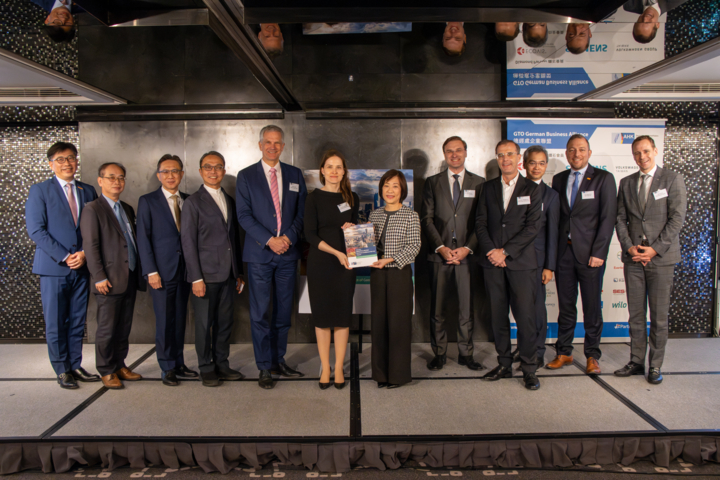
At today’s Economic Outlook Conference, Dr. Langerbeck formally submitted the 2025/2026 Business Sentiment Survey Report to the Deputy Minister of Economic Affairs (MOEA), Ms. Cynthia Kian. Taipei German Trade Bureau aims to further strengthen Taiwan’s business environment and deepen bilateral economic cooperation through continuous constructive policy dialogue.
The conference was also attended by representatives of German companies and industry experts, who exchanged views on artificial intelligence, semiconductors, energy transition, advanced manufacturing, etc., and provided positive insights on economic development in 2026.