If your business has a website, odds are an AI SEO agency has pitched you in the past year. These agencies claim search is being replaced by AI answers, your competitors are already turning up in ChatGPT and keeping pace now requires a separate discipline than traditional SEO. They’re selling “answer engine optimization”, or AEO, and some businesses are charging up to thousands per month for it.
The trends they’re describing are real, but whether it justifies the price tag and a separate agency is a different question. In May 2026, Google published its own guidance on optimizing for AI search, and its position is unusually blunt for a company that rarely commits to specifics. We read that documentation alongside the available research on what AI search is actually doing to website traffic, and the picture is clearer than the marketing suggests.
What AI SEO agencies are selling
AEO is sometimes called by other names, including generative engine optimization (GEO), large language model optimization (LLMO) and “AI SEO”. These terms are used more or less interchangeably, and no standard definition separates them.
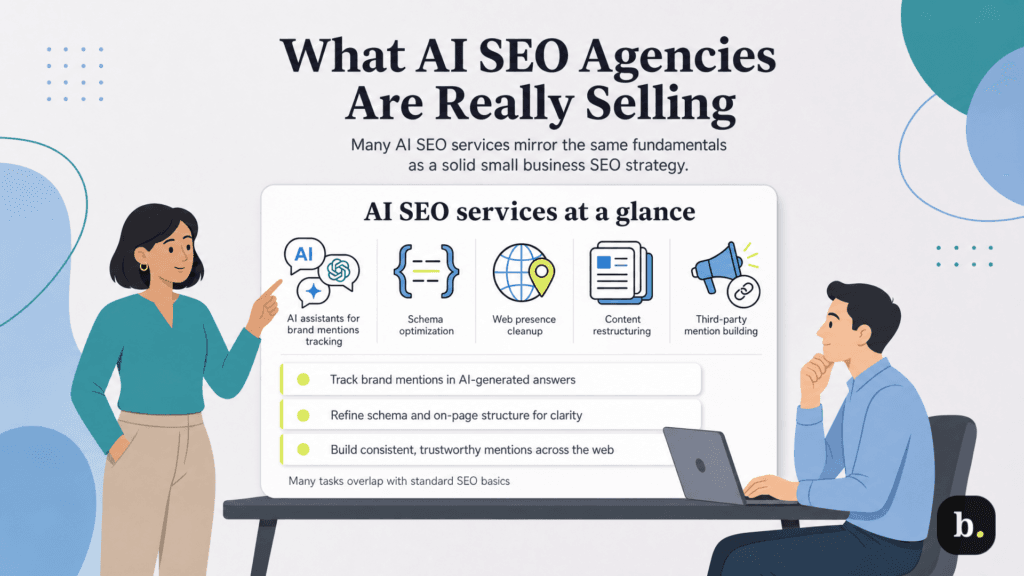
The services that AI SEO agencies offer generally include:
- Tracking how often your brand appears in answers from ChatGPT, Gemini, Claude and Perplexity
- Adding or restructuring schema markup
- Cleaning up how your business is described across the web
- Rewriting pages into shorter, more extractable chunks
- Pursuing mentions on third-party sites so AI systems encounter your brand in more places.
Some vendors bundle traditional technical audits in as well. Most of this list will look familiar to anyone who has run a small business SEO strategy, which also means your current SEO efforts may already be doing the bulk of what is needed without requiring additional spend.
What Google says about AEO and GEO
Google Search Central now publishes a dedicated guide to optimizing for generative AI features such as AI Overviews and AI Mode. Its central claim is that these features are rooted in Google’s existing Search ranking and quality systems, which means standard SEO best practices still apply. On AEO and GEO specifically, Google states that optimizing for generative AI search is “still SEO”, and it points anyone weighing third-party AEO or GEO services toward its separate guidance on evaluating third-party SEO advice.
The guide also includes a mythbusting section listing tactics site owners can disregard for Google Search:
- You do not need to create llms.txt files or other special machine-readable markup, because Google Search does not use them.
- There is no requirement to break content into small chunks, and no ideal page length. It says you do not need to rewrite content specifically for AI systems, which can already handle synonyms and intent.
- Chasing inauthentic mentions across the web is less effective than it appears.
- Structured data is not required for generative AI search, with no special schema to add (though it remains worth maintaining for rich results.)
Google is also direct about measurement claims, cautioning site owners to be wary of third-party tools that promise ranking success or claim access to internal Google metrics. No third-party tool has access to Google’s ranking or AI systems, and none can guarantee performance.
However, Google only speaks for Google. AI Overviews, AI Mode and Gemini’s grounded answers run on Google’s index, so the “still SEO” claim is well supported there. ChatGPT, Claude and Perplexity, for example, do not use Google’s index, and none have published equivalent optimization guidance. The fundamentals that make a page retrievable appear to carry over, but anyone telling you they have decoded how a specific model picks its sources is overstating what is publicly known.
What good AI search optimization actually involves
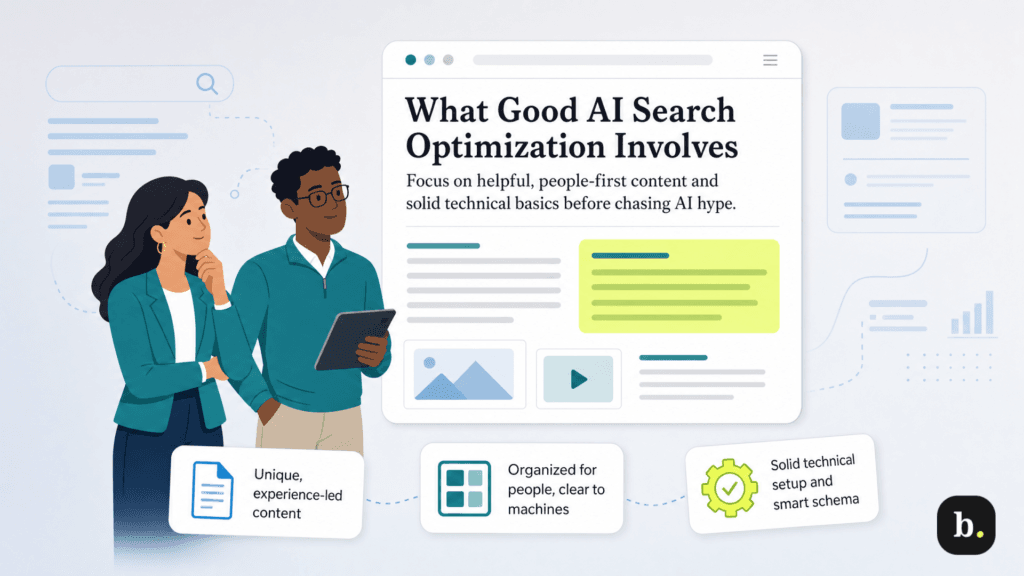
Foundational SEO principles remain important to AI search, and the rest is speculative. Consider the following to ensure a positive user experience that also positions you well when it comes to SEO and AEO, regardless of what the hype suggests:
- Publish content that is not a commodity: A generic tips roundup assembled from common knowledge adds little, while a piece grounded in your own experience offers something no other source has. Google says this factor will likely influence your visibility in generative AI search more than anything else in its guide.
- Organize pages for people: Clear sections, sensible headings and readable paragraphs make for a positive user experience. It also has the benefit of being easily crawlable by machines, but this consideration should be secondary.
- Keep the technical foundation sound: A page has to be indexed and eligible to appear with a snippet before it can show up in Google’s AI features at all. That means crawlable pages, working JavaScript rendering, reasonable load times, a site that behaves on mobile and minimal duplicate content.
- Use structured data where it adds value: Mark up the things that map to a real search feature, like products, events, recipes, local business details or reviews. Do not scatter schema across every page on the theory that volume wins over AI systems. Google says there is no special markup for generative AI search.
- Add images and videos where they help. Google’s AI features can surface both, which creates openings beyond a plain text link.
- Keep your business details current. For local and retail businesses, Google Business Profile and Merchant Center feed information into AI responses as well as conventional results.
The through line is that content built to be genuinely useful and easy to skim tends to be content that machines parse well too. Avoid chopping a page into terse fragments or padding it with markup in the hope of pleasing a model at the cost of the person actually reading it. Google’s advice on creating helpful, people-first content has not changed. Short, direct answers are good when they serve the reader.
None of this is a departure from the longstanding principles of a sound digital marketing strategy. Stick to these best practices and you’re likely to see results in a positive direction.
Where traditional SEO stops
While there is considerable overlap, there is a difference between conventional SEO and AI search visibility. Here are a few new things to keep in mind as the search landscape evolves.
Crawler access outside Google
The major AI companies run several crawlers with separate purposes and separate robots.txt controls. OpenAI documents GPTBot for model training, OAI-SearchBot for surfacing sites in ChatGPT’s search features and ChatGPT-User for pages fetched when someone asks a question.
You can control these crawlers independently. For example, you could disallow GPTBot to keep your content out of training while still allowing OAI-SearchBot so you remain eligible to appear in answers. OpenAI states that sites opted out of OAI-SearchBot will not be shown in ChatGPT search answers, and recommends allowing it. Anthropic documents a parallel three-bot structure for Claude and warns that disabling its search crawler may reduce a site’s visibility. Perplexity operates a two-crawler version.
This matters because a great many site owners added blanket AI crawler blocks to opt out of model training. Unfortunately, in doing so, these sites also blocked the search crawlers that determine whether they can be cited at all. If that describes your site, you are unlikely to be cited in AI answers. Fixing it requires a robots.txt edit, not an AI SEO agency retainer.
Before you evaluate a single proposal, open your robots.txt file and check whether you are blocking OAI-SearchBot, Claude-SearchBot or PerplexityBot. Blocking a training crawler such as GPTBot or ClaudeBot does not block the corresponding search crawler, and vice versa—each needs its own line. OpenAI notes that robots.txt changes can take roughly 24 hours to register on its side.
Search Console cannot see Bing
ChatGPT’s search layer has drawn on Bing’s index, which makes Bing Webmaster Tools a free and relevant check that Google Search Console will not give you. Treat the specifics as directional rather than settled. OpenAI has been building out its own retrieval infrastructure, and reporting suggests ChatGPT now stitches together its own crawler alongside multiple outside providers. Getting indexed in multiple places, not just Google, increases your odds of being picked up in AI citations.
Visibility measurement across engines
Google Search Console reports on Google’s AI surfaces only, so seeing whether ChatGPT or Perplexity names your business requires third-party tooling. That category has matured quickly, and entry-level plans generally run from roughly $30 to a few hundred dollars a month. We compare the options in our roundup of the best AI visibility platforms.
Whether AI search traffic justifies a separate budget
If traffic is your goal, it’s unclear whether AI search will actually help you meet it. The research is limited, but seems to suggest that AI search significantly reduces the number of users who click through to a website at all.
A field experiment by Saharsh Agarwal of the Indian School of Business and Ananya Sen of Carnegie Mellon University used a custom Chrome extension to randomly assign 1,065 U.S. participants to standard Google Search or a version with AI Overviews removed. When an AI Overview appeared, the researchers found outbound organic clicks fell by 39.8 percent and zero-click searches rose by 34.5 percent, with no effect on sponsored clicks or overall search frequency.
Observational research points the same direction. Pew Research Center analyzed 68,879 Google searches from 900 U.S. adults in March 2025 and found users clicked a traditional result in 8 percent of searches that produced an AI summary, against 15 percent of those that did not. Clicks on links inside the summaries were rarer still, at 1 percent of visits.
Published estimates of how much traffic AI assistants actually send span roughly twentyfold. Cloudflare network data put every AI chatbot combined at a fraction of a percent of search referrals in May 2026. Marketing platform benchmarks have put AI referrals at around 1 percent of total website traffic. At least one agency panel reports north of 6 percent of sessions. Those figures measure different populations with different methods, and most of them are published by companies that sell AI search services or software.
The traffic you stand to lose from AI-generated answers has been measured. The traffic you stand to gain from AI visibility work is often estimated inconsistently, mostly by parties with a commercial interest in the estimate. These are reasons to protect your search fundamentals and to be conservative about incremental spending, not to panic-buy a new service.
When hiring an AI search specialist makes sense
The case against a dedicated AI SEO retainer is strong for most small businesses, but it is not universal. Google itself now lists optimizing for generative AI among the services SEO professionals legitimately provide. Our position is not that the work is fake, but that a competent provider should already be absorbing it.
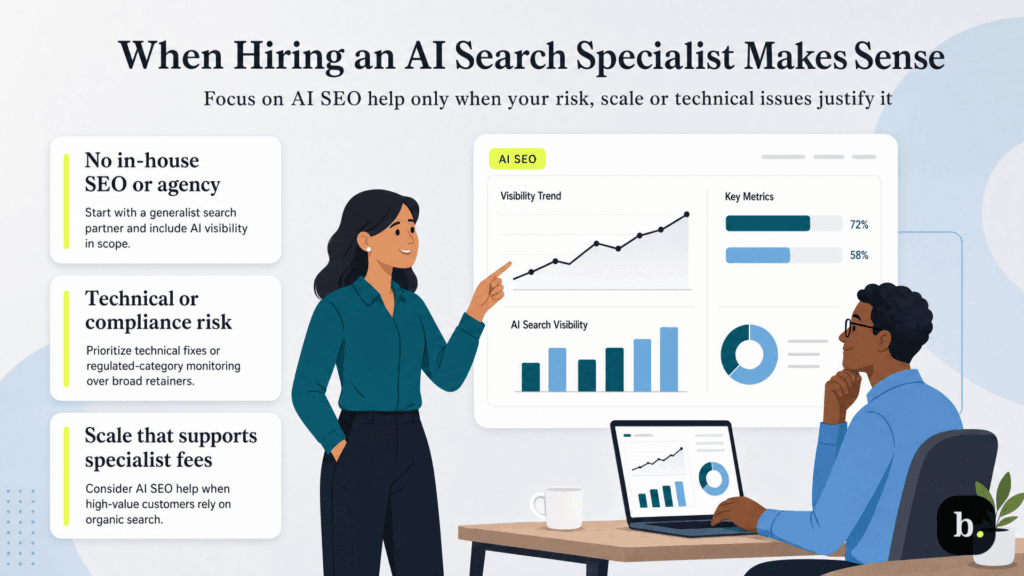
A few circumstances may justify hiring an AI SEO specialist, though. Consider doing so when:
- You have no search function at all: If nobody owns SEO at your company and no agency is engaged, your problem is not AEO. Hire generalist search help and let AI visibility be part of that scope. Our guide to when to hire a digital marketing agency covers how to scope that engagement.
- Your site has real technical debt: A JavaScript-heavy site that does not render server-side, a migration that broke indexing or a catalog with pervasive duplicate content all block visibility everywhere, AI included. That is a technical SEO project with a defined end, not an open-ended retainer.
- You operate in a regulated or high-liability category: In healthcare, financial services, insurance and law, an AI assistant misstating your pricing, coverage or credentials is a compliance exposure rather than a marketing inconvenience. Monitoring for and correcting inaccurate claims about your business carries value that has nothing to do with traffic and is a good reason to pay for specialist attention.
- Your scale and economics support it: If your business operates in multiple markets or languages, maintains a large product catalog, or has a long considered-purchase cycle, dedicated AI SEO work may be worth it. If a single customer is worth tens of thousands of dollars and organic search is a primary acquisition channel, a few thousand dollars per month may be a worthwhile investment. If a typical sale is worth a few hundred dollars, it is not.
If your current agency cannot answer basic questions about AI search and shows no interest in learning, replace your agency rather than adding a second one. Questions about whether your current agency is earning its fee are worth raising directly. Our overview of what a digital marketing expert should deliver can help you determine if they’re up to standards.
Red flags in an AI SEO pitch
Google’s guidance on hiring an SEO predates the AI search boom but transfers almost intact. Treat the following as reasons to slow down.
- Guaranteed rankings or guaranteed citations: Google states plainly that no one can guarantee a top ranking, and warns against providers that claim otherwise. Guaranteed AI citations are a weaker promise still, because assistants can return different answers to the same prompt.
- A claimed special relationship with Google: Google does not evaluate or endorse third-party SEO services or tools, so any “Google-approved” framing is a fabrication.
- Tools that claim internal Google data: No third-party tool has access to Google’s internal ranking or AI systems. Predictions built on third-party data are the vendor’s own.
- Deliverables that contradict Google’s published guidance: Selling llms.txt files or aggressive content chunking as levers for Google visibility is the clearest example.
- Cold outreach, and vagueness about method: Google advises the same skepticism toward an unsolicited SEO email that you would apply to any other spam, and cautions against firms that will not clearly explain what they intend to do. You are responsible for what a vendor does on your behalf.
- Reporting that never reaches a business outcome: Impression counts and share-of-voice charts are easy to grow, but they mean little unless they contribute to a more meaningful business goal. Ask what the engagement is expected to do in terms of leads or revenue, and how that will be attributed.
Google’s guidance also supplies the questions worth asking any SEO:
- Can you show previous work and results?
- Do you follow Google Search Essentials?
- What results do you expect, in what timeframe and how do you measure success?
- What is your experience in my industry?
- Will you share every change you make and the reasoning behind it?
For AI search specifically, Google suggests asking whether the provider’s advice aligns with its official generative AI guidance and whether they cite that documentation as support. Check references with past clients, too.
What to check before you pay anyone
You can establish your own baseline at no cost, which is worth doing before a vendor establishes one for you.
- Open the generative AI report in Search Console: Google launched a report in mid-2026 that shows your impressions in AI Overviews, AI Mode and generative AI features in Discover, broken out by page, country, device and date. It reports impressions only, so there is no information about clicks, click-through rate, queries or position. It answers whether you are visible, not whether visibility is earning anything, but it does provide a sense of whether you’re positioned to earn AI citations at all.
- Segment ChatGPT referrals in your analytics: ChatGPT appends a utm_source=chatgpt.com parameter to outbound links, so you can isolate that traffic pretty easily right now.
- Audit robots.txt and set up Bing Webmaster Tools: Both are free and take just a few minutes. Both can also be the reason you are not earning AI citations today.
- Ask the assistants what your customers would ask. Run a handful of real buying questions through ChatGPT, Gemini, Claude and Perplexity and note who gets named. Responses vary between runs, so repeat each prompt a few times rather than drawing conclusions from one answer. This is a spot check, not a measurement, but it is often clarifying about what gets cited and what doesn’t.
Do that work first and a proposal becomes much easier to read. You will know whether you have a visibility problem, a crawler problem or a content problem, and you will be able to tell whether what you are being sold addresses any of them. If it turns out you need help, that same baseline belongs in your small business marketing plan so the spending has something to be measured against.
For Google’s AI surfaces, Google has told us the work is ordinary SEO, and we have no reason to doubt it. For the other assistants, the fundamentals appear to transfer and nobody can credibly claim more than that yet. We recommend doing the basics well and keeping your commitments small and reversible—avoid committing a large budget to an AI SEO agency that hasn’t had time to prove their worth yet.