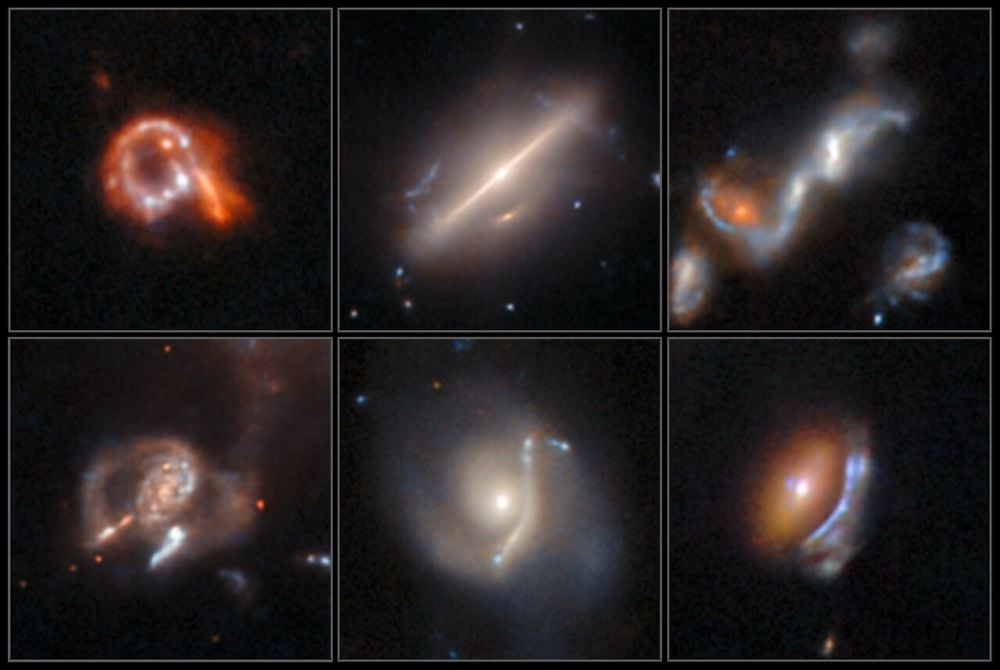
AI faces daily criticism from those concerned about its negative effects. But the type of AI that draws this ire is large-scale language models (LLMs). There are other types of AI with special capabilities that don’t appear on the home page. Sifting through vast amounts of astronomical data is a task perfect for AI and unlikely to be replicated by human thinking.
A case in point is a new study published in the journal Astronomy and Astrophysics. The title is “Using AnomalyMatch to identify astrophysical anomalies in 99.6 million source cutouts from the Hubble Heritage Archive” and the authors are David O’Ryan and Pablo Gomez. Mr. O’Ryan and Mr. Gomez are both from ESA’s European Space Astronomy Center (ESAC) in Madrid, Spain.
Our powerful collection of astronomical telescopes is producing massive amounts of data. JWST provides approximately 57 GB of data each day, depending on what observations are scheduled. The Vera Rubin Observatory is equipped with the largest digital camera ever built, and by a large margin. Approximately 20 terabytes of raw data are generated each night, and special infrastructure is required just to process it. With powerful new telescopes like the Giant Magellan Telescope and the Very Large Telescope coming online soon, the amount of astronomical data that needs scientific scrutiny is growing like a flood.
There are many surprises hidden in this huge amount of data. Our technology has outstripped our organic brain’s ability to process everything. But technical AI is catching up to astronomy’s ability to generate large amounts of data.
“Hubble Space Telescope archival observations now date back 35 years and provide a treasure trove of data from which astrophysical anomalies can be discovered,” said co-first author O’Ryan.
“Astronomical archives contain vast amounts of unexplored data that may harbor rare and scientifically valuable cosmic phenomena,” the authors write. “We leverage a new semi-supervised method to extract such objects from the Hubble Legacy Archive.”
Astrophysical anomalies are important because they can be outliers that represent different aspects of nature. If you are a trained scientist, you may be attuned to them and find them relatively easy. But there is too much data.
The researchers used a recently developed anomaly detection framework called AnomalyMatch to quickly search around 100 million cropped images from the Hubble Legacy Archive. The archive contains images dating back approximately 35 years.
AnomalyMatch is not the type of AI that techno-oligarchs are trying to cram into every piece of consumer software. It’s a neural network, a machine learning tool inspired by the human brain. In a previous paper introducing the AnomalyMatch tool, the authors wrote, “AnomalyMatch is tailored for large-scale applications, efficiently processing predictions for approximately 100 million images within three days on a single GPU.”
It took AnomalyMatch just a few days to process this amount of data, a fraction of the time it takes a human thinker. This is the first time such a systematic anomaly search has been conducted in the Hubble Legacy Archive. AnomalyMatch has generated a list of possible anomalies. That list includes about 1,400 anomalous objects, a number that is much easier to process by the human mind. O’Ryan and Gomez manually inspected these 1,400 objects and determined that 1,300 of them were indeed anomalous, and more than 800 of them were undocumented.
Galactic mergers and interactions were the most common type of anomaly detected in the archive. The number was 417.
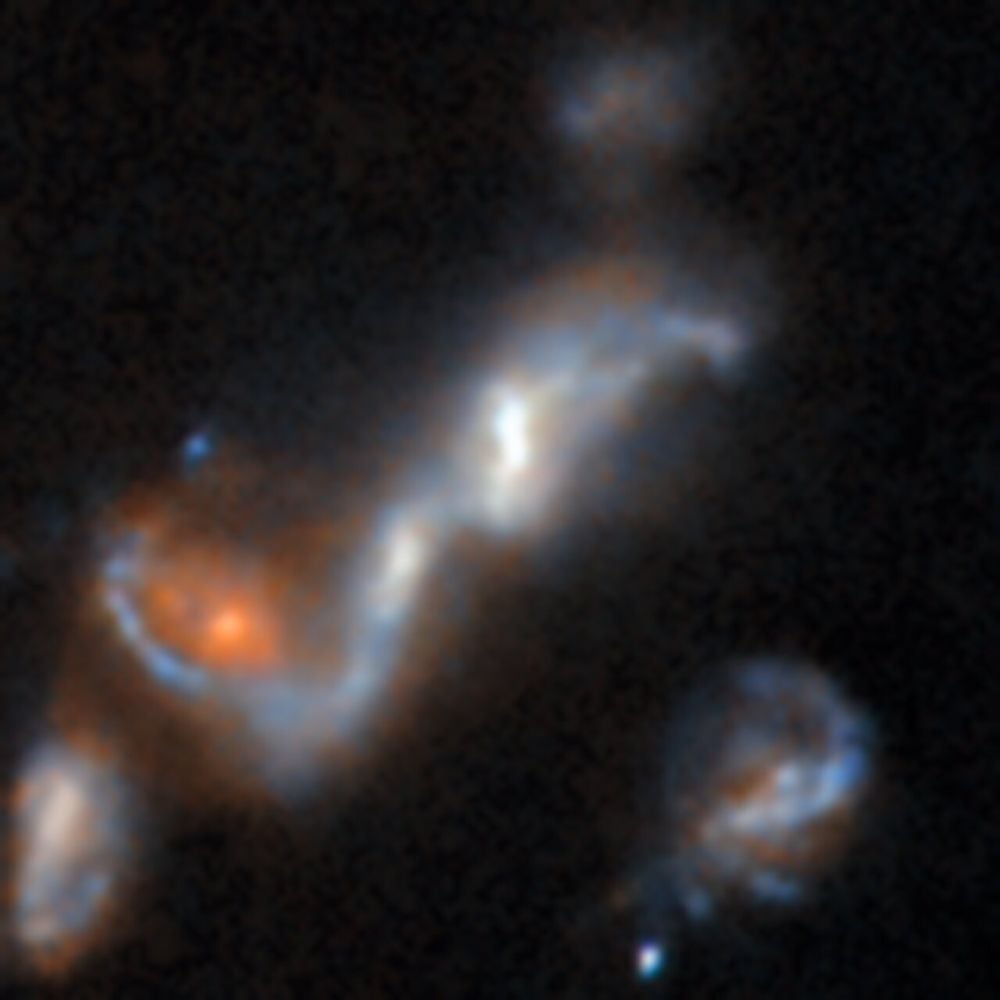 This group of gravitational interacting galaxies is one of the anomalous galaxies researchers discovered in the Hubble Legacy Archive. Distorted shapes and tidal tails indicate the effects of gravity. Image credits: ESA/Hubble & NASA, D. O’Ryan, P. Gómez (European Space Agency), M. Zamani (ESA/Hubble)
The researchers also discovered 86 new potential gravitational lenses. These are important because they allow us to reach objects that are too far away to observe. It also helps scientists study the distribution of dark matter in the universe, measure distances and the expansion of the universe, and test the theory of general relativity. “While we identify many gravitational lenses that have already been identified in the literature, there are also many new lens candidates,” the authors write.
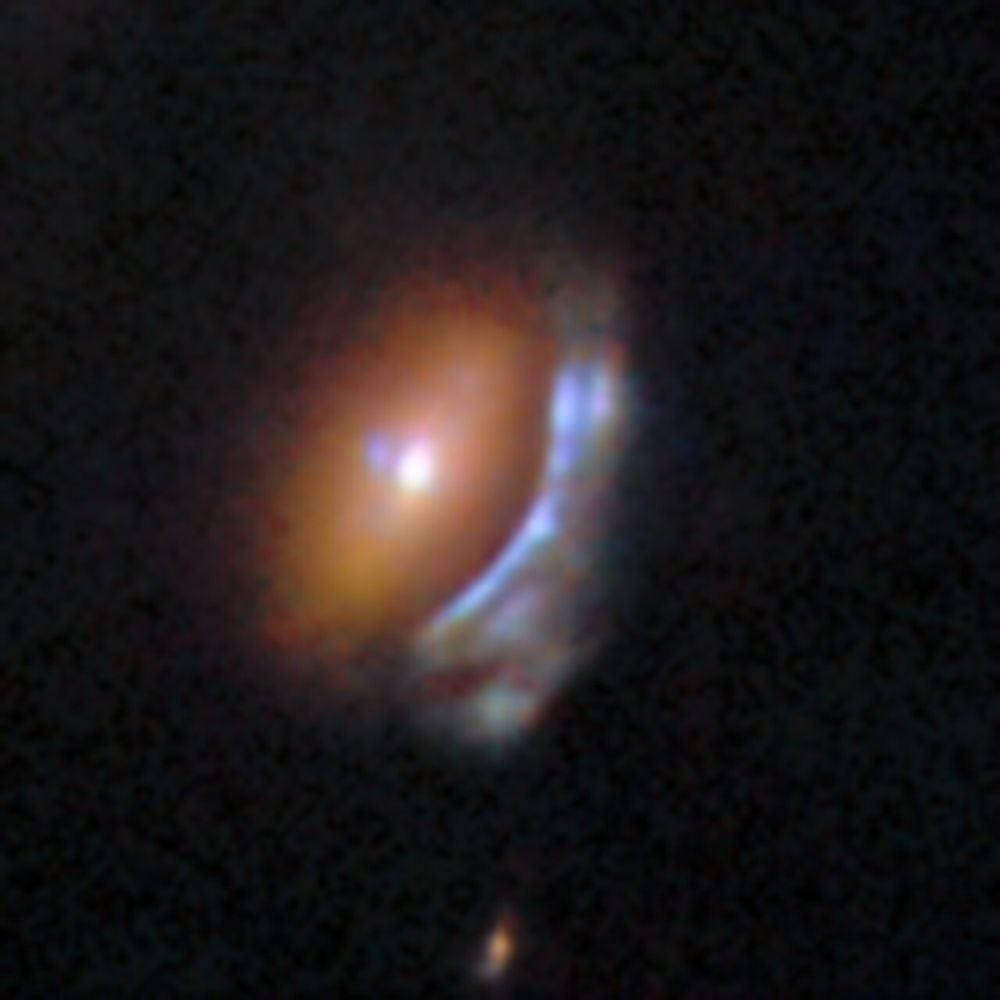 This is one of the gravitational lenses found in the Hubble Legacy Archive. The reddish elliptical galaxy is the lens in the foreground, and the blue spiral galaxy in the background is magnified and distorted by the elliptical galaxy. This type of arrangement brings distant celestial objects within observation range. Image credits: ESA/Hubble & NASA, D. O’Ryan, P. Gómez (European Space Agency), M. Zamani (ESA/Hubble)
There were other anomalies in the archives. AnomalyMatch has also discovered other unusual objects like the jellyfish galaxy. They are found in galaxy clusters where the pressure of the ram strips gas from galaxies, leaving behind long tails illuminated by star formation. 35 of them were found in the archives.
The study also discovered several anomalies of uncertain nature. One of them is the strange sight of a galaxy with a swirling core and open lobes.
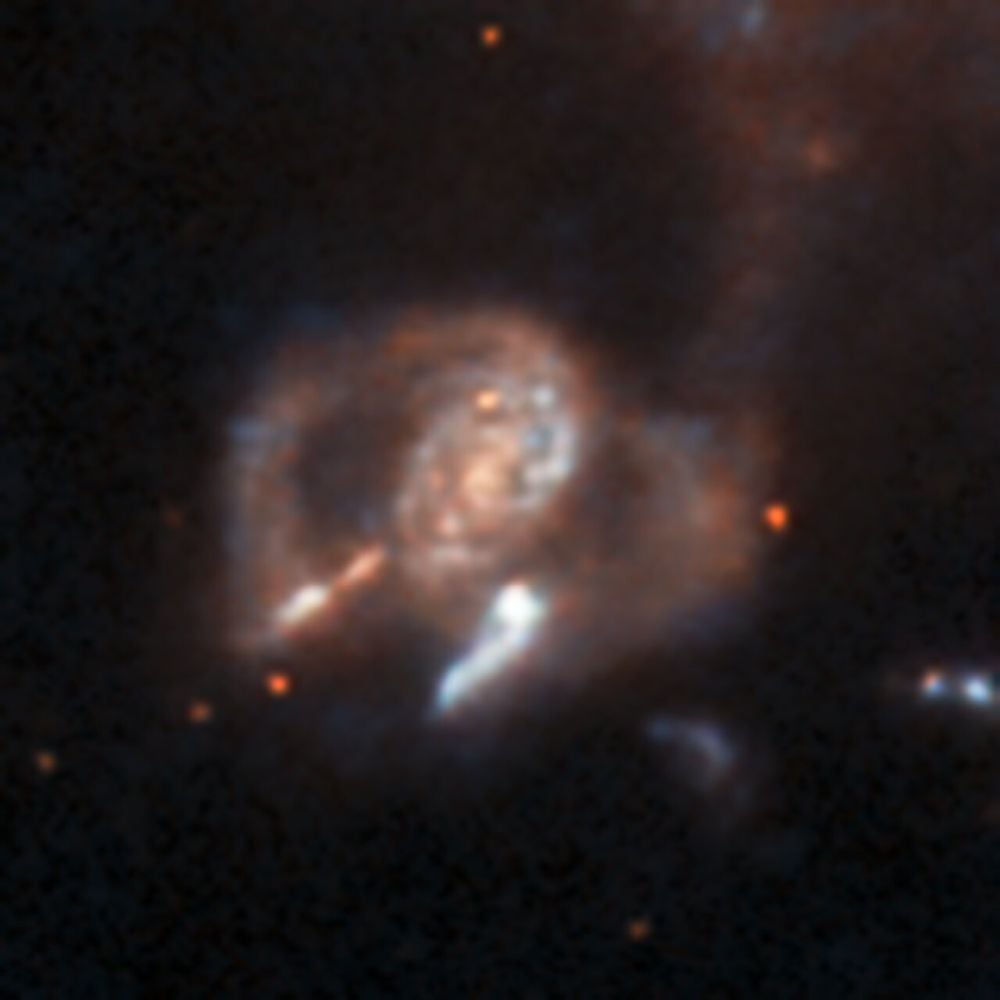 This galaxy highlights the unusual properties of some objects that are difficult to classify. It is a bipolar galaxy with a compact swirling center and open lobes on each side. This celestial body is newly discovered and previously unknown. It’s not clear what type of galaxy it is or whether its strange morphology is related to a merger. This discovery highlights the utility of AI tools for searching astronomical archives. Image credits: ESA/Hubble & NASA, D. O’Ryan, P. Gómez (European Space Agency), M. Zamani (ESA/Hubble)
Finding hidden surprises in vast amounts of astronomical data is a great use of AI. In addition to the aforementioned anomalies, the researchers also discovered overlapping galaxies, cluster galaxies, ring galaxies, and even high-redshift galaxies that are too close to the detection limit to be identified. They also discovered jet galaxies and galaxies that host AGNs.
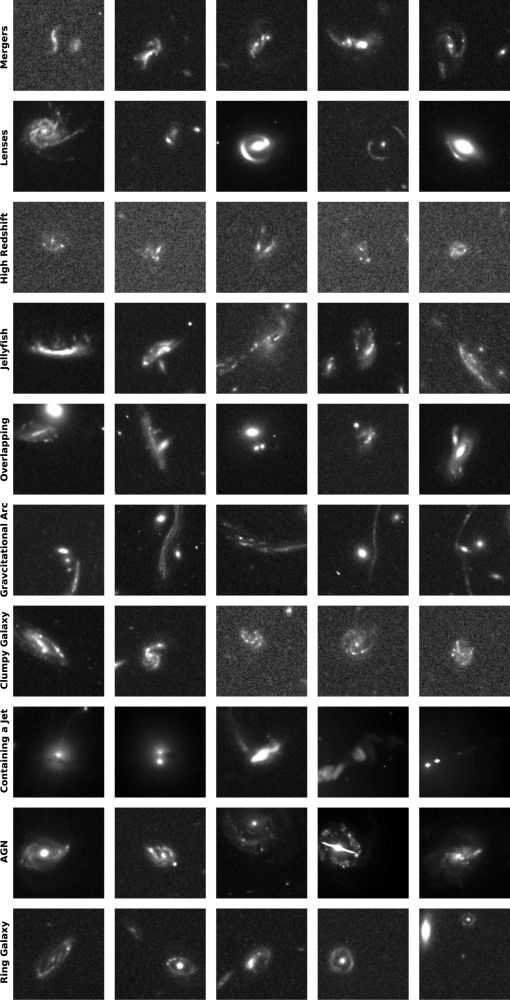 *This figure from the study shows five examples of all anomalous subclasses in which at least five objects were found, except for lenticular quasars. These were selected to be representative of each subclass. Image credit: O’Ryan and Gomez 2026. A&A*
Even if all astronomical observations stopped tomorrow, discoveries would not stop. Competent AI tools are destined to become more and more powerful. Vast existing datasets from other missions such as Hubble and ESA’s Gaia are the basis for future tools.
Who knows what is waiting to be discovered in all that data?
“This is a powerful demonstration of how AI can enhance the scientific return of archival datasets,” said Gomez. “The discovery of many previously undocumented anomalies in the Hubble data highlights the potential of this tool for future investigations.”