

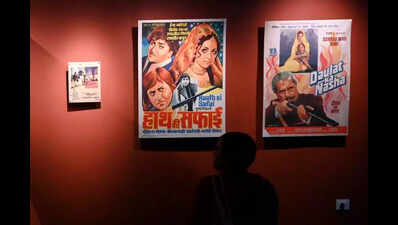
New Delhi: We remember movies in bits and pieces: scenes, songs, dialogues, posters. Our memories exist in an uncertain space between remembering and forgetting. At Arcira, an art center located in the industrial heart of Okla, far from the capital's arts district, the ongoing exhibition “Duniya Parchaiyon Ki” (World of Shadows) takes visitors on a guided tour of cinephilia, exploring how and why it forms the sacred core of cinematic memory.Cinephilia is the love of movies in all their forms. Spanning three floors, the show is a multi-layered spectacle of posters, murals, sound pieces, multi-channel videos, AI-generated animations, song booklets, lobby cards, and memorabilia. “Six artists were specifically asked to create new works,” says Ashish Rajadhyaksha, a film historian who organized the exhibition for the Taxila Education Society.CSDS intermedia historian Ravikant says understanding cinephilia is not easy because there is no clear way to measure it. Often, all that remains are paper traces, such as magazines, letters, posters, and song booklets, and sound traces, such as old audio recordings. Movies may disappear, but these fragments will survive and carry on the memory of cinema in other forms. “This exhibition is really about the story of cinema beyond the screen,” he says.”Old movie posters are an important part of the expo. On the surface, it looks like a casual assortment of the past: 'Del De Ke Dekho', 'April Fool's', 'Geetha Mera Naam' and 'Sultana Dak'. But “posters are yesterday's memes,'' says Rajadhyaksha, as he talks about its underground history and economy.During the 60s and 70s, the original posters issued for film releases were often created by famous artists such as Diwakar Karkare. It was then shaped based on local tastes in color, tone, and texture, first in small towns and later during reruns. Posters and even song booklets helped people own and tame the film, says Rajadhyaksha. “They intervened in the film and allowed the art to speak back. In other words, posters have multiple lives and sometimes even an afterlife.At the exhibition, next to the elevator, posters will melt into new shapes like liquid metal thanks to artificial intelligence (AI). Stars come to life as moments are seamlessly created and recreated. Dilip Kumar waves a knife in 'Kranti', Rekha fires a gun in 'Madam X', Nargis carries a spade in 'Mother India' and Surendra smiles in 'Anmol Gadhi'. AI is creating fluid posters.The exhibition is structured like a three-act play and spans approximately 6,000 square feet. Giant fabric murals, approximately 12 by 24 feet, are displayed on all three floors. In the dimly lit hall, art and text come together, with Urdu poet Jaun Elia's poem “Zindagi Ek Fan Hai/Ramhon ko apne andaz mein gawane ka” (Life is a skill, spend every moment your way) in calligraphy in both Urdu and Hindi. “Everyone understands and interprets art in their own way. Murals reflect the way we interpret the words of poets,” says Siraj Hussain of the Khwab Tanha Collective, a forum that visually celebrates Indian poetry.Elsewhere, magazines from before the 1980s, including the famous Urdu film magazine Sama, are on display. “Since Jamia is also nearby, the use of Urdu became a central part of the exhibition,” says Rajadhyaksha.The exhibit also incorporates the linguistic and cultural history of the region. The exhibit features an abstract film shot almost entirely within a kilometer of Arcila. Okhla is known for its recycling economy, and hand-woven textiles made from recycled movie posters are also part of the show. In the center of the hall are 30 televisions mounted on three-foot-high stands, showing scenes from Amitabh Bachchan's “Deewar.” Within seconds, the video cuts to a henchman growling at an expressionless Chunky Pandey in a movie that doesn't know where he is. The clip loops continuously. The televisions, specially manufactured in Old Delhi for this exhibition, clearly evoke a 90s vibe. The changing soundscape transforms faded memories into fresh experiences.For decades, listeners in small towns, mofussils, kasbahs, and villages were the driving force behind film-based radio programming in the 1970s and 1980s. Hundreds of 'Shrota Sanghs' (listener clubs) sprang up across India, some even publishing their own magazines, a concrete expression of cinephilia.Why people in towns like Aligarh, Jabalpur and Jumli Teraiya published their own magazines is a question worth posing, Ravikant said. Perhaps it was a way to give permanence to a temporary experience, he suggests, like hearing your name read out on a radio show.Less than 5 percent of Indian films are kept in the vaults of the National Film Archive of India, Rajadhyaksha said. Much of it is lost forever. What survives often exists as VHS tapes, VCDs, or 16mm prints with kabaddiwalas, reels stripped to silver, repurposed into bangles, or simply remaining as songs online.“The idea of keeping the memory of cinema alive is similar to what people do when they strip film reels and turn them into handlooms or something. There's a strange connection between the recycling economy and the struggle to keep cinema alive. Everyone talks about the death of movies, but movies aren't dying. It goes underground and becomes part of the illegal bootlegging economy,” says Rajadhyaksha.Almost 130 years ago, this film made its way to India to wonder and acclaim. Hiccups aside, this remains America's premier entertainment medium. The Artshira exhibition, which will be held next in Patna, will highlight that the love story between people and cinema continues on and off screen.


