

The term “AI bubble” is being thrown around a lot.
The phrase “AI bubble” appeared in 42 earnings calls and investor meeting transcripts from October to December. This is a 740% increase from the previous quarter, according to AlphaSense analysis.
In the third quarter of 2025, five records mentioned this term. The quarter before that was 4. Throughout 2024, management and analysts used this phrase in a total of 24 recordings. In 2023, it was 9. (The analysis counted transcripts in which “AI” and “bubble” appeared within 5 words of each other.)
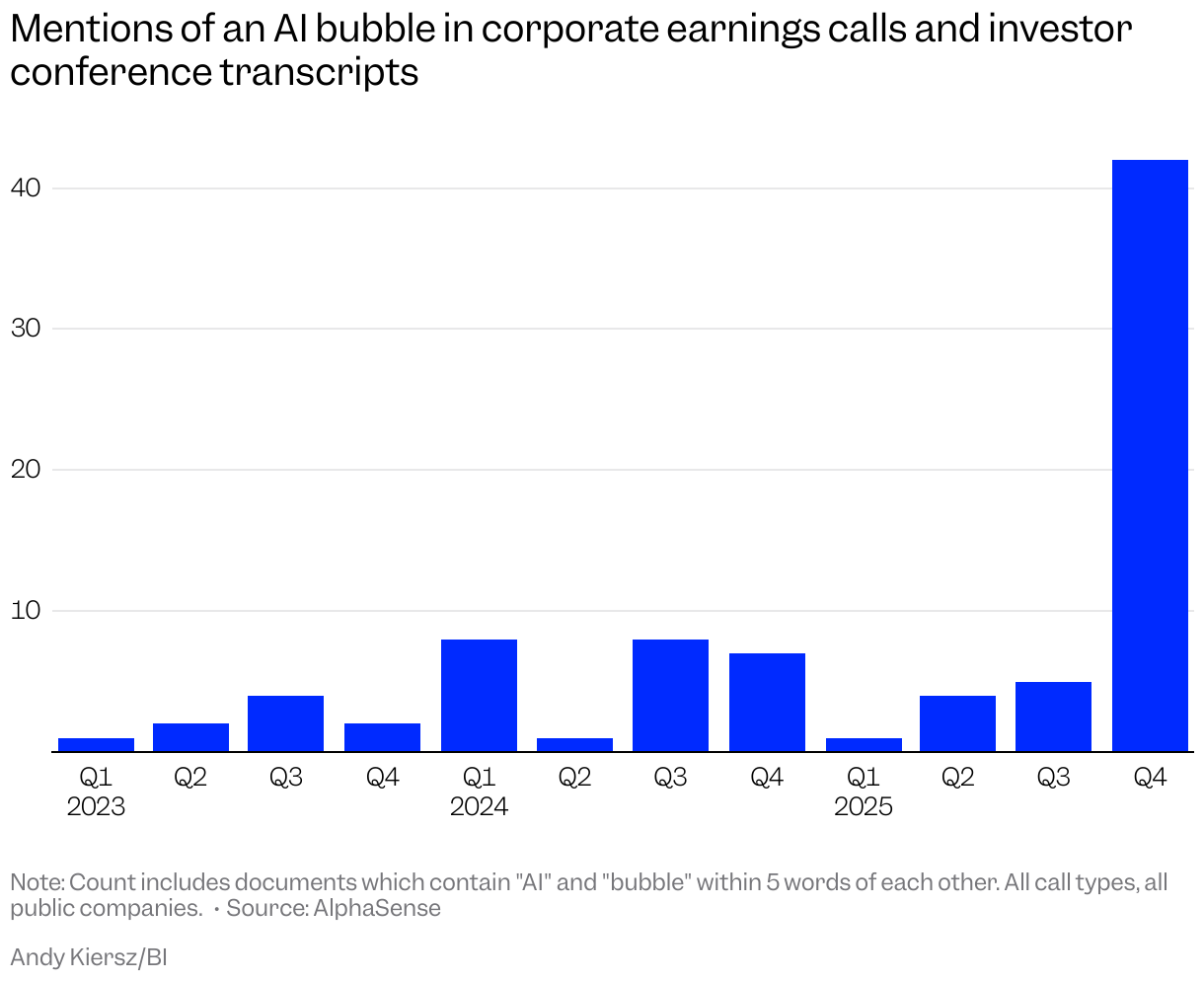
Dozens of companies across semiconductors, cloud infrastructure, financial services, and industrial sectors are now asking some form of the same question: “Is the AI boom a bubble?”
“From that standpoint, is there a bubble? I don't see a bubble,” AMD CEO Lisa Su told investors at the UBS Global Technology and AI Conference on Dec. 2.
Nvidia CFO Colette Kress similarly dismissed that premise, describing it on stage as an “imagined AI bubble.”
Her boss, CEO Jensen Huang, said as much during Nvidia's November earnings call. “There's a lot of talk about an AI bubble,” he says. “From our perspective, we see something completely different.”
German semiconductor equipment maker Extron was asked during its November earnings call whether customers might delay capacity plans if enthusiasm for AI wanes. Paris-based credit insurer Coface said it has recalculated its large AI-related capital requirements to ensure they are sustainable even if the “bubble-like enthusiasm” wanes.
So why the sudden spike?
Analysts pointed out the scale of the numbers being thrown around.
“We've been seeing these large partnerships and people putting trillions of dollars into infrastructure, and I don't remember hearing about it before,” Sarah Hoffman, director of AI thought leadership at AlphaSense, told Business Insider. The gap between the trillions of dollars being invested and the billions of dollars in revenue from many AI efforts “is what's surprising people a little bit,” she said.
Gil Luria, managing director and head of technology research at DA Davidson, said analysts and CEOs are already hearing concerns from investors.
Luria pointed to what he called “cyclical trading” as one cause for concern. He said, “Nvidia invested $1 in CoreWeave, and CoreWeave borrowed $9, of which they used $8 to buy Nvidia chips.” “It's an echo of past bubbles.”
The past eight weeks have given bubble proponents plenty of ammunition.
Big names in the tech world, including Sam Altman and Bill Gates, say they're seeing some bubbles in AI spending. In this quarter's earnings conferences, Google, Meta, Microsoft, and Amazon all said they plan to increase spending on data centers, the backbone of AI. Michael Burry, who became famous for betting on the housing market in “The Big Short,'' made headlines when he said he had shorted Nvidia, the world's most valuable company.
Executives have pushed back on skeptics, but Luria said all it takes is cash to quiet the conversation.
“There's nothing I've said that's going to change people's perception about whether there's a bubble or not,” he said. “All they can do is show results, and those have to be financial results.”


